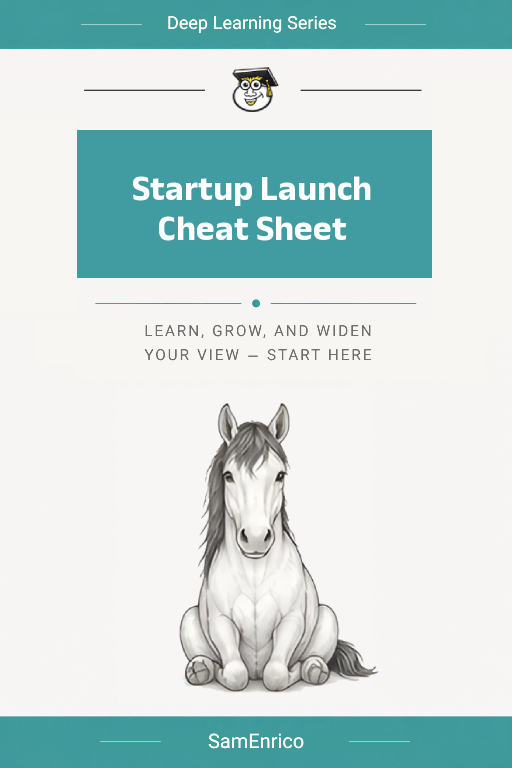
Startup Launch Cheat Sheet eBook
Coordinate pre-launch, launch day, and post-launch
by Kay Ozie
Coordinate pre-launch, launch day, and post-launch marketing tasks on a single action plan.
Formats
Free sample
Chapter 1: The One Lie--You are probably lying to yourself right now.Not maliciously. Not even consciously. But the lie is there, sitting quietly beneath every spreadsheet you've filled out, every landing page you've sketched, every late-night conversation where you told a friend "I'm working on something." The lie sounds like this: I know what my customers want.You don't. And that is not a failure. It is the starting line.Every failed startup launch I have ever studied—and I have studied hundreds—began with a founder who was certain.
Certain about the problem. Certain about the solution. Certain about the price. Certain about the channel. Certainty is the enemy of a successful launch because certainty stops you from testing.
Certainty makes you build before you validate. Certainty makes you fall in love with your idea instead of falling in love with your customer's problem.This chapter is going to break that certainty. Not to make you feel bad, but to save you six months of building something nobody wants. By the time you finish these pages, you will have done something most founders never do: you will have written down the single belief that must be true for your startup to succeed, and you will have a concrete plan to test that belief before you spend a dollar on product development.Let me tell you about a founder named Sarah.The $50,000 Mistake Sarah had spent twenty years in corporate human resources. She had watched countless managers struggle with performance reviews—the paperwork, the awkward conversations, the legal landmines.
So she built a software platform that automated performance reviews. Beautiful interface. Smart workflows. Integration with Slack. She spent $50,000 of her own savings and nine months of nights and weekends.She launched on Product Hunt.
She emailed her network. She ran Linked In ads.Seven people signed up for the free trial. Zero converted to paid.Sarah's mistake was not her product. Her product was fine. Her mistake was that she never asked a single manager outside her own head whether the problem she was solving was the problem they actually wanted solved.
She assumed. She was certain. And certainty cost her fifty thousand dollars.This chapter is the antidote to Sarah's story.The Lean Launch Canvas: One Page, One Assumption, One Metric Before we talk about launch day or email sequences or beta cohorts, we have to talk about what you are launching. Not the features. Not the logo.
Not the pricing tier. The assumption.Most founders start with a business plan or a pitch deck or a feature list. Those documents are useful later. Right now, they are dangerous because they give you the illusion of progress. You can spend three weeks perfecting a pitch deck for a product that should never exist.Instead, you are going to fill out a one-page document called the Lean Launch Canvas.
It is adapted from Eric Ries's The Lean Startup and Peter Thiel's Zero to One, but I have stripped it down to the absolute essentials. You do not need nine boxes. You need three.Box One: The Customer Who, exactly, has the problem? Not "small business owners." That is a demographic, not a customer. Name a specific person with a specific job in a specific industry.
"Sarah, a mid-level HR manager at a 200-person tech company who is responsible for performance reviews for twelve direct reports." That is a customer.If you cannot name a specific human being with a specific pain, you do not have a customer. You have a hypothesis about a customer. That is fine—write it down. But be honest with yourself about what you know and what you are guessing.Box Two: The Problem What is the specific, measurable, expensive problem this customer has? Not "performance reviews are hard." That is vague.
"Sarah spends eight hours per quarter manually compiling performance data from three different systems, and she has received two formal complaints from employees about inconsistent ratings." That is a problem.A real problem has three characteristics. First, the customer can describe it without using your product's vocabulary. Second, the customer has tried to solve it before (even badly). Third, the customer has felt the pain of the problem within the last thirty days. If your problem does not meet those three criteria, you are solving something that does not actually hurt.Box Three: The Falsifiable Assumption This is the heart of the canvas.
What is the single belief that must be true for your startup to succeed? Not ten beliefs. Not five. One.For Sarah's performance review software, her falsifiable assumption might have been: "HR managers will pay $49 per month for a tool that automates performance review data collection." That is one belief. It is specific.
And crucially, it is falsifiable—meaning you can design a test that could prove it wrong.Most founders write falsifiable assumptions that are not actually falsifiable. "Customers will love our product" cannot be falsified because "love" is not measurable. "At least 30% of surveyed HR managers will say they would definitely purchase this tool at $49 per month" is falsifiable. You can run that test.Write your falsifiable assumption on a sticky note. Put it on your monitor.
Do not write another line of code, design another screen, or record another sales video until you have tested it.The One Metric That Matters (OMTM)Once you have your falsifiable assumption, you need one number to track. Just one. The Lean Launch Canvas gives you many possible metrics—waitlist signups, survey completion rates, pre-order dollars, interview completion rates. You are going to choose exactly one.This is harder than it sounds because founders love data. They love dashboards.
They love watching numbers go up. But most metrics are what I call "vanity metrics"—they feel good but do not tell you whether your falsifiable assumption is true.Vanity metrics include:Page views (a hundred people can look at your landing page and never sign up)Social media likes (likes are not dollars)Email opens (opens are not purchases)"Interest" (unmeasurable and meaningless)Your One Metric That Matters (OMTM) must meet three tests. First, it must be directly connected to your falsifiable assumption. Second, it must be measurable within seven days. Third, it must have a clear success threshold.Here are examples of good OMTMs for different types of falsifiable assumptions:Falsifiable Assumption OMTMSuccess Threshold HR managers will pay $49/month for performance review software Pre-order dollars from target customer segment$1,000 in 7 days Freelance designers need a simpler invoicing tool Waitlist signups with verified email200 signups in 14 days Small bakeries would use a delivery scheduling app Completed survey responses from bakery owners50 responses in 10 days Notice what is not on this list.
"Positive feedback." "Great conversations." "Lots of interest." Those are feelings, not metrics. Feelings do not pay for servers.The 5-5-5 Method: Finding Early Adopters Without Spending Money You have your falsifiable assumption. You have your OMTM. Now you need people to test it against. Where do you find them?Most founders answer this question by saying "social media" or "ads" or "my network." Those are channels.
They are tactics. They are not a method. The method I am about to teach you is called the 5-5-5…
This is the end of the free sample. Get the eBook to keep going. Buy now
About this book
Details
- Author
- Kay Ozie
- Publisher
- SamEnrico
- Language
- English
- Genre
- Non-Fiction, Business Brief, Launch Strategy
- Released
- 2026-06-01
- Pages (approx.)
- 136
- Available as
- eBook, Audiobook

Read better in the ZLOADR app
Your eBooks on your phone or tablet. Sign in with your SamEnrico account and start reading.
More by Kay Ozie
 Collaborative Analogies GuideKay Ozie$11.99
 Teeth in Aircraft AccidentsKay Ozie$11.99
 Student Evacuation PlansKay Ozie$11.99
 Meditation Flow State BridgeKay Ozie$11.99
 Learning Before ScrollingKay Ozie$11.99
 Digital Body Language GuideKay Ozie$11.99
 Acupuncture for Low LibidoKay Ozie$11.99
 Self Hypnosis for EndometriosisKay Ozie$11.99
 The Silent Witness: The DNA Breakthrough That Solved a 30-Year-Old MurderKay Ozie$11.99
 The Golden Voice of Shanghai: Li Xianglan’s Secret War of SongKay Ozie$11.99
 A Collector's Handbook to the Wartburg TouristKay Ozie$11.99
 How to Produce Pillow FormsKay Ozie$11.99