
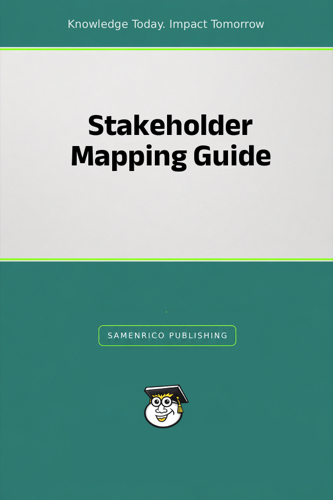
Non-FictionSelf-HelpProject Management
Stakeholder Mapping Guide eBook
Identify and align key players before launching a
Identify and align key players before launching a design project.
Formats
Free sample
Chapter 1: The $147,000 Meeting--–- The email arrived at 2:47 PM on a Wednesday. Subject line: "Quick call to discuss the project." No agenda. No attachments. Just seven words that would undo nine months of work.By 3:00 PM, Sarah, the lead product designer at a mid-sized healthtech company, was on the line with Marcus, the VP of Sales. She had never met Marcus.
He hadn't been at the kickoff. His name wasn't on any stakeholder map. He hadn't responded to the monthly newsletter. He was, for all practical purposes, a ghost."I've been looking at the prototype," Marcus said, his voice carrying the casual authority of someone who had just realized he had an opinion. "I don't think our enterprise clients will go for this.
We need to add an approval workflow. And change the color scheme to match our sales deck. Oh, and can we move the launch? Q4 is terrible for us. Let's target February."Sarah felt the floor drop.
The approval workflow alone would take six weeks. The color scheme change meant revisiting every screen. The launch delay would trigger contract penalties with their implementation partners. She did the math silently: $147,000 in rework, nine months of team morale, and one dead startup if they missed their funding milestones tied to the original launch date."I'm sorry, Marcus," she said, her voice steadier than she felt. "Where have you been for the last nine months?""I've been busy," he said.
"But I'm here now."That meeting—that single, seven-minute phone call—cost $147,000. Not because Marcus was wrong. Not because the design was flawed. But because no one had identified Marcus as a stakeholder before the project launched. He was a "sleeping giant" (high power, low interest until suddenly he wasn't), and the team paid the price for waking him up too late.This book exists because meetings like Sarah's happen every day, in every industry, on every continent.
And they are almost entirely preventable.The Lie You Have Been Sold For decades, design and project management education has promoted a seductively simple narrative: focus on the user, build something great, and success will follow. Agile methodologies promised to solve coordination problems through daily standups and sprint reviews. Design thinking offered empathy maps and user journeys. Lean startup gave us the build-measure-learn loop.None of these frameworks failed. They were incomplete.The missing variable—the one that sinks more projects than technical debt, budget overruns, or even bad product-market fit—is the stakeholder ecosystem.
Not users. Not customers. Stakeholders. The people who may never touch your product but who can kill it with a single email. The VP who wasn't invited.
The legal director who "didn't think they needed to be involved." The IT security lead who was on the email chain but didn't read it. The CEO's special advisor who has no formal title but has the CEO's ear every Friday at 4 PM.These are the ghost stakeholders. And they are everywhere.The Real Statistic That Changes Everything Industry data paints a grim picture. According to the Project Management Institute's 2023 Pulse of the Profession report, 67% of projects experience scope creep. Of those, nearly 80% cite "stakeholder misalignment" as the primary cause—not technical failure, not resource constraints, not even budget cuts.
The Standish Group's famous CHAOS Report, updated for 2022, found that "lack of stakeholder input" and "incomplete stakeholder requirements" rank in the top three reasons projects are challenged or fail outright.Let me translate those percentages into real numbers.A typical enterprise design project lasts six months and costs $500,000 in team salaries and overhead. If that project experiences stakeholder-driven rework—which 53% of projects do according to a 2023 survey by the Design Management Institute—the average overrun is 37%. That is $185,000 of rework. Per project.For a design agency with ten concurrent projects, stakeholder-driven rework costs nearly two million dollars annually. For an internal product team at a Fortune 500 company, those dollars translate directly to delayed revenue, missed market windows, and burned team morale.But the financial cost is only the beginning.The Hidden Costs No One Tracks Money is measurable.
Teams track budgets, hours, and rework. But there are four costs of stakeholder chaos that almost never appear on spreadsheets, and they are far more damaging than the line items.Cost One: The Exhaustion Tax Every time a stakeholder introduces a late change, the design team doesn't just lose hours—they lose psychological safety. Designers who watch their carefully researched solutions get overturned by a single opinion begin to hedge their bets. They stop advocating for the user. They start designing for the person with the loudest voice or the highest title.
This is not a failure of character; it is a rational response to an unpredictable environment. The result is work that is safe, bland, and ultimately useless to the people it was meant to serve.Cost Two: The Trust Deficit When stakeholders feel excluded from the process, they don't trust the output. When teams feel blindsided by late stakeholders, they don't trust the process. Trust is the currency of collaboration, and stakeholder chaos spends it recklessly. Once trust is gone, every subsequent decision requires three meetings, seventeen emails, and a sign-off from someone who doesn't understand the problem.
The project doesn't fail—it drowns in process.Cost Three: The Innovation Kill Stakeholder chaos doesn't just delay projects; it calcifies them. Teams that have been burned by late changes become risk-averse. They avoid novel solutions because novel solutions invite more opinions. They stick to what is safe, what has been done before, what no one will question. The project succeeds on paper—it launches on time, within budget, with all checkboxes ticked—and it fails in the market because it solved no real problem.Cost Four: The Career Tax Sarah, our designer from the opening story, did not get fired for the $147,000 overrun.
Her manager did not get fired either. But six months after the project finally limped across the finish line, Sarah left the company for a role with less responsibility. She didn't quit because she was angry. She quit because she was exhausted. Stakeholder chaos is a leading contributor to design turnover, and turnover costs an average of 150% of annual salary to replace.
No one tracks that against stakeholder alignment. They should.The Alignment Gap Defined Let me give you a precise definition for the problem this book solves.The Alignment Gap is the distance between the stakeholders who can affect a project's outcome and the team's awareness of and engagement with those stakeholders.When the Alignment Gap is narrow, stakeholders are identified early, their needs are understood, their influence is mapped, and their engagement is calibrated to their role. The team moves fast. Decisions are clear. Rework is minimal.When the Alignment Gap is wide, stakeholders appear without warning, objections surface at the last minute, and decisions are unmade as quickly as they were made.
The team moves slowly. Meetings multiply. Morale erodes.Your job—the entire purpose of this book—is to close the Alignment Gap before you write a single line of code, sketch a single wireframe, or schedule a single user interview.Why "Users First" Is Not Enough If you are a designer, you have been told your entire…
This is the end of the free sample. Get the eBook to keep going. Buy now
About this book
Details
- Author
- Hutchinson Angle
- Publisher
- SamEnrico
- Language
- English
- Genre
- Non-Fiction, Self-Help, Project Management
- Released
- 2026-06-09
- Pages (approx.)
- 148
- Available as
- eBook, Audiobook

Read better in the ZLOADR app
Your eBooks on your phone or tablet. Sign in with your SamEnrico account and start reading.
More by Hutchinson Angle
 I Statements MarriageHutchinson Angle$11.99
 Body Image and Romantic EsteemHutchinson Angle$11.99
 Alcoholism and Social Anxiety RecoveryHutchinson Angle$11.99
 Senior Housing Conversion GuideHutchinson Angle$11.99
 Dysthymia Medication GuideHutchinson Angle$11.99
 Police Food AddictionHutchinson Angle$11.99
 Founder Equity Accounting GuideHutchinson Angle$11.99
 The Mercedes Heist: A Deadly Test Drive in SingaporeHutchinson Angle$11.99
 Shadows of the New World: The Secret Missions of MagellanHutchinson Angle$11.99
 How to Produce Gum RemoverHutchinson Angle$11.99
 Nigeria VAT Aggregate Threshold WorkbookHutchinson Angle$12.99
 GOTS Certification Textile ExportHutchinson Angle$12.99
You may also like
 Hong Kong Handover 1997Dunn Johnnie$11.99
 Zumba For Postnatal Recovery CourseNeal Christian$11.99
 Zumba for BeginnersLadner Nikia$11.99
 YouTube Comment Mining GuideHumes Pandora$12.99
 Worry Box MeditationCarlin Rudy$11.99
 Workplace Stress MeditationNguyen Lynn$11.99
 Workplace Stress and Sleep RepairHawley Ivory$11.99
 Workplace Perfectionism CureDelaney Jeffry$11.99
 Workplace Injustice Anger GuideWallen Isabelle$11.99
 Work Addiction and Burnout LinkGreenwood Ester$11.99
 Women in Yoga and WellnessBeattie Galina$11.99
 Women in Stand Up ComedyChun Evangeline$11.99