
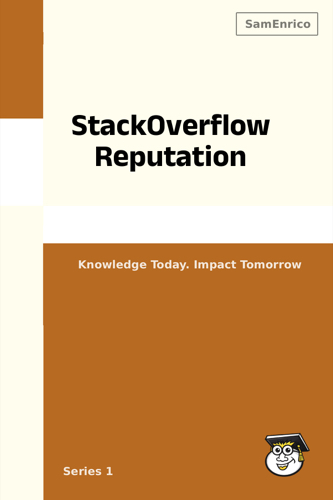
StackOverflow Reputation eBook
undefined
by Fields Dale
undefined
Formats
Free sample
Chapter 1: The Garbage Collector’s Dilemma--–- The first time I lost a thousand reputation points overnight, I wasn’t debugging code. I was debugging my own ego.It was 3:47 AM. My answer—a technically perfect, beautifully formatted, ten-paragraph masterpiece about Java Script closures—had sat at +42 for six months. Then someone posted a single line: “This is wrong in strict mode.” Forty-two upvotes evaporated into twenty-three. Then twelve.
Then negative two. By morning, my answer had been deleted by a moderator I’d never met.I did what any reasonable developer would do. I rage-clicked the user’s profile. Fourteen answers. All of them short.
All of them scannable. All of them wrong in subtle ways that nobody seemed to notice or care about. I fumed for three days. Then I did something worse: I stopped answering questions altogether.That was my mistake. Not the technical error—the emotional one.Here’s what I eventually learned, after crawling back to the platform six months later with a different username and a radically different approach: Stack Overflow does not reward the best programmers.
It rewards the best teachers. And teaching is not about being right. It’s about being understood by someone who is frustrated, exhausted, and one keystroke away from throwing their laptop out a window.This chapter is about unlearning everything you think you know about reputation. It’s about the single most important insight that separates the 10,000-reputation users from the ones who stay stuck at 500 forever. That insight is deceptively simple, brutally hard to internalize, and the foundation for every technique in this book.Here it is: Write for humans first, compilers second.The Myth of Technical Meritocracy Let me tell you a story about two developers.Alice has been coding for twelve years.
She knows the C++ memory model like most people know their own phone number. She can recite the Gang of Four patterns in her sleep. When she answers a question on Stack Overflow, she writes a comprehensive, technically rigorous explanation that covers edge cases, performance implications, and three alternative approaches. Her answers are correct. They are complete.
They are also rarely accepted.Bob has been coding for three years. He’s solid but unspectacular. He knows enough to be dangerous. When he answers a question, he writes three sentences. He includes a code snippet that solves exactly the problem asked—nothing more, nothing less.
He uses bold text for the key line. He adds a one-sentence warning about the most common pitfall. His answers are sometimes incomplete. They occasionally miss edge cases. They get accepted constantly.Alice fumes.
“Stack Overflow rewards laziness,” she says. “Nobody reads anymore.”Bob gets job offers from his reputation score.Here’s the truth that Alice refuses to accept: Bob isn’t winning because he’s lazier. Bob is winning because he understands the attention economy of a frustrated developer. The person asking a question at 11 PM on a Tuesday doesn’t want a dissertation. They want to unblock their build pipeline so they can go to sleep.
They will accept the first answer that is:Scannable (they can find the solution in under ten seconds)Specific (it solves their exact problem, not a generalization)Safe (it doesn’t introduce new, obvious bugs)Alice’s answer fails on all three counts. It is too long to scan. It solves a generalization that the asker doesn’t have. It presents three alternatives, which paralyzes decision-making.This is the Garbage Collector’s Dilemma, and it’s the central metaphor of this chapter.The Garbage Collector’s Dilemma Explained In programming languages with automatic memory management—Java, C#, Python, Java Script—a garbage collector runs in the background, identifying and freeing memory that your program no longer needs. This is a miracle of engineering.
It hides enormous complexity. You don’t have to think about when to call free() or delete. You just allocate objects and trust that the system will clean up after you.The dilemma is this: the garbage collector works perfectly until it doesn’t.When a memory leak happens in a garbage-collected language, the symptoms are baffling. Your program slows down over time. It consumes more and more RAM.
Eventually, it crashes with an Out Of Memory Error. The garbage collector is still running. It’s still doing its job. But somewhere, a reference is being held that shouldn’t be—an event listener that was never removed, a cache that never expires, a closure that captured a large object and never released it.The developer who only knows that “garbage collection exists” cannot debug this. They need to understand what the garbage collector is doing under the hood.
They need to know about reachability, about weak references, about the difference between memory leaks in C++ (forgetting to delete) and memory leaks in Java (holding a reference you forgot about).Stack Overflow rewards the developer who can explain the hidden layer.The same dynamic applies to everything in software development. The compiler or runtime hides enormous complexity from you. That’s by design. But when something breaks—and it always breaks—the person who can explain what’s happening beneath the abstraction gets the upvote.This is why legacy code questions receive far more upvotes than theoretical whiteboard problems. The theoretical problem is clean.
It exists in a pristine environment where all the abstractions hold perfectly. The legacy code question is messy. It exists in a world where someone violated the abstraction five years ago and nobody noticed until today.Let me give you a concrete example.Theoretical question: “What’s the time complexity of quicksort in the average case?”Legacy question: “Why does our sorting function work on the staging server but crash in production when the input list has more than 10,000 items?”The second question is worth ten times the reputation of the first. Why? Because the first question can be answered by reading a textbook.
The second question requires you to understand the actual implementation, the memory constraints of the production environment, the difference between stack and heap allocation, and maybe even the specific version of the standard library that was deployed.The person who can answer the second question is valuable. The person who can only answer the first question is replaceable.The Broken Window Theory of Technical Debt In 1982, criminologists James Wilson and George Kelling introduced the Broken Windows Theory. The theory argued that visible signs of disorder—broken windows, graffiti, litter—encourage more serious crime. A building with one broken window, left unrepaired, signals that nobody is in charge. Soon, all the windows are broken.Software development has its own version of the Broken Windows Theory.Every codebase has small problems: an unused variable, an inconsistent naming convention, a comment that no longer matches the code, a function that’s slightly too long.
These are the broken windows. Ignore them, and the message is clear: nobody cares about quality. Soon, the small problems become medium problems. The medium problems become system-wide failures.Here’s what this means for Stack Overflow reputation: the most upvoted questions come from codebases with the most broken windows.Think about your own experience. When was the last time…
This is the end of the free sample. Get the eBook to keep going. Buy now
About this book
Details
- Author
- Fields Dale
- Publisher
- SamEnrico
- Language
- English
- Genre
- Non-Fiction, Self-Help / Developer
- Released
- 2026-06-07
- Pages (approx.)
- 146
- Available as
- eBook, Audiobook

Read better in the ZLOADR app
Your eBooks on your phone or tablet. Sign in with your SamEnrico account and start reading.
More by Fields Dale
 The Community Choir DirectorFields Dale$11.99
 Anger At Child's Learning DisabilityFields Dale$11.99
 Spousal Loss Prolonged GriefFields Dale$11.99
 Self Care for Grandparents Raising GrandkidsFields Dale$11.99
 Founder Capitalized CostsFields Dale$11.99
 Cryptocurrency Tax Planning GuideFields Dale$11.99
 Childhood DepressionFields Dale$11.99
 The Last Scribes of Timbuktu: Saving Knowledge from the FlamesFields Dale$11.99
 The Forgotten War: Korea's Bloody Stalemate (1950-1953)Fields Dale$11.99
 How to Start a Hobby in AstrologyFields Dale$11.99
 How to Produce Hazardous Waste ContainersFields Dale$11.99
 VA Work Sample Test LibraryFields Dale$12.99