
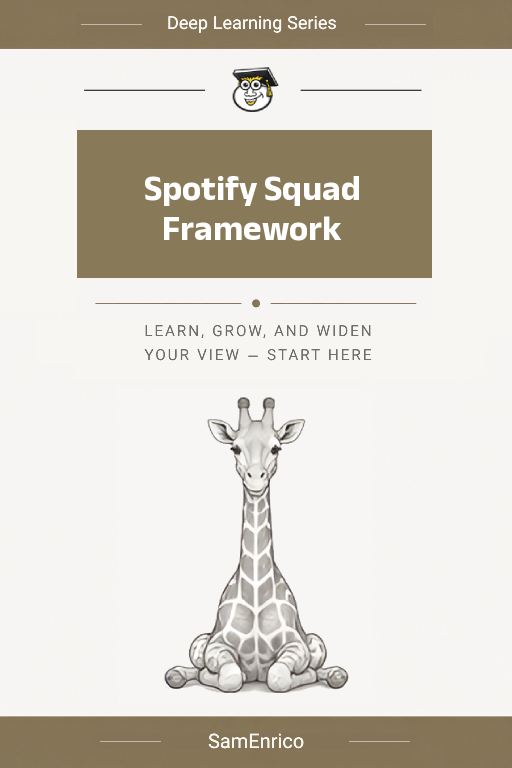
Spotify Squad Framework
Use Spotify's cross-functional squad model with Ka
Use Spotify's cross-functional squad model with Kanban for two-week iterations.
Formats
About this book
Free sample
Chapter 1: The Copycat's Graveyard--–- In 2015, a mid-sized financial technology company in Austin, Texas decided to "go Spotify." They hired consultants. They reorganized every engineering team into Squads and Tribes. They renamed their project managers "Product Owners." They bought new software to visualize their Kanban boards. They spent $470,000 on the transformation.Nine months later, their lead time had increased by 40 percent. Developer turnover doubled.
The CTO was fired.The post-mortem revealed something that has been repeated in thousands of organizations since: they had copied every visible element of the Spotify model and understood none of it. They had the Squads. They had the Tribes. They had the two-week iterations. What they did not have was a single ounce of trust, a single mechanism for autonomy, or any understanding of why Spotify's structure worked in the first place.They built a beautiful corpse.This chapter is not a history lesson.
It is a warning. And then, because warnings without solutions are just anxiety, it is the foundation upon which the rest of this book will build a working, adaptable, human-centered alternative to the Agile industrial complex that has left so many teams exhausted, cynical, and no faster than they were a decade ago.The Great Agile Misunderstanding Let us begin with an uncomfortable truth: most of what you know about the Spotify model is wrong. Not slightly inaccurate. Not in need of minor correction. Fundamentally, structurally, dangerously wrong.The reason is simple.
What the software industry calls the "Spotify model" was never a model. It was never a framework. It was never intended to be copied. In 2012, two Spotify engineers named Henrik Kniberg and Anders Ivarsson gave a talk and published a whitepaper describing how their engineering organization happened to be structured at that moment in time. They called it "Scaling Agile at Spotify." They showed diagrams of Squads, Tribes, Chapters, and Guilds.
They described a culture of autonomy and trust.Then the internet did what the internet does. It took a case study and turned it into a religion.Consultants built certification programs around those diagrams. Tools companies built "Spotify model" templates…
This is the end of the free sample. Get the eBook to keep going. Buy now
Contents
- Chapter 1
- Chapter 2
- Chapter 3
- Chapter 4
- Chapter 5
- Chapter 6
- Chapter 7
- Chapter 8
- Chapter 9
- Chapter 10
- Chapter 11
- Chapter 12
Details
- Author
- Delaney Layne
- Publisher
- SamEnrico
- Language
- English
- Genre
- Non-Fiction, Startup Guide, Squad Model, Cross-Functional
- Released
- 2026-05-29
- Pages (approx.)
- 141
- Available as
- eBook, Audiobook

Read better in the ZLOADR app
Your eBooks on your phone or tablet. Sign in with your SamEnrico account and start reading.
More by Delaney Layne
 Restless Leg Syndrome In Children GuideDelaney Layne$11.99
 Managing Anger With Your BossDelaney Layne$11.99
 NVC For Activism GuideDelaney Layne$11.99
 Hillary Everest Search BodyDelaney Layne$11.99
 Twelve Step Intergroup GuideDelaney Layne$11.99
 The 4D Interruption MethodDelaney Layne$11.99
 Yitzchak Hutner Pachad YitzchakDelaney Layne$11.99
 Shipwreck Raft OrdealDelaney Layne$11.99
 From the Margins to the Mainstream: The Literary Agent Who Redefined Indigenous StorytellingDelaney Layne$11.99
 Echoes of the Ancients: The Medieval Rediscovery of Europe's Lost Cave ArtDelaney Layne$11.99
 The Last Prophet: The Rise and Fall of Marshall Applewhite’s Heaven’s GateDelaney Layne$11.99
 AI Prompts for Compliance AnalysisDelaney Layne$11.99