
Non-FictionCrisis ManagementSIEM
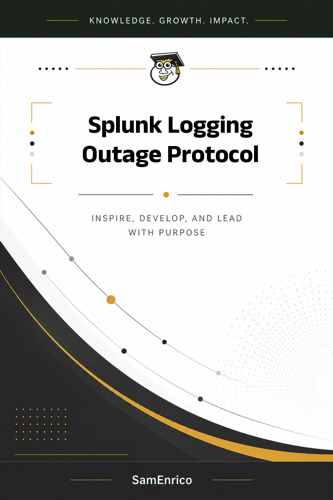
Splunk Logging Outage Protocol eBook
Emergency security and compliance when Splunk fail
by Coates Trish
Emergency security and compliance when Splunk fails, including local log capture and manual review.
Formats
Free sample
Chapter 1: The 2 a.m. Alarm...--It is 2:17 a.m. on a Tuesday when your phone buzzes for the fifth time in thirty seconds. The first four were ignored—false positives, a routine disk space warning, a certificate about to expire. But the fifth is different.
It reads: “Splunk Indexer Cluster – CRITICAL – All search heads unreachable.” You sit up in bed, the fog of sleep dissolving into something colder. You open your laptop. The Splunk login page spins indefinitely. The admin console returns a connection refused. You ping the indexers.
Nothing. You check the forwarder monitoring dashboard on a backup system. It shows a flatline: zero events ingested in the last twelve minutes.This is not a drill. Your SIEM is dead.In the next sixty seconds, a cascade of questions will hit you like a physical force. Are we under attack?
Who needs to know? How long until we’re out of compliance? What data are we losing right now? Can I fix it? Where do I even start?The silence is the enemy.
Not the technical failure—the silence that follows it, the vacuum where alerts used to be, the void where your security visibility just evaporated. In that silence, attackers don't pause. Ransomware doesn't wait for your ticket to be resolved. Data exfiltration doesn't take a coffee break. The clock is ticking on three separate but equally dangerous counts: technical recovery, security exposure, and regulatory compliance.This chapter exists because that 2:17 a.m.
moment is inevitable. Not if, but when. Every organization that depends on Splunk for security monitoring and compliance will experience a logging outage. The question is not whether you will survive it. The question is whether you will be ready when it happens.
And being ready starts with a single, counterintuitive truth: you must stop trying to fix Splunk before you start managing the crisis.Welcome to the Protocol.The Three Failure Modes: Not All Outages Are Equal The first mistake most teams make is treating every Splunk outage as a single problem with a single solution. They run the same troubleshooting playbook regardless of what actually broke. This is like a paramedic treating a heart attack and a broken leg with the same procedure. The outcomes are predictably catastrophic.A Splunk logging outage manifests in three fundamentally distinct failure modes. Each requires a different diagnosis, a different response, and a different declaration threshold.
Understanding these modes is not academic—it is the difference between restoring service in twenty minutes versus twenty hours, and the difference between preserving your compliance audit trail versus explaining to a regulator why you have a four-hour gap in your security records.Failure Mode One: The Total Indexer Blackout This is the nightmare scenario that most disaster recovery plans are written for, yet few actually survive. In a Total Indexer Blackout, the Splunk indexers—the core storage and search infrastructure—are completely unavailable. This can result from hardware failure (a RAID controller dies, power supply fails, storage array corrupts), software failure (a bad update crashes the indexing service, license expiry bricks the cluster), or infrastructure failure (network partition isolates the indexer tier, hypervisor host crashes).The signature of this failure mode is absolute: search heads cannot query, forwarders cannot connect, the monitoring console shows red across every indexer. More critically, data that has not yet been acknowledged by the indexer is at risk of permanent loss if buffers overflow. The clock starts immediately on your Recovery Point Objective (RPO)—the maximum amount of data you are willing to lose.The compliance implications of a Total Indexer Blackout are severe.
Depending on your regulatory environment, you may be required to maintain continuous audit logs. GDPR Article 30, for example, requires data controllers to maintain records of processing activities "without undue delay." PCI-DSS Requirement 10.7 mandates log retention for at least one year, but also requires continuous monitoring—a gap of hours could be interpreted as a violation of Requirement 10.6, which demands "immediate" alerting of security events.Failure Mode Two: The Ingestion Block This is the silent killer—the failure mode that often goes unnoticed for minutes or even hours because Splunk itself appears healthy. In an Ingestion Block, the indexers are operational, search heads can run queries, and the dashboard looks green. But new logs are not arriving. The causes are varied: a licensing limit has been exceeded and Splunk has stopped indexing (a feature, not a bug, for organizations on volume-based licenses), network congestion is dropping syslog packets, a configuration change on the forwarders has broken connectivity, or a certificate has expired.The signature of an Ingestion Block is the flatline.
Your dashboards show historical data but no new events. The internal _internal index shows ingestion volume dropping to zero. The forwarder management console shows healthy forwarders that are "connected" but not "sending."This failure mode is particularly dangerous because it creates a false sense of security. Your SOC analysts continue monitoring dashboards that show no alerts—because there are no new events to generate alerts from. Attackers love this scenario.
They can operate with impunity while your SIEM silently starves. The compliance risk is equally severe: you are technically in violation of continuous monitoring requirements from the moment the first log is dropped, even if you don't know it yet.Failure Mode Three: The Search Head Outage The most frustrating failure mode because the data exists—you just can't get to it. In a Search Head Outage, the indexers are healthy and ingesting logs normally. The forwarders are happy. Your log data is safe on disk.
But the search tier is unavailable due to web server failure, authentication provider outage, load balancer misconfiguration, or a denial-of-service condition on the search head pool.The signature is paradoxical: health checks pass on the indexers, the monitoring console (if you have a separate instance) shows ingestion continuing, but users cannot log in or searches return errors. The data is there, locked in a vault you cannot open.From a compliance perspective, this is the least dangerous failure mode because no data is lost. However, from an incident response perspective, it is uniquely painful. If you are actively responding to a security incident and your ability to query logs is removed, you are flying blind at exactly the moment you need visibility most.The Compliance Clock: Your Legal Tether Every minute of a Splunk outage is not created equal. The first five minutes are an operational nuisance.
The fifteenth minute is a potential compliance violation. The sixtieth minute is a regulatory notification trigger. Understanding the Compliance Clock means understanding the specific legal and contractual obligations that bind your organization.The Compliance Clock is not a single timer. It is a framework of three overlapping deadlines:The Detection Clock (Typically 72 Hours)Under GDPR Article 33, data controllers must notify the supervisory authority of a personal data breach "without undue delay and, where feasible, not later than 72 hours after having become aware of it." This does not mean you have 72 hours to detect a breach—it means you have 72 hours from detection to notification. The clock starts when you become aware.
If your SIEM outage prevents you from detecting a breach that occurs during the outage, the clock may not start…
This is the end of the free sample. Get the eBook to keep going. Buy now
About this book
Details
- Author
- Coates Trish
- Publisher
- SamEnrico
- Language
- English
- Genre
- Non-Fiction, Crisis Management, SIEM
- Released
- 2026-06-08
- Pages (approx.)
- 155
- Available as
- eBook, Audiobook

Read better in the ZLOADR app
Your eBooks on your phone or tablet. Sign in with your SamEnrico account and start reading.
More by Coates Trish
 Medicare and Housing Cost InteractionsCoates Trish$11.99
 Health Crisis Relationship ManagementCoates Trish$11.99
 Affirmation Rock PaintingCoates Trish$11.99
 The Google Calendar Reminder GuideCoates Trish$11.99
 The Last Emperor’s Shadow: How a Forgotten Dynasty Shaped Modern ChinaCoates Trish$11.99
 Refrigeration Appliance RepairCoates Trish$11.99
 How to Start a Basic Dye Business (Beginners Guide)Coates Trish$11.99
 Terms vs Privacy Policy GuideCoates Trish$12.99
 Venture Debt Pros Cons GuideCoates Trish$12.99
 Understanding Waardenburg SyndromeCoates Trish$17.99
You may also like
 Hong Kong Handover 1997Dunn Johnnie$11.99
 Zumba For Postnatal Recovery CourseNeal Christian$11.99
 Zumba for BeginnersLadner Nikia$11.99
 YouTube Comment Mining GuideHumes Pandora$12.99
 Worry Box MeditationCarlin Rudy$11.99
 Workplace Stress MeditationNguyen Lynn$11.99
 Workplace Stress and Sleep RepairHawley Ivory$11.99
 Workplace Perfectionism CureDelaney Jeffry$11.99
 Workplace Injustice Anger GuideWallen Isabelle$11.99
 Work Addiction and Burnout LinkGreenwood Ester$11.99
 Women in Yoga and WellnessBeattie Galina$11.99
 Women in Stand Up ComedyChun Evangeline$11.99