
Non-FictionHealth & WellnessMusic
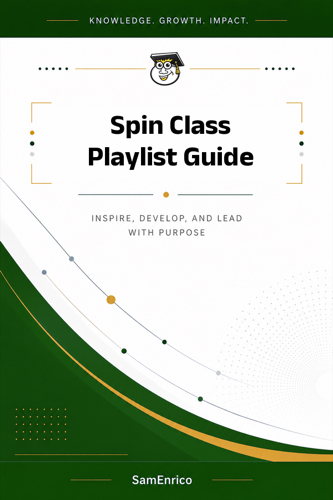
Spin Class Playlist Guide eBook
Curate music that matches cadence, climbs, and spr
by Hoff Connie
Curate music that matches cadence, climbs, and sprints for maximum motivation.
Formats
Free sample
Chapter 1: The Hidden Beat--–- Every Spin instructor remembers the moment they realized music was not just background noise. For some, it happens during a perfect climb when the chorus hits exactly as the resistance maxes out. For others, it is the sudden silence of a dropped playlist that reveals how dependent the room has become on the beat. And for a few, it comes from exhaustion—the terrible, hollow feeling of teaching a class where the music is simply wrong. The legs are heavy, the faces are blank, and forty-five minutes feels like a lifetime.
In that moment, you understand a brutal truth: without the right music, you are not a Spin instructor. You are just a person yelling at people on bikes.This book exists because that truth is also an opportunity. The difference between a ride your riders survive and a ride they crave is not the bike, the shoes, the resistance knob, or even your coaching. It is the seventeen songs you play between the warm-up and the cool-down. When those songs are chosen correctly—when the beats per minute match the revolutions per minute, when the builds align with the climbs, when the drops trigger the sprints—something magical happens.
The class stops feeling like exercise. It becomes a physical conversation between the music and the body, with you as the conductor. Riders stop checking the clock. They stop negotiating with themselves about whether to add resistance. They just move.
And when the final song fades out, they are already checking their schedules for your next class.This is not luck. It is not natural talent. It is a system—a repeatable, teachable method for curating music that drives performance. Over the next twelve chapters, you will learn that system. But before we talk about tools, techniques, or playlists, we have to answer a more fundamental question: Why does music work so powerfully on a bike?
What is happening inside the brain and body when a great track drops? And why do even experienced instructors consistently make the same five mistakes when choosing songs?The Neurological Shortcut The human brain is wired to move to rhythm. This is not a metaphor or a motivational slogan. It is a biological fact. When you hear a steady, predictable beat, your brain's motor cortex—the region responsible for planning and executing movement—begins firing in synchrony with that rhythm.
This phenomenon, called auditory-motor entrainment, means your brain is literally preparing your muscles to move before you consciously decide to do so. You cannot stop it. It is as automatic as your heart beating or your lungs drawing breath.For Spin instructors, this has enormous implications. A rider on a bike is not making a conscious choice about every pedal stroke. Their motor cortex is continuously receiving input from the music and adjusting their cadence to match.
When the beat is clear and consistent, this process is effortless. When the beat is ambiguous, or worse, absent, the rider's brain must work harder to maintain a steady pace. That extra cognitive load manifests as fatigue. The rider feels tired earlier, complains of heavy legs, and checks out mentally. They do not blame the music.
They blame themselves. They think they are out of shape. They think your class is too hard. But the real culprit is the gap between the beat and the body.Research in sports science has quantified this effect. Studies examining the relationship between music tempo and perceived exertion consistently find that listening to motivational, high-tempo music can lower perceived exertion by ten to fifteen percent at the same absolute workload.
This means a rider working at what feels like an eight out of ten without music will feel like a six or seven with the right soundtrack. They are doing the same amount of work. They are producing the same power output. But their brain is receiving different signals from their body because the music is occupying neural pathways that would otherwise process fatigue.This is the dissociation effect. High-energy music distracts the brain from the unpleasant sensations of intense exercise—the burning in the legs, the heaviness of breathing, the voice in your head telling you to stop.
Instead of focusing on internal discomfort, the rider focuses on external stimulation: the beat, the melody, the lyrics, the drop. The music becomes a gateway out of the body and into the experience. And when the music is perfectly aligned with the movement, the dissociation is so complete that riders report losing track of time entirely. They are not exercising. They are dancing on a bike.The BPM-to-RPM Relationship If music is a tool, then beats per minute is its calibration.
Every song has a BPM—the number of quarter-note beats in sixty seconds. A slow ballad might have sixty BPM. A fast techno track might have one hundred and forty BPM. And a punk rock song can reach one hundred and eighty BPM or higher. Understanding BPM is not enough, however.
You must understand how BPM translates to the bike.On a stationary bike, revolutions per minute measures how many times the pedals complete a full circle in sixty seconds. For most riders, a comfortable flat-road cadence is between eighty and ninety RPM. A climb, where resistance is high, drops to sixty to seventy RPM. And a sprint pushes past one hundred RPM. The relationship between BPM and RPM is not one-to-one.
Because the pedal stroke has two phases (the push down and the pull up), most riders naturally match a BPM that is roughly twice their RPM. A rider pedaling at eighty RPM will naturally lock onto a track at one hundred and sixty BPM. A rider climbing at sixty-five RPM will match one hundred and thirty BPM. This is not a rigid mathematical rule—some riders prefer a half-time feel, matching each downbeat to every other pedal stroke—but it is a reliable starting point.Throughout this book, we will use a consistent mapping system. For seated climbs, target sixty to seventy RPM using one hundred twenty to one hundred forty BPM music.
For standing climbs, where the body moves more slowly and deliberately, target fifty-five to sixty-five RPM using one hundred ten to one hundred thirty BPM music. For flat roads, target eighty to ninety RPM using one hundred sixty to one hundred eighty BPM music. For sprints, target one hundred or more RPM using two hundred or more BPM music. These are not arbitrary numbers. They come from thousands of hours of observation, experimentation, and rider feedback across dozens of studios and thousands of classes.One crucial exception exists.
The warm-up and cool-down segments of class are freeform zones where the BPM-to-RPM rule does not apply. During the first five minutes, your goal is not to force a cadence but to invite movement. One hundred to one hundred twenty BPM tracks work well here because they suggest rhythm without imposing it. Riders should be allowed to find their natural cadence—typically fifty to sixty RPM at this stage, though the number does not matter—without pressure. The same freedom applies to the cool-down, where music under one hundred BPM with minimal percussion helps lower…
This is the end of the free sample. Get the eBook to keep going. Buy now
About this book
Details
- Author
- Hoff Connie
- Publisher
- SamEnrico
- Language
- English
- Genre
- Non-Fiction, Health & Wellness, Music
- Released
- 2026-06-10
- Pages (approx.)
- 140
- Available as
- eBook, Audiobook

Read better in the ZLOADR app
Your eBooks on your phone or tablet. Sign in with your SamEnrico account and start reading.
More by Hoff Connie
 The Cold Turkey Anxiety FixHoff Connie$11.99
 Parent Death and Addiction RiskHoff Connie$11.99
 The Nap Negative Side EffectsHoff Connie$11.99
 Pain AffirmationsHoff Connie$11.99
 Child Loss And FaithHoff Connie$11.99
 The Bangkok Brothel EscapeHoff Connie$11.99
 Boundary Setting For LawyersHoff Connie$11.99
 The Dacian Inferno: Trajan's Bloody ConquestHoff Connie$11.99
 The Last Waltz: How a Forgotten Ballroom Saved a CityHoff Connie$11.99
 The Pearl of the Nile: A Royal Wedding That Changed the WorldHoff Connie$11.99
 Growing GriselinaHoff Connie$11.99
 The Mineral Guide to HyalophaneHoff Connie$11.99
You may also like
 Hong Kong Handover 1997Dunn Johnnie$11.99
 Zumba For Postnatal Recovery CourseNeal Christian$11.99
 Zumba for BeginnersLadner Nikia$11.99
 YouTube Comment Mining GuideHumes Pandora$12.99
 Worry Box MeditationCarlin Rudy$11.99
 Workplace Stress MeditationNguyen Lynn$11.99
 Workplace Stress and Sleep RepairHawley Ivory$11.99
 Workplace Perfectionism CureDelaney Jeffry$11.99
 Workplace Injustice Anger GuideWallen Isabelle$11.99
 Work Addiction and Burnout LinkGreenwood Ester$11.99
 Women in Yoga and WellnessBeattie Galina$11.99
 Women in Stand Up ComedyChun Evangeline$11.99