
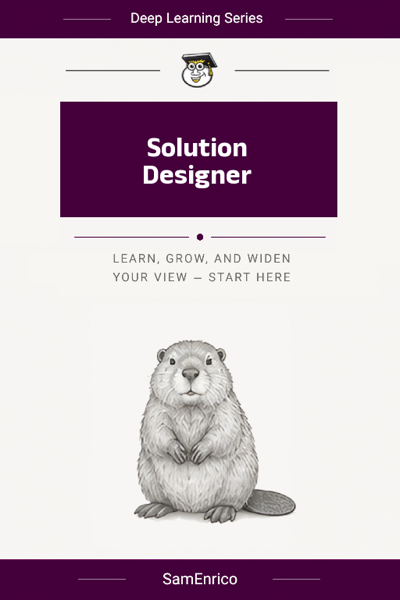
Solution Designer eBook
A Coursebook on Solution Designer
by Worden Debby
A Coursebook on Solution Designer
Formats
Free sample
Chapter 1: The Translation Trap...–- You are about to make a mistake. Not a coding mistake. Not a design mistake. A category mistake. You think this role is about diagrams, documents, or decisions.
It is not. It is about translation. And most people who call themselves Solution Designers fail at translation within their first ninety days. They fail because no one told them the truth: the industry has been lying about what this job actually is.Let me tell you about Priya.Priya was a senior developer at a mid-sized financial services company. She wrote clean code, mentored juniors, and could debug a production issue at 2 AM without breaking a sweat.
After five years, her manager pulled her aside. "You're ready for the next step," he said. "We want you to become a Solution Designer."Priya was thrilled. She imagined herself drawing architecture diagrams, making high-level technology decisions, and finally escaping the grind of ticket-by-ticket development. She read three books on software architecture, studied UML, and practiced creating component diagrams.
On her first day as a Solution Designer, she was assigned to a major project: replacing the company's legacy customer portal.She did everything by the book. She interviewed stakeholders. She documented requirements. She created beautiful sequence diagrams and a detailed logical data model. She presented her design to the architecture review board.
They approved it with minor comments. Priya felt validated. She was doing it. She was a real Solution Designer.Then the project went to development.The developers looked at her diagrams and asked questions she could not answer. "What about error handling when the payment API times out?" "How should we handle concurrent edits to the same customer record?" "Which of these fields are required and which are optional?" Priya had not thought about these details.
She had drawn the happy path. The real world has no happy path.Three months later, the project was behind schedule. The developers had made their own decisions to fill the gaps in Priya's design. Those decisions contradicted each other. The system was a patchwork of inconsistent assumptions.
The stakeholders blamed the developers. The developers blamed Priya. Priya blamed the process.Priya was not incompetent. She was set up to fail. No one told her that the Solution Designer's job is not to produce perfect diagrams.
It is to reduce ambiguity. And she reduced zero ambiguity because she did not know where ambiguity hides.This book is for Priya. And for Marcus. And for everyone who has been told "go design this" without being given the actual tools to do so.Marcus was different. He came from a business analysis background.
He was excellent at stakeholder management, requirements workshops, and writing user stories. When he was promoted to Solution Designer, he thought his people skills would carry him. He facilitated collaborative sessions, built consensus, and kept everyone happy.But when the technical leads asked him about database indexing strategies, API versioning policies, and idempotency patterns, Marcus had nothing to offer. He had never written production code. He did not know what made a system testable or deployable.
The developers lost confidence in him. They went around him to the architects directly. Marcus became a meeting scheduler and document librarian. He quit six months later.Priya and Marcus failed in opposite directions. Priya had technical depth but no business translation skill.
Marcus had business skill but no technical depth. Both thought the Solution Designer role was an extension of what they already knew. Both were wrong.The Lie You Have Been Told The industry has a convenient fiction: that job titles map cleanly to responsibilities. Software Architect designs systems. Developer writes code.
Business Analyst writes requirements. Project Manager tracks dates. Solution Designer sits somewhere in the middle, doing a bit of everything.This is a lie.The truth is messier. In some organizations, the Solution Designer is a junior architect who produces diagrams that no one reads. In others, they are a senior developer who also attends boring meetings.
In consulting companies like Pega, Salesforce, or AWS, the Solution Designer is a billable role that bridges the gap between what the sales team promised and what the delivery team can actually build. In product companies, the Solution Designer might be called a "Technical Product Manager" or "System Analyst."The confusion is not accidental. The industry has never agreed on what this role does because the role emerged organically to fill a gap that no other role covers. That gap is the space between strategy and execution, between business goals and technical reality, between what stakeholders say and what developers hear.This book defines the Solution Designer by that gap. You are not a junior architect.
You are not a senior developer. You are not a business analyst, project manager, or product owner. You are the translation layer between all of these. Your job is not to produce artifacts. Your job is to reduce ambiguity.
Everything else is a means to that end.The Three Pillars of Solution Design Every solution exists at the intersection of three forces. Ignore any one, and your design will fail—not because the technology is wrong, but because you optimized for the wrong thing.Pillar One: Feasibility (Can we build it?)Feasibility asks the technical question. Do we have the skills, time, budget, and technology to build this solution? Feasibility is not a yes/no question. It is a spectrum.
Most things are feasible given unlimited time and money. The real question is: Is it feasible given our actual constraints?A solution designer who over-indexes on feasibility produces designs that are technically elegant but solve the wrong problem. They optimize for the developer's experience, not the user's. They demand six months to build the perfect event-driven architecture when a two-week batch job would have worked fine.Pillar Two: Viability (Should we build it financially?)Viability asks the business question. Does this solution generate enough value to justify its cost?
Viability includes direct revenue, cost savings, risk reduction, and strategic positioning. A feature that costs 500,000tobuildbutsaves500,000 to build but saves 500,000tobuildbutsaves50,000 per year might still be viable if it prevents a regulatory fine or enables a new market.A solution designer who over-indexes on viability produces designs that are profitable on paper but impossible to build. They promise the business what it wants to hear without checking with engineering. The result is a death march: a project that was approved but cannot be delivered.Pillar Three: Desirability (Do users actually want it?)Desirability asks the user question. Will people use this solution?
Does it solve a real pain? Is it easier than the current alternative? Desirability is the most frequently ignored pillar because it is the hardest to measure. Stakeholders say "users want this" based on anecdotes and assumptions. User research reveals the truth.A solution designer who over-indexes on desirability produces designs that users love but the business cannot afford or the team cannot build.
The result is a beautiful product that launches to applause and then dies because it costs too much to maintain or never generated revenue.The art of solution design is balancing these three pillars. Every decision involves trade-offs. The chapter diagram below—though textually…
This is the end of the free sample. Get the eBook to keep going. Buy now
About this book
Details
- Author
- Worden Debby
- Publisher
- SamEnrico
- Language
- English
- Genre
- Non-Fiction, Informative, Educational
- Released
- 2026-05-11
- Pages (approx.)
- 151
- Available as
- eBook, Audiobook

Read better in the ZLOADR app
Your eBooks on your phone or tablet. Sign in with your SamEnrico account and start reading.
More by Worden Debby
 Personal Ing For Success Board SeatsWorden Debby$11.99
 Intuitive Eating Body Scan HandbookWorden Debby$11.99
 Scheduling Important Tasks FirstWorden Debby$11.99
 Palliative Pain Medication EssentialsWorden Debby$11.99
 Sponsorship in Twelve Step ProgramsWorden Debby$11.99
 The Great Beer Heist: How a Brewery Outsmarted ProhibitionWorden Debby$11.99
 Beneath the Black Diamond: The Forgotten Vein of ButteWorden Debby$11.99
 Understanding Bk Virus NephritisWorden Debby$17.99
 Career Switcher Bootcamp PathWorden Debby$12.99
 Alibaba Sourcing Playbook For ResellersWorden Debby$12.99
 How to Start a Poultry Dishes Business (Beginners Guide)Worden Debby$11.99