
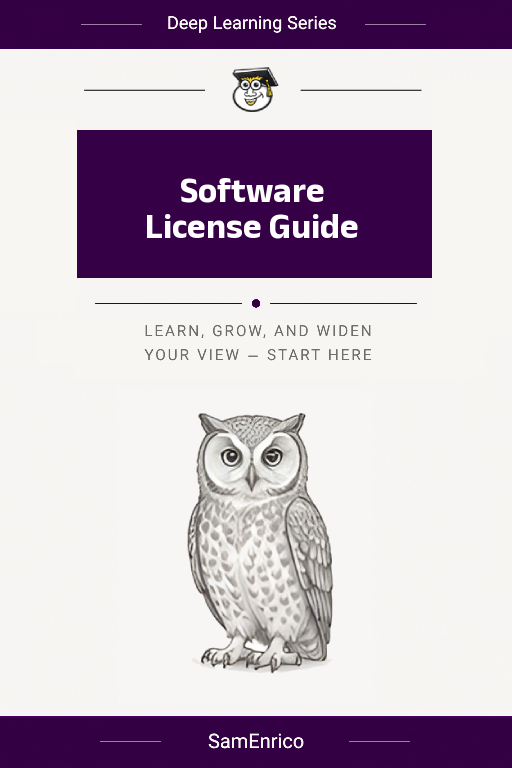
Non-FictionStrategic AtlasSoftware Pricing
Software License Guide eBook
Analyze perpetual vs. subscription, named user vs.
by Casimir Gena
Analyze perpetual vs. subscription, named user vs. concurrent, and enterprise pricing tiers.
Formats
Free sample
Chapter 1: The $47 Million Mistake--–- When Andrea Chen walked into the conference room on a Tuesday morning in March, she expected a routine budget review. Instead, she found the CFO, the CIO, and a representative from one of the world's largest software vendors waiting for her. On the table was a document titled "True-Up Reconciliation Report." The number at the bottom was $47.3 million. The vendor representative smiled pleasantly. "This is just the preliminary assessment," he said.
"We haven't finished auditing your disaster recovery environments yet."Andrea's stomach dropped. She had been promoted to Director of IT Finance just ninety days earlier, inheriting a team of twelve and a software budget that had grown from 18millionto18 million to 18millionto64 million over five years. Her predecessor, a beloved thirty-year veteran named Frank, had retired to Florida. Frank had run everything on spreadsheets he kept on a network drive labeled "DO NOT TOUCH - FRANK'S SYSTEM." When Andrea finally accessed the drive, she found spreadsheets with names like "MASTER_v34_FINAL_FINAL2.xls" and no documentation whatsoever. The vendor's True-Up number was more than half of her entire annual IT budget.
And she had no idea whether it was accurate, inflated, or somewhere in between.This book is for everyone who has ever sat in Andrea's chair, or who wants to avoid ever sitting there.The Unspoken Truth About Software Licensing Software licensing is not a technical problem. It is not a legal problem. It is not even really a procurement problem. Software licensing is a financial leverage problem disguised as a compliance exercise. The difference between a well-negotiated license agreement and a poorly negotiated one is not a line item.
It is a strategic asset or liability that can swing an enterprise's annual technology spend by thirty to fifty percent in either direction. Yet most organizations treat software licensing as an afterthought—something to be handled by IT operations during the final weeks of a renewal cycle, under pressure, with incomplete data, and without a clear understanding of the economics at play.Consider the numbers. A typical enterprise with five thousand employees spends between 15millionand15 million and 15millionand30 million annually on software licenses across vendors like Microsoft, Salesforce, Oracle, SAP, Adobe, and dozens of others. A thirty percent overspend—which industry benchmarks consistently show is the norm rather than the exception—represents 4.5millionto4.5 million to 4.5millionto9 million in pure waste. That waste does not buy better features, faster support, or improved security.
It buys nothing except the comfort of not having to make difficult decisions about who actually needs what.The vendors know this. They have built entire departments—often called "License Compliance" or "Software Asset Management" internally—whose sole purpose is to identify and capture this waste. They are not evil. They are rational actors in a system designed to extract maximum value from their products. But their rationality depends on a mismatch of information and incentives.
The vendor knows exactly what you have deployed, or can find out through audit rights you probably signed away without reading. The vendor knows exactly when your contract expires and has a team of compensation-driven salespeople whose bonuses depend on maximizing your renewal. The vendor knows that your internal stakeholders—the business units that actually use the software—have no incentive to reduce their license counts because their budgets are separate from IT's.You, the buyer, are at a structural disadvantage from the moment you sign the first agreement.The Anatomy of a License Disaster Andrea's $47 million problem did not appear overnight. It was years in the making. Her company, a mid-sized manufacturer we will call Apex Industrial, had grown through acquisition.
Each acquired company brought its own software licenses, its own agreements, its own renewal dates, and its own way of counting users. Frank, the retired finance director, had tried to keep everything in his spreadsheets, but the complexity overwhelmed him. By the time Andrea arrived, Apex had:Three separate Microsoft Enterprise Agreements, each on different renewal cycles Oracle database licenses deployed across seventeen physical servers with no documentation of which edition or metric applied Salesforce licenses for two hundred "active" users, of whom seventy-three had not logged in for more than six months A SAP contract with "indirect access" language that no one understood but everyone assumed was fine Adobe Creative Cloud subscriptions for the entire marketing department, including ten people who had left the company two years earlier The 47million True−Upfrom Microsoftwasjustthebeginning.Withinsixmonths,Oraclewouldaudit Apexandclaimanadditional47 million True-Up from Microsoft was just the beginning. Within six months, Oracle would audit Apex and claim an additional 47million True−Upfrom Microsoftwasjustthebeginning.Withinsixmonths,Oraclewouldaudit Apexandclaimanadditional22 million in under-licensing. Salesforce would refuse to reduce their user count because the renewal was thirty days away and the contract had automatically renewed for another year.
SAP would send a letter asking for "clarification" on how Apex's e-commerce platform accessed its backend systems.Andrea's company was not unusual. It was typical. And that is the most frightening statistic in this entire book: you are probably in the same position, or will be soon.Why This Book Exists I wrote this book because I have been Andrea. Not exactly, but close enough. Over fifteen years as an IT financial analyst, procurement manager, and independent consultant, I have sat across the table from every major software vendor.
I have negotiated agreements worth hundreds of millions of dollars. I have defended audits. I have cleaned up the messes left by predecessors who thought licensing was "boring" or "too complicated" or "someone else's problem." And I have watched organizations save between fifteen and forty percent on their software spend simply by applying the frameworks, metrics, and negotiation tactics you will learn in this book.The top ten books on software licensing—the ones every procurement professional and IT finance analyst reads—cover this material. But they cover it in fragments. One book focuses on audit defense.
Another focuses on cloud migration. A third focuses on negotiating Microsoft agreements specifically. None of them connect the dots. None of them give you a unified framework that works across perpetual and subscription, across named user and concurrent, across enterprise tiers and volume ladders.This book is that unified framework.What You Will Learn in This Chapter Before we dive into the specifics of licensing models, user metrics, and pricing structures, this chapter has a more fundamental goal: to change how you think about software licensing entirely. By the time you finish reading, you will understand:Why the shift from perpetual to subscription licenses is not a technology trend but a financial engineering trend, and why that distinction matters for your negotiation leverage The three financial metrics that every licensing decision actually impacts (hint: it is not just "cost")Why most organizations over-license by thirty percent and what the root causes are (they are not what you think)The single question that will save you more money than any negotiation tactic (and how most people answer it wrong)A framework for assessing your own organization's license health in less than one hour Part One: The Great Financial Migration The story of software licensing over the past decade is not a story about technology.
Cloud computing, software-as-a-service, and subscription models did not emerge because the technology finally caught up with the vision. They emerged…
This is the end of the free sample. Get the eBook to keep going. Buy now
About this book
Details
- Author
- Casimir Gena
- Publisher
- SamEnrico
- Language
- English
- Genre
- Non-Fiction, Strategic Atlas, Software Pricing
- Released
- 2026-05-29
- Pages (approx.)
- 140
- Available as
- eBook, Audiobook

Read better in the ZLOADR app
Your eBooks on your phone or tablet. Sign in with your SamEnrico account and start reading.
More by Casimir Gena
 Technical Difficulty Anxiety ProtocolCasimir Gena$11.99
 Performance Review Self EsteemCasimir Gena$11.99
 Instagram Reels MasteryCasimir Gena$11.99
 The Teen Assertiveness Roleplay GuideCasimir Gena$11.99
 Yaka Mask Initiation GuideCasimir Gena$11.99
 The Grand Jeté: How Black Ballerinas Conquered the World StageCasimir Gena$11.99
 Understanding Post-infectious MyocarditisCasimir Gena$17.99
 HARO Social Proof BuildingCasimir Gena$12.99
 Clinical ResearcherCasimir Gena$11.99
 How to Become a Cement-mason ApprenticeCasimir Gena$11.99
You may also like
 Hong Kong Handover 1997Dunn Johnnie$11.99
 Zumba For Postnatal Recovery CourseNeal Christian$11.99
 Zumba for BeginnersLadner Nikia$11.99
 YouTube Comment Mining GuideHumes Pandora$12.99
 Worry Box MeditationCarlin Rudy$11.99
 Workplace Stress MeditationNguyen Lynn$11.99
 Workplace Stress and Sleep RepairHawley Ivory$11.99
 Workplace Perfectionism CureDelaney Jeffry$11.99
 Workplace Injustice Anger GuideWallen Isabelle$11.99
 Work Addiction and Burnout LinkGreenwood Ester$11.99
 Women in Yoga and WellnessBeattie Galina$11.99
 Women in Stand Up ComedyChun Evangeline$11.99