
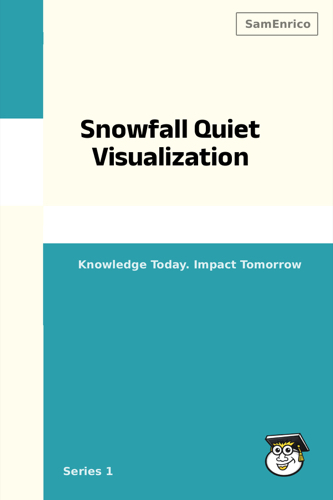
Snowfall Quiet Visualization eBook
Stand in a gentle snowfall and watch as white flak
Stand in a gentle snowfall and watch as white flakes muffle all noise and stress.
Formats
Free sample
Chapter 1: Nature's Original Noise-Canceler--–- Outside my window, the first real snow of winter has been falling for about an hour. I stop typing, set down my coffee, and just watch. The street below has gone from wet black asphalt to a softening gray. The sharp edges of parked cars have rounded. A bus that would normally announce itself with a a diesel growl and a hydraulic hiss passes by in what sounds like a long, low exhale.
My neighbor’s dog, usually a reliable source of high-pitched commentary on every squirrel in the county, is silent. Even the air feels different—denser, slower, as if the sky itself has taken a sedative.I have lived through dozens of snowfalls, but this is the first time I notice something strange. The quieter the world gets outside, the quieter my mind gets inside. The little voice that has been listing unfinished tasks, replaying an awkward conversation from three days ago, and worrying about something I said to a friend last week—that voice is still there, but it has turned down its own volume. It is speaking at the level of a library whisper instead of a crowded restaurant.
I have done nothing special. I have not meditated. I have not repeated a mantra. I have simply stood here and watched snow fall.This is the promise of this book, and it is not a metaphor. Snowfall visualization works because your brain is wired to respond to certain patterns in your environment—patterns that signal safety, predictability, and the permission to rest.
When you learn to generate those patterns inside your own imagination, you gain access to a state of quiet that does not depend on weather, location, or circumstance. You carry the mute button with you.But before we learn how to push that button, we need to understand why it works. This chapter builds the scientific and experiential foundation for everything that follows. We will explore how real snow changes your physical and psychological environment, why your brain treats imagined snow similarly to real snow, and why snow—not rain, not wind, not sunlight—is uniquely suited to produce the kind of deep, restorative silence that modern life constantly steals from you.The Physics of Quiet: How Real Snow Muffles the World Let us begin with something you have probably experienced but never thought about. After a heavy snowfall, the world sounds different.
Not just quieter, but qualitatively different. Footsteps change from a slap or a scuff to a soft creak or a muffled thump. Voices that would normally carry half a block seem to stop after a few feet. Traffic sounds become distant, abstract, almost harmless. This is not your imagination, and it is not merely because people stay indoors.Snow is a remarkable acoustic material.
When sound waves travel through air and hit a surface, one of three things happens: they reflect (bounce back, which is how you hear an echo), they transmit (pass through), or they absorb (disappear into the material as heat). Most surfaces—concrete, glass, dry ground, water—are poor absorbers and good reflectors. That is why a city street without snow can feel loud and harsh. Sound bounces off buildings, pavement, and cars, layering on top of itself until the auditory environment becomes a kind of noise soup.Fresh snow is the opposite. A layer of newly fallen snow is porous, crystalline, and complex.
It contains up to ninety percent air trapped in intricate lattice structures. When sound waves enter this lattice, they do not bounce back cleanly. Instead, they scatter, bounce around inside the air pockets, and lose energy with each bounce. High-frequency sounds—the sharp, attention-grabbing ones like a car horn, a dog bark, or the clatter of dishes—are absorbed most effectively. Low-frequency sounds, like the rumble of a distant highway, travel further but become muted, losing their sharp edges and becoming a soft background hum.This is why a snowy landscape feels not just quieter but softer.
The sounds that remain have been stripped of their urgency. Your brain hears this and interprets it as safety. In evolutionary terms, sudden sharp sounds signal danger—a breaking branch, a predator’s growl, a cry of alarm. The absence of sharp sounds signals that nothing urgent is happening. You can lower your guard.
You can rest.Now here is the crucial insight that makes this entire book possible: your brain does not require actual snow to produce this safety response. It requires the pattern of snow—the sensory signature of soft, repetitive, non-threatening input. And that pattern can be generated entirely inside your imagination.Psychoacoustics: Why Your Brain Loves the Sound of Silence (and Almost-Silence)Psychoacoustics is the study of how your brain interprets sound. It is not the physics of sound waves but the psychology of hearing—how your nervous system turns pressure waves into emotions, memories, and physiological responses. And psychoacoustics has a clear finding: your brain craves predictable, low-intensity auditory environments.Consider two scenarios.
In the first, you are sitting in a room where random sounds occur at unpredictable intervals—a door slams here, a phone rings there, someone laughs loudly across the hall. Your brain cannot predict what comes next, so it remains in a state of low-level vigilance. Your heart rate stays slightly elevated. Your muscles retain a small amount of tension. You are not frightened, but you are not relaxed either.
This is the auditory environment of most modern workplaces, coffee shops, and even many homes.In the second scenario, you are sitting in a room with a single, predictable, gentle sound—a fan running, waves lapping at a shore, or snow falling outside a window. Your brain can predict the sound’s continuance. It knows what to expect. As a result, it stops allocating attention to threat detection and begins to allocate resources elsewhere—digestion, immune function, cellular repair, and the kind of deep cognitive processing that leads to insight and creativity.This is not a metaphor. Researchers have measured cortisol levels, heart rate variability, and brain wave activity in response to different soundscapes.
Gentle, predictable, continuous sounds shift the nervous system toward the parasympathetic mode—often called “rest and digest.” Sharp, unpredictable, intermittent sounds shift the nervous system toward the sympathetic mode—“fight or flight.”Now consider snow. Falling snow produces sound, contrary to popular belief, but that sound is so soft and so high-frequency that most people do not consciously hear it. Scientists have recorded the sound of individual snowflakes landing, and it is a whisper-thin click at around 10,000 hertz—far above the range where most ambient noise lives. But even if you cannot hear it consciously, your brain can. And what your brain hears is a soft, continuous, perfectly predictable patter at the very edge of perception.
It is the auditory equivalent of a silk curtain brushing against your skin.When you visualize snowfall, you are not just seeing white shapes drift downward. You are also, whether you realize it or not, generating the expectation of that soft, continuous, high-frequency sound. Your brain begins to listen for it. And in listening for it, your brain stops listening for threats. The result is…
This is the end of the free sample. Get the eBook to keep going. Buy now
About this book
Details
- Author
- Heckman Aleida
- Publisher
- SamEnrico
- Language
- English
- Genre
- Non-Fiction, Self-Help
- Released
- 2026-06-07
- Pages (approx.)
- 135
- Available as
- eBook, Audiobook

Read better in the ZLOADR app
Your eBooks on your phone or tablet. Sign in with your SamEnrico account and start reading.
More by Heckman Aleida
 Badminton Hypnosis CourseHeckman Aleida$11.99
 The Senior Pain Management GuideHeckman Aleida$11.99
 Watermark Design CanvaHeckman Aleida$11.99
 Self Talk Transformation GuideHeckman Aleida$11.99
 Phobia Medication GuideHeckman Aleida$11.99
 Self Hypnosis for Carpal TunnelHeckman Aleida$11.99
 Digital Healthcare CommunicationHeckman Aleida$11.99
 Bark of the Sphinx: The Hound Who Guarded the RiddlesHeckman Aleida$11.99
 The Brush and the Crown: How a Russian Painter Captured Napoleon's Last BreathHeckman Aleida$11.99
 How to Produce DetergentHeckman Aleida$11.99
 Tiffanie Cats: Burmilla LonghairHeckman Aleida$11.99
 A Collector's Handbook to the Wolseley 80Heckman Aleida$11.99
You may also like
 Hong Kong Handover 1997Dunn Johnnie$11.99
 Zumba For Postnatal Recovery CourseNeal Christian$11.99
 Zumba for BeginnersLadner Nikia$11.99
 YouTube Comment Mining GuideHumes Pandora$12.99
 Worry Box MeditationCarlin Rudy$11.99
 Workplace Stress MeditationNguyen Lynn$11.99
 Workplace Stress and Sleep RepairHawley Ivory$11.99
 Workplace Perfectionism CureDelaney Jeffry$11.99
 Workplace Injustice Anger GuideWallen Isabelle$11.99
 Work Addiction and Burnout LinkGreenwood Ester$11.99
 Women in Yoga and WellnessBeattie Galina$11.99
 Women in Stand Up ComedyChun Evangeline$11.99