
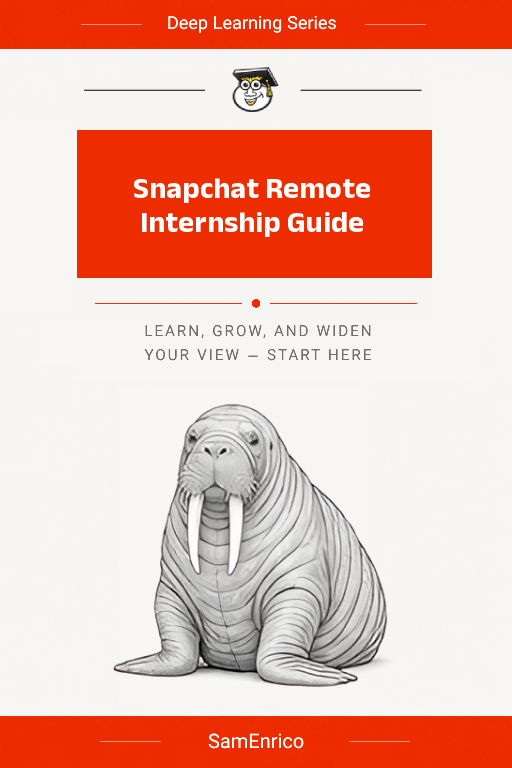
Non-FictionVirtual Work ExperienceAR Guide
Snapchat Remote Internship Guide eBook
Join Snapchat's virtual internship program. AR fil
Join Snapchat's virtual internship program. AR filters, camera tech, and remote social product design.
Formats
Free sample
Chapter 1: The Ghost in the Machine--The first time I opened Snapchat as an intern, I made a mistake that almost cost me the entire summer. I treated it like Instagram.I opened the app, checked my friends’ Stories, sent a few casual snaps back and forth, and closed it. That was what normal people did with Snapchat. But I was not a normal user anymore. I was an intern at a company that called itself a “camera company” and expected me to understand why that distinction mattered.
I did not understand. Not yet.Three days into the program, my manager asked me a simple question during our weekly sync: “How would you explain Snap’s business model to your grandmother?” I laughed nervously and gave an answer about disappearing messages and filters. She smiled the way people smile when you have given the wrong answer but they are too polite to say so. “Read the investor letter,” she said. “Then come back to me.”That night, I read Snap’s quarterly shareholder letter for the first time.
The word “camera” appeared forty-seven times. The word “social media” appeared zero times. That was the moment everything clicked.Snap Inc. is not a social media company that happens to have a camera. It is a camera company that happens to have a social network.
This distinction is not semantic. It is the difference between understanding your job as an intern and wasting your summer building things that do not matter.Most people who apply to Snap’s remote internship program make the same mistake I did. They see the ghost logo, they think of streaks and filters and teenage ephemera, and they assume the company is playing the same game as Facebook, Tik Tok, and Instagram. They are wrong. And because they are wrong, they spend their five weeks building Lenses that look pretty but do not fit the ecosystem, pitching ideas that belong on a different platform, and wondering why they did not get a return offer.This chapter exists to ensure you are not one of those people.Before you write a single line of Java Script, before you open Blender, before you record your first demo video, you need to understand what Snap actually is, how it makes money, and why the camera is the most important piece of technology in your internship.
You need to see the ghost in the machine.The Camera Company Thesis In 2016, before Snap went public, Evan Spiegel (co-founder and CEO) gave an internal presentation that has since become legendary among early employees. He stood in front of a whiteboard and drew two columns. On the left, he wrote “Social Media Companies.” On the right, he wrote “Camera Companies.”Under Social Media Companies, he listed Facebook, Twitter, and Linked In. Their core product, he explained, was the social graph—the connections between people. Their primary interaction was the feed.
Their business model was advertising based on attention and identity.Under Camera Companies, he listed Apple, Google, and Nikon. Their core product was imaging technology. Their primary interaction was capturing and augmenting reality. Their business model was hardware, software tools, and experiences that start with a camera click.Then he drew a circle around the right column and said: “Snap is a camera company.”The room went quiet. Most employees had joined thinking they were building a messaging app.
Spiegel was telling them they were actually building something closer to a visual operating system.Eight years later, that thesis has only become more true. Snapchat is the application layer, but the real product is the camera technology that sits underneath it. Every time a user opens Snapchat, they are not “checking their feed” in the Facebook sense. They are activating a camera that can recognize faces, track movements, map rooms, overlay digital objects, and connect to external data sources. The social features—messaging, Stories, Spotlight—are distribution channels for camera-based content, not the product themselves.This is why understanding Snap as a camera company is the single most important concept in this book.
Every decision you make as an intern—from the Lenses you build to the way you communicate with your manager—should flow from this thesis. If you forget everything else in this chapter, remember this: you are not a social media intern. You are a camera software intern.The Four Pillars of Snap Inc.Snap’s business is not monolithic. It is built on four distinct but interconnected pillars. As an intern, you will likely touch only one or two of these directly.
But the interns who get return offers understand all four, because they understand how their small piece fits into the larger machine.Pillar One: Snapchat (The Social Layer)Snapchat is the public face of the company. It is the app that 400 million daily active users open to talk to friends, watch Stories, and—most importantly for you—use Lenses. But from a business perspective, Snapchat serves a specific function: it is the distribution network for camera experiences.Think of Snapchat as the storefront. Users come for the social connection, but they stay for the camera. And every time they use a Lens, they are generating data that helps Snap improve its camera technology, training the models that power Face Mesh and World Tracking.
Your internship project, whatever it is, ultimately exists to serve these users. If you build a Lens that nobody uses, you have wasted everyone’s time. If you build a Lens that goes viral, you have proven that you understand what Snapchat users actually want.Pillar Two: Lens Studio (The Creator Tool)Lens Studio is where you will spend most of your internship. It is Snap’s free desktop application for building AR Lenses, and it is the company’s bet on democratizing camera creation. Before Lens Studio (2017), building an AR filter required a team of engineers and a six-figure budget.
Today, a solo intern with a laptop can build a professional Lens in an afternoon.Lens Studio is also a strategic moat. Every Lens created in Lens Studio stays within Snap’s ecosystem. Unlike Tik Tok’s Effect House (which allows exports to other platforms), Snap has designed Lens Studio to lock in creators. The more Lenses exist in Snapchat, the harder it is for users to leave. As an intern, you are not just learning a tool.
You are joining a creator economy that Snap controls.Pillar Three: Spectacles (The AR Hardware)Spectacles are Snap’s augmented reality glasses. The first version (2016) was a commercial failure—too expensive, too weird, too early. The second version (2021) was better but still niche. The current version (Spectacles 5, released to developers in 2024) is the first one that actually works for extended use.Most interns ignore Spectacles because they seem like a side project. That is a mistake.
Spectacles represent Snap’s long-term bet on the future of computing. Spiegel has said publicly that he believes AR glasses will eventually replace smartphones, just as smartphones replaced desktop computers. If that happens, Snap wants to own the camera software on those glasses. Your internship is happening at the exact moment this transition is beginning. Understanding Spectacles—even if you never hold a…
This is the end of the free sample. Get the eBook to keep going. Buy now
About this book
Details
- Author
- Melton Kirsten
- Publisher
- SamEnrico
- Language
- English
- Genre
- Non-Fiction, Virtual Work Experience, AR Guide
- Released
- 2026-06-01
- Pages (approx.)
- 148
- Available as
- eBook, Audiobook

Read better in the ZLOADR app
Your eBooks on your phone or tablet. Sign in with your SamEnrico account and start reading.
More by Melton Kirsten
 Women Cooperative Leadership GuideMelton Kirsten$11.99
 Walking Meditation For Breakup RecoveryMelton Kirsten$11.99
 Chronic Illness Anger Triggers CourseMelton Kirsten$11.99
 Walking Meditation for HikersMelton Kirsten$11.99
 Assertiveness for Social Anxiety GuideMelton Kirsten$11.99
 The Vanishing of the Lady of the Lake: A Forensic Deep DiveMelton Kirsten$11.99
 Understanding OnychomatricomaMelton Kirsten$17.99
 How to Start a Pesticides and other Agrochemical Products Business (Beginners Guide)Melton Kirsten$11.99
 Bundle Pricing During Cost InflationMelton Kirsten$12.99
 HSE SpecialistMelton Kirsten$11.99
You may also like
 Hong Kong Handover 1997Dunn Johnnie$11.99
 Zumba For Postnatal Recovery CourseNeal Christian$11.99
 Zumba for BeginnersLadner Nikia$11.99
 YouTube Comment Mining GuideHumes Pandora$12.99
 Worry Box MeditationCarlin Rudy$11.99
 Workplace Stress MeditationNguyen Lynn$11.99
 Workplace Stress and Sleep RepairHawley Ivory$11.99
 Workplace Perfectionism CureDelaney Jeffry$11.99
 Workplace Injustice Anger GuideWallen Isabelle$11.99
 Work Addiction and Burnout LinkGreenwood Ester$11.99
 Women in Yoga and WellnessBeattie Galina$11.99
 Women in Stand Up ComedyChun Evangeline$11.99