
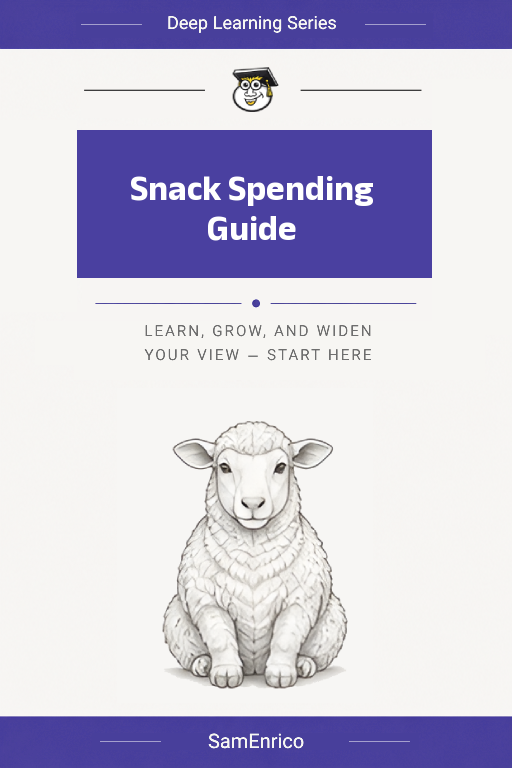
Non-FictionConsumer Mind ReportSnack Strategy
Snack Spending Guide eBook
Examines healthy vs indulgent, portion size, and b
Examines healthy vs indulgent, portion size, and brand preference differences for CPG brands.
Formats
Free sample
Chapter 1: The Fifty-Billion-Dollar Blindspot--–- The first time I watched my neighbor Lisa unload her weekly groceries, I saw a woman who had clearly read every budget blog on the internet. Her cart was a masterpiece of fiscal responsibility: store-brand oats, a family-size bag of brown rice, frozen vegetables in bulk, and a calculator-tape list organized by aisle. She beamed with pride as she told me she had cut her grocery bill by 22 percent that month. I believed her. I also noticed, sitting on top of her reusable bags like a confession she hadn't yet made, a single-item receipt from the corner store dated later that same afternoon.
On it: one bag of Doritos, one pint of Häagen-Dazs, and a Gatorade. Total: 12.47.Shehadsaved12.47. She had saved 12.47.Shehadsaved0.47 on canned tomatoes and spent 12.47onsnacksshehadn′tplannedtobuy,didn′tbudgetfor,andconsumedinasinglesittingwhilewatching Netflix.That12.47 on snacks she hadn't planned to buy, didn't budget for, and consumed in a single sitting while watching Netflix. That 12.47onsnacksshehadn′tplannedtobuy,didn′tbudgetfor,andconsumedinasinglesittingwhilewatching Netflix.That12.47 was not an anomaly. It was a subscription.
And she had been paying it, in various forms, for years.This book is built on a simple, uncomfortable truth: most of us have no idea how much we actually spend on snacks. Not because we are bad with money, and not because we lack willpower, but because the modern snack economy is specifically designed to hide its true cost from us. It hides in the $3.47 "add-on" item that pushes your delivery order over the free-shipping threshold. It hides in the 100-calorie pack that costs five times more per ounce than the family-size bag sitting right next to it on the shelf. It hides in the "health halo" of a gluten-free cookie that has more sugar than the original recipe.
And it hides, most insidiously, in the gap between what we plan to spend and what we actually spend when our blood sugar crashes at 3:00 PM and we find ourselves staring blankly at a vending machine.This chapter is about that gap. It is about the $50 billion in annual unplanned snack sales that fuel an entire industry built on the fragile architecture of human impulse. It is about why your brain, your body, and the grocery store are not neutral actors in your spending—they are active opponents. And it is about the first and most important tool you will learn in this book: how to see the snack aisle for what it really is, before you ever walk down it.The Statistic That Should Make You Uncomfortable Let us start with a number that does not get nearly enough attention in personal finance literature: 50billion.Thatistheannualvalueofunplannedsnackpurchasesinthe United Statesalone,accordingtoaggregateddatafromthe Food Marketing Instituteandmultiple CPGearningsreports.Tobeclear,thisisnotthetotalsnackmarket.Thetotalsnackmarket—includingchips,cookies,candy,nuts,yogurt,proteinbars,popcorn,icecream,andeveryothersalty,sweet,orsavorybiteconsumedbetweenmeals—iscloserto50 billion. That is the annual value of unplanned snack purchases in the United States alone, according to aggregated data from the Food Marketing Institute and multiple CPG earnings reports.
To be clear, this is not the total snack market. The total snack market—including chips, cookies, candy, nuts, yogurt, protein bars, popcorn, ice cream, and every other salty, sweet, or savory bite consumed between meals—is closer to 50billion.Thatistheannualvalueofunplannedsnackpurchasesinthe United Statesalone,accordingtoaggregateddatafromthe Food Marketing Instituteandmultiple CPGearningsreports.Tobeclear,thisisnotthetotalsnackmarket.Thetotalsnackmarket—includingchips,cookies,candy,nuts,yogurt,proteinbars,popcorn,icecream,andeveryothersalty,sweet,orsavorybiteconsumedbetweenmeals—iscloserto150 billion annually. The $50 billion figure represents the slice of that market that consumers did not intend to buy when they walked into the store, opened an app, or approached the checkout counter.Think about what that means. One out of every three dollars spent on snacks in this country is an accident. Not a treat you budgeted for.
Not a planned indulgence. An accident. And accidents, by their very nature, are systematically more expensive than planned purchases. When you plan to buy a snack, you compare prices, you check the unit cost, you consider whether you actually need it. When you buy a snack on impulse, you skip all of those steps.
You pay whatever the price is because the transaction is not about value. It is about relief. Relief from hunger, relief from boredom, relief from the tiny, persistent voice in your head that says "you deserve this."The grocery industry knows this better than you know your own spending habits. In fact, they have built multi-billion-dollar supply chains, store layouts, and pricing strategies around the explicit goal of turning your momentary lapse into their recurring revenue. This chapter will expose how they do it, why it works, and how you can disrupt the pattern without becoming a joyless ascetic who eats only raw kale and resentment.The Cart Theory: Why Size Matters More Than Price One of the most powerful concepts in this book is something I call the Cart Theory.
It is deceptively simple, and once you see it, you cannot unsee it. The Cart Theory states that the size of the container you use to shop has a direct, measurable, and largely unconscious effect on how much you spend on snacks. Specifically, using a large shopping cart increases unplanned snack spending by up to 40 percent compared to using a hand basket or no cart at all.This is not a metaphor. Multiple behavioral economics studies have tested this exact variable. In one controlled experiment conducted in a real grocery store, shoppers were randomly assigned to either a standard large cart or a smaller hand basket.
The large-cart group purchased, on average, 40 percent more unplanned snack items than the basket group—not 40 percent more total spending, 40 percent more specifically in the snack category. The researchers controlled for household size, income, and shopping frequency. The effect persisted across all demographics.Why does this happen? The answer lies in a cognitive bias called the "emptiness heuristic." When you see a large, empty space—whether it is a shopping cart, a pantry shelf, or a hard drive—your brain automatically registers that empty space as a problem to be solved. It is the same psychological mechanism that makes you want to fill the last empty seat at a table or the final blank page of a notebook.
A large cart, by virtue of its size, signals to your brain that you have not bought enough yet, even if your shopping list is complete. A hand basket, by contrast, signals constraint. When the basket is half full, your brain registers that you are running out of room, and you become more selective about what goes into it.The snack industry exploits this bias relentlessly. That is why warehouse clubs like Costco and Sam's Club give you a cart that could fit a small sofa. That is why the shopping carts at grocery stores have been getting larger over the past two decades, even as household sizes have shrunk.
That is why the "convenience store" basket is exactly the size of one adult's arm span—large enough to hold a few items, small enough to feel full quickly.The actionable insight from the Cart Theory is simple but powerful: before you enter any store where you might buy snacks, make a conscious choice about your container. If you are doing a full weekly grocery run and need a…
This is the end of the free sample. Get the eBook to keep going. Buy now
About this book
Details
- Author
- Mcmillen Fern
- Publisher
- SamEnrico
- Language
- English
- Genre
- Non-Fiction, Consumer Mind Report, Snack Strategy
- Released
- 2026-05-29
- Pages (approx.)
- 154
- Available as
- eBook, Audiobook

Read better in the ZLOADR app
Your eBooks on your phone or tablet. Sign in with your SamEnrico account and start reading.
More by Mcmillen Fern
 Fiverr Buyer PersonaMcmillen Fern$11.99
 Fall Recovery Self Esteem WorkbookMcmillen Fern$11.99
 Breath Awareness for Public SpeakingMcmillen Fern$11.99
 Anger De escalation Role PlayMcmillen Fern$11.99
 Thai Elite Visa Business Case StudyMcmillen Fern$11.99
 The Architects of the Skies: The Great Pyramid HeistMcmillen Fern$11.99
 Understanding Lubinsky SyndromeMcmillen Fern$17.99
 Non Resident LLC Formation FAQ GuideMcmillen Fern$12.99
 GlowstickingMcmillen Fern$11.99
 A Beginners Guide to Endurance riding (Volume 1)Mcmillen Fern$11.99
You may also like
 Hong Kong Handover 1997Dunn Johnnie$11.99
 Zumba For Postnatal Recovery CourseNeal Christian$11.99
 Zumba for BeginnersLadner Nikia$11.99
 YouTube Comment Mining GuideHumes Pandora$12.99
 Worry Box MeditationCarlin Rudy$11.99
 Workplace Stress MeditationNguyen Lynn$11.99
 Workplace Stress and Sleep RepairHawley Ivory$11.99
 Workplace Perfectionism CureDelaney Jeffry$11.99
 Workplace Injustice Anger GuideWallen Isabelle$11.99
 Work Addiction and Burnout LinkGreenwood Ester$11.99
 Women in Yoga and WellnessBeattie Galina$11.99
 Women in Stand Up ComedyChun Evangeline$11.99