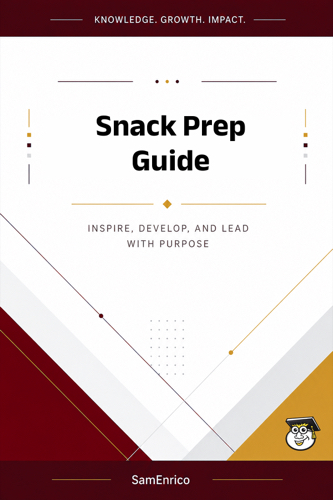
Snack Prep Guide eBook
Portion healthy grab and go snacks to avoid vendin
by Tilley Signe
Portion healthy grab and go snacks to avoid vending machines.
Formats
Free sample
Chapter 1: The 3:00 PM Siren--–- The fluorescent lights hum overhead. Your screen has gone blurry. The last email you sent was full of typos. And somewhere down the hallway, inside a metal box with a glass front, a bag of chips is calling your name. You know the sound: the soft thunk of a dollar bill being rejected, the whir of the spiral turning, the satisfying drop.
It’s not hunger. Not really. It’s 3:00 PM, and the vending machine has become a siren, and you are the sailor crashing against the rocks.This chapter is not about willpower. It is not about shame, or calorie counting, or throwing away your favorite snacks. It is about understanding why you walk toward that machine even when you swore you wouldn’t.
It is about the difference between physical hunger and learned habit. And it is about a single, counterintuitive strategy that will change everything: crowding out instead of cutting out.By the end of this chapter, you will have completed a self-assessment that reveals your personal vending machine personality. You will understand the three hidden triggers that drive you to buy junk you don’t even really want. And you will begin a one-week Trigger Log that will become the foundation for every recipe and system in the rest of this book.But first, let’s be honest about something most diet books refuse to admit: you are not broken. Your brain is working exactly as it evolved to work.
The problem is that the vending machine is newer than your brain.The Biology of the Break Room Let’s travel back in time for a moment. Imagine your ancestor, let’s call her Grog, living 50,000 years ago. Grog spends her days walking long distances, occasionally finding a patch of berries or digging up a root. Food is scarce. Sugar is almost nonexistent except for brief periods when fruit ripens.
Salt is a rare mineral she sometimes licks from a rock.Now imagine Grog stumbles upon a berry bush loaded with sweet, ripe fruit. What should her brain do? Should it say, “Eat two berries and save the rest for later”? Absolutely not. If she does that, another animal will eat the rest, and she will starve.
So evolution built a powerful mechanism: when sugar is available, eat as much as possible, as fast as possible. The same goes for salt and fat—critical nutrients that were historically hard to find.Fast forward to today. You are not Grog. You have a desk, a commute, and a break room with a machine that contains shelf-stable, laboratory-engineered combinations of sugar, salt, and fat at a ratio that never existed in nature. Your brain, still running on Grog’s software, sees that bag of chips and thinks, “Rare resource!
Eat it all now!” You are not weak. You are operating a Ferrari engine inside a traffic jam.The problem is not your character. The problem is that your environment has changed faster than your biology can keep up. And the vending machine is a perfect trap: it requires zero effort, delivers an immediate dopamine hit, and is available 24 hours a day.But here is the good news. Once you understand that your cravings are not moral failures but biological signals, you can stop fighting yourself and start working with your brain.
That is what this book teaches. Not deprivation. Not shame. Strategy.The Three Faces of the Vending Machine Monster Before you can beat the vending machine habit, you need to know which version of the monster you are fighting. Through years of research and thousands of client interviews, three distinct patterns have emerged.
Most people fall into one primary category, though some are hybrids.The Stress Clicker The Stress Clicker doesn’t eat out of hunger. She eats out of cortisol. When stress hits—a deadline, a difficult conversation, a financial worry—her body releases the hormone cortisol, which increases appetite and specifically drives cravings for salty, fatty, and sugary foods. Why? Because evolutionarily, stress meant danger, and danger meant you might need energy to fight or flee.
Your body is trying to help you survive.The Stress Clicker’s pattern looks like this: something stressful happens at 2:00 PM. By 2:15, without conscious thought, she is standing in front of the vending machine. She buys a candy bar, eats it in under two minutes, and feels a brief wave of relief. Then comes the guilt. Then the crash.
Then more stress because she feels out of control.If this sounds like you, your solution is not more willpower. Your solution is to decouple stress from the action of walking to the machine. You need a different stress response. Later chapters will give you specific snack prep strategies for stress, but for now, simply naming the pattern is the first step.The Bored Grazer The Bored Grazer doesn’t eat because she’s hungry. She eats because she’s under-stimulated.
Her brain is seeking a small, low-effort hit of dopamine—the neurotransmitter associated with pleasure and reward. The vending machine is the cheapest, fastest dopamine source available.The Bored Grazer’s pattern: she finishes a task, opens a new tab, closes it, opens her email, closes it, and then, without really deciding to, finds herself at the vending machine. She buys something not because she wants it but because she wants something to do. The snack becomes a fidget toy she can eat.If this is you, your solution is to identify the gap between the trigger (boredom) and the response (vending machine). You need to insert a different activity into that gap.
Chapter 12 will provide a full list of Boredom Busters, but for now, notice how often you snack when you aren’t actually hungry.The Blood Sugar Rollercoaster The Blood Sugar Rollercoaster is the most physically driven of the three types. Her pattern: she skips breakfast or eats a carb-heavy meal (pastry, cereal, toast with jam). Her blood sugar spikes, then crashes around 10:30 AM. She grabs a sugary snack from the vending machine, which spikes her blood sugar again, leading to another crash around 3:00 PM. By dinner, she is ravenous, overeats, and wakes up the next day without hunger, skipping breakfast again.This is a biological cycle, not a character flaw.
Each sugar spike triggers an insulin response that drives blood sugar down, sometimes below baseline, which triggers intense cravings for more sugar. You are not addicted to sugar in the moral sense; you are caught in a physiological loop.If this is you, your solution is to stabilize your blood sugar with protein and fiber at every eating occasion. The recipes in Chapters 4 through 6 are specifically designed to provide sustained energy without spikes and crashes. You will also learn to prep breakfast snacks that prevent the first crash of the day.Take the Vending Machine Personality Test To determine which type you are, answer the following questions honestly. There are no wrong answers, and no judgment.
This is data.Read each statement and rate yourself 1 (never) to 5 (always).I often find myself at the vending machine immediately after a stressful meeting or difficult conversation.I eat snacks even when I’m not physically…
This is the end of the free sample. Get the eBook to keep going. Buy now
About this book
Details
- Author
- Tilley Signe
- Publisher
- SamEnrico
- Language
- English
- Genre
- Non-Fiction, Health & Wellness, Snacks
- Released
- 2026-06-10
- Pages (approx.)
- 140
- Available as
- eBook, Audiobook

Read better in the ZLOADR app
Your eBooks on your phone or tablet. Sign in with your SamEnrico account and start reading.
More by Tilley Signe
 Loneliness Recovery for Homeless YouthTilley Signe$11.99
 Tornado GR4 PilotTilley Signe$11.99
 The Immigrant Beauty BrandTilley Signe$11.99
 Design Thinking for BusinessTilley Signe$11.99
 The Collaborative Genius HandbookTilley Signe$11.99
 SAD And Sleep HygieneTilley Signe$11.99
 Grit for NonprofitsTilley Signe$11.99
 The Witch of the Iron Wood: A Love Forbidden by the LeshyTilley Signe$11.99
 The Vanishing of Mary Ann: Canada's First High-Profile Parental Abduction (1877)Tilley Signe$11.99
 How to Produce Law Enforcement EquipmentTilley Signe$11.99
 Schedule G FundraisingTilley Signe$12.99
 Pivotal Tracker Startup GuideTilley Signe$12.99