
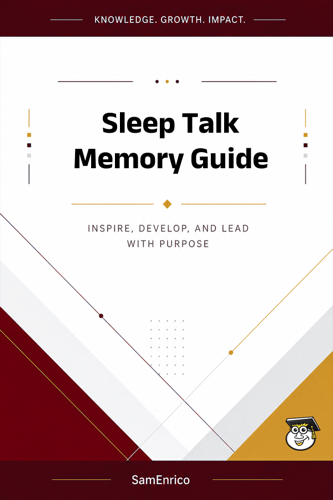
Non-FictionSelf-HelpSleep Learning
Sleep Talk Memory Guide eBook
Uses audio cues during rest.
Uses audio cues during rest.
Formats
Free sample
Chapter 1: The Pillow Paradox...--–- You are about to discover something that most neuroscientists wish their own families understood: the eight hours you spend asleep are not a pause button on learning. They are the main event.Every night, while you lie motionless, your brain performs a feat of data management that would make the world’s best IT team weep with envy. It cleans house, moves files, strengthens connections, and decides what you will remember tomorrow—and what you will forget forever. The catch? Most people have no idea this is happening.
Even worse, most people accidentally sabotage it.This book exists because of a simple, almost embarrassing question: What if you could tell your sleeping brain what to remember?For decades, scientists believed that sleep was a passive state—a time when the brain simply rested, dreaming occasionally as a sort of neurological screensaver. That myth has been shattered. Over the past twenty years, a revolution in sleep science has revealed that your brain is not only active during sleep but in many ways more organized than when you are awake. And the most exciting discovery of all—the one that will change how you think about your pillow—is that you can use sound to guide this process.This is not science fiction. It is not a self-help gimmick.
It is a rigorously studied phenomenon called Targeted Memory Reactivation, or TMR, and it works like this: when you pair a specific sound with a specific memory while you are awake, playing that same sound during deep sleep strengthens that memory. You wake up remembering more. Not vaguely—measurably. In study after study, participants who received audio cues during sleep recalled 20 to 30 percent more information than those who slept in silence.But here is the paradox that gives this chapter its name: the very thing that makes sleep so powerful for memory—the brain’s detachment from the outside world—also makes it fragile. Your sleeping brain is exquisitely sensitive to the wrong kind of stimulation.
A loud noise, a jarring sound, or even a well-intentioned audio cue played at the wrong volume can fragment your sleep and erase the very memories you are trying to strengthen. The same tool that can double your retention can also cut it in half.Understanding this paradox is the first step toward mastering it. And mastering it will change everything about how you learn.The Million-Dollar Misunderstanding Let us start with a confession. For most of human history, sleep was seen as wasted time. Benjamin Franklin famously called it a "thief" that steals precious hours from productive life.
Thomas Edison bragged about sleeping only four hours per night, claiming that sleep was a "heritage from our cave days." The Industrial Revolution turned sleep into a liability—something to be minimized in the pursuit of efficiency.We are still living with that hangover.Today, the average adult sleeps less than seven hours per night, despite every major health organization recommending seven to nine. Students pull all-nighters before exams, believing that extra hours of cramming will offset the lost sleep. Professionals answer emails at 2 AM, treating rest as a luxury rather than a biological necessity. And the self-improvement industry—worth billions of dollars—largely ignores sleep, selling instead brain-training apps, nootropic supplements, and meditation courses that promise to make you smarter while you are awake.Here is the truth those products do not want you to know: no amount of daytime brain training can compensate for poor sleep. None.A 2014 study from the University of California, Berkeley, compared two groups of people learning the same material.
One group studied, slept normally, and was tested the next day. The other group studied, stayed awake all night, and was tested after 24 hours without sleep. The sleep-deprived group remembered 40 percent less than the well-rested group. Forty percent. That is the difference between an A and a failing grade.But here is where it gets interesting.
When the researchers looked at brain scans of the sleep-deprived participants, they found that their hippocampus—the brain’s temporary storage center for new memories—was essentially offline. New information was arriving but could not be filed away. It was like trying to save files to a computer with a corrupted hard drive.This is the million-dollar misunderstanding: we think of sleep as optional recovery time when, in fact, it is mandatory processing time. You do not learn despite sleep. You learn because of sleep.The Midnight Janitor To understand why sleep is so critical for memory, you need to meet a part of your brain you have probably never heard of: the glymphatic system.Discovered only in 2012 by Dr.
Maiken Nedergaard at the University of Rochester, the glymphatic system is your brain’s waste-clearing network. During wakefulness, your brain produces metabolic debris—including beta-amyloid, the protein associated with Alzheimer’s disease—as a byproduct of normal neural activity. During deep sleep, the glymphatic system activates, flushing this debris out through cerebrospinal fluid. In fact, the flow of fluid through the brain increases by an astounding 60 percent during sleep.Think of it this way: every day, your brain generates garbage. If that garbage is not removed, it accumulates, clogs the system, and impairs function.
Sleep is your brain’s trash pickup day.But the glymphatic system is only part of the story. An even more remarkable process is happening simultaneously: memory consolidation.From Temporary to Permanent Imagine that your memory works like a library with two floors. The ground floor is the hippocampus—fast, flexible, but small. New books (memories) arrive here throughout the day. The problem is that the ground floor has limited shelf space.
If you do not move books to the second floor—the neocortex, which is vast and permanent—new books will eventually be pushed out to make room.Sleep is the elevator between floors.During deep sleep, the hippocampus replays the day’s events at high speed—roughly ten times faster than they actually happened. This replay is not a random replay; it is a deliberate process of selecting which memories are important enough to keep. The brain uses several signals to make this decision: emotional intensity, repetition, novelty, and—most relevant to this book—the presence of associated cues.This is where audio cues enter the picture. When you pair a sound with a memory while awake, that sound becomes a key. During sleep, playing that key unlocks the replay process, telling the brain, "This memory matters.
Keep it."The results are dramatic. In a landmark 2009 study led by Dr. John Rudoy at Northwestern University, participants learned the locations of several objects on a computer screen. Each object was paired with a unique sound (a meow for a cat, a bell for a teapot). After learning, participants took a nap while the sounds were played softly during deep sleep.
When they woke up, their recall of the object locations was significantly better than participants who slept without the sounds. The improvement was not subtle—it was a full 20 to 30 percent.The Fragile Night Now we arrive at the paradox. If sleep is so powerful and audio cues so effective, why isn’t everyone doing this?…
This is the end of the free sample. Get the eBook to keep going. Buy now
About this book
Details
- Author
- Gaither Weldon
- Publisher
- SamEnrico
- Language
- English
- Genre
- Non-Fiction, Self-Help, Sleep Learning
- Released
- 2026-06-07
- Pages (approx.)
- 124
- Available as
- eBook, Audiobook

Read better in the ZLOADR app
Your eBooks on your phone or tablet. Sign in with your SamEnrico account and start reading.
More by Gaither Weldon
 KPI Selection RemoteGaither Weldon$11.99
 The Mayor's Bike Lane WarGaither Weldon$11.99
 LGBTQ Child Parenting Stress GuideGaither Weldon$11.99
 Coping With Utility Shutoff NoticesGaither Weldon$11.99
 Microbiome Diet ProtocolGaither Weldon$11.99
 Alibaba Shipping Terms GuideGaither Weldon$11.99
 Thyroid MeditationGaither Weldon$11.99
 The Star Mappers of Meroë: Kush’s Astronomical LegacyGaither Weldon$11.99
 The Stanford Prison Experiment: Beyond the LabGaither Weldon$11.99
 Silk and Shadows: The Fall of the Medici BankGaither Weldon$11.99
 How to Start a Fabrics (wholesale) Business (Beginners Guide)Gaither Weldon$11.99
 Growing GalegaGaither Weldon$11.99
You may also like
 Hong Kong Handover 1997Dunn Johnnie$11.99
 Zumba For Postnatal Recovery CourseNeal Christian$11.99
 Zumba for BeginnersLadner Nikia$11.99
 YouTube Comment Mining GuideHumes Pandora$12.99
 Worry Box MeditationCarlin Rudy$11.99
 Workplace Stress MeditationNguyen Lynn$11.99
 Workplace Stress and Sleep RepairHawley Ivory$11.99
 Workplace Perfectionism CureDelaney Jeffry$11.99
 Workplace Injustice Anger GuideWallen Isabelle$11.99
 Work Addiction and Burnout LinkGreenwood Ester$11.99
 Women in Yoga and WellnessBeattie Galina$11.99
 Women in Stand Up ComedyChun Evangeline$11.99