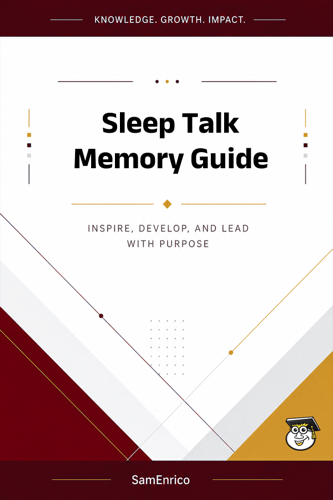
Sleep Talk Memory Guide
Uses audio cues during rest.
Uses audio cues during rest.
Formats
About this book
Free sample
Chapter 1: The Pillow Paradox...--–- You are about to discover something that most neuroscientists wish their own families understood: the eight hours you spend asleep are not a pause button on learning. They are the main event.Every night, while you lie motionless, your brain performs a feat of data management that would make the world’s best IT team weep with envy. It cleans house, moves files, strengthens connections, and decides what you will remember tomorrow—and what you will forget forever. The catch? Most people have no idea this is happening.
Even worse, most people accidentally sabotage it.This book exists because of a simple, almost embarrassing question: What if you could tell your sleeping brain what to remember?For decades, scientists believed that sleep was a passive state—a time when the brain simply rested, dreaming occasionally as a sort of neurological screensaver. That myth has been shattered. Over the past twenty years, a revolution in sleep science has revealed that your brain is not only active during sleep but in many ways more organized than when you are awake. And the most exciting discovery of all—the one that will change how you think about your pillow—is that you can use sound to guide this process.This is not science fiction. It is not a self-help gimmick.
It is a rigorously studied phenomenon called Targeted Memory Reactivation, or TMR, and it works like this: when you pair a specific sound with a specific memory while you are awake, playing that same sound during deep sleep strengthens that memory. You wake up remembering more. Not vaguely—measurably. In study after study, participants who received audio cues during sleep recalled 20 to 30 percent more information than those who slept in silence.But here is the paradox that gives this chapter its name: the very thing that makes sleep so powerful for memory—the brain’s detachment from the outside world—also makes it fragile. Your sleeping brain is exquisitely sensitive to the wrong kind of stimulation.
A loud noise, a jarring sound, or even a well-intentioned audio cue played at the wrong volume can fragment your…
This is the end of the free sample. Get the eBook to keep going. Buy now
Contents
- Chapter 1
- Chapter 2
- Chapter 3
- Chapter 4
- Chapter 5
- Chapter 6
- Chapter 7
- Chapter 8
- Chapter 9
- Chapter 10
- Chapter 11
- Chapter 12
Details
- Author
- Gaither Weldon
- Publisher
- SamEnrico
- Language
- English
- Genre
- Non-Fiction, Self-Help, Sleep Learning
- Released
- 2026-06-07
- Pages (approx.)
- 124
- Available as
- eBook, Audiobook

Read better in the ZLOADR app
Your eBooks on your phone or tablet. Sign in with your SamEnrico account and start reading.
More by Gaither Weldon
 KPI Selection RemoteGaither Weldon$11.99
 The Mayor's Bike Lane WarGaither Weldon$11.99
 LGBTQ Child Parenting Stress GuideGaither Weldon$11.99
 Coping With Utility Shutoff NoticesGaither Weldon$11.99
 Microbiome Diet ProtocolGaither Weldon$11.99
 Alibaba Shipping Terms GuideGaither Weldon$11.99
 Thyroid MeditationGaither Weldon$11.99
 The Star Mappers of Meroë: Kush’s Astronomical LegacyGaither Weldon$11.99
 The Stanford Prison Experiment: Beyond the LabGaither Weldon$11.99
 Silk and Shadows: The Fall of the Medici BankGaither Weldon$11.99
 How to Start a Fabrics (wholesale) Business (Beginners Guide)Gaither Weldon$11.99
 Growing GalegaGaither Weldon$11.99