
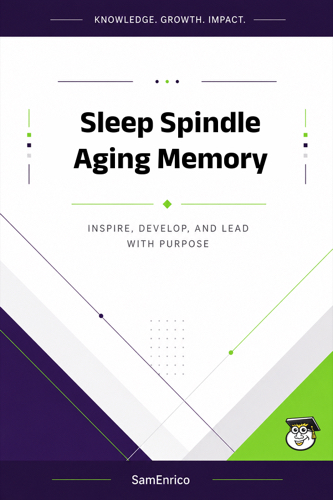
Non-FictionSelf-HelpCognitive Aging
Sleep Spindle Aging Memory Audiobook
Preserve cognitive function in older adults throug
Preserve cognitive function in older adults through spindle optimization.
Formats
Free sample
Chapter 1: The Midnight Librarian--–- You have never seen your brain’s night shift. And that is precisely the problem.Every evening, while you brush your teeth, set your alarm, and pull up the covers, an invisible workforce stirs to life inside your skull. This workforce does not clock in at a factory or an office. It operates in the dark, silent, and utterly beyond your conscious awareness. Its job is not to keep your heart beating or your lungs breathing—those tasks belong to other, better-known crews.
This particular night shift has a far more delicate assignment: it sorts, files, and sometimes discards the thousands of memories you generated during the day.Most people imagine memory as a library where books are simply placed on shelves and stay there. That is a comforting fiction. In reality, your brain’s memory system is more like a busy urban post office at holiday peak. Incoming parcels—the day’s experiences, conversations, facts, skills, and emotions—arrive in a chaotic flood. They must be sorted, addressed, redirected, and eventually shipped to long-term storage.
If this process fails, the parcels get lost. You forget where you put your keys. You cannot recall the name of someone you met yesterday. You lose the muscle memory for a golf swing you practiced all afternoon. The parcels pile up, undelivered, while you sleep.The foreman of this overnight postal operation is a tiny, little-known brainwave event called the sleep spindle.If you have never heard of sleep spindles, you are in excellent company.
Until roughly twenty years ago, even most neuroscientists regarded them as neurological curiosities—pretty squiggles on an EEG readout, perhaps, but nothing more. They appear as brief bursts of oscillating electrical activity, typically lasting between half a second and two seconds, with a frequency of approximately 11 to 16 Hertz. They emerge predominantly during a phase of sleep called NREM2 (non-rapid eye movement stage 2), which occupies about 45 to 55 percent of a healthy adult’s total sleep time. For decades, the textbooks dismissed spindles as byproducts of the thalamus’s natural pacemaker rhythm, like the idle hum of a car engine at a stoplight—present, measurable, but functionally uninteresting.But science has a way of humbling its assumptions. Over the past two decades—and accelerating dramatically in the last five years—research has revealed that sleep spindles are not idle hums at all.
They are the brain’s active filing mechanism. They are the librarians who decide which books stay in the temporary bin…
This is the end of the free sample. Get the Audiobook to keep going. Buy now
About this book
Details
- Author
- Dockery Elfreda
- Publisher
- SamEnrico
- Language
- English
- Genre
- Non-Fiction, Self-Help, Cognitive Aging
- Released
- 2026-06-09
- Pages (approx.)
- 158
- Available as
- eBook, Audiobook

Listen in the VoxFlicks app
Audiobooks and audio dramas wherever you go. Sign in with your SamEnrico account and press play.
More by Dockery Elfreda
 Imposter Syndrome Recovery CourseDockery Elfreda$11.99
 Working Memory Journal LogDockery Elfreda$11.99
 Second Generation EntrepreneurshipDockery Elfreda$11.99
 Low Income Subscription ChurnDockery Elfreda$11.99
 The Two Minute Distraction RuleDockery Elfreda$11.99
 Dividend Portfolio GuideDockery Elfreda$11.99
 Process Analysis Essay PromptsDockery Elfreda$12.99
 Paleo For Families WorkbookDockery Elfreda$11.99
 The Phantom of the Danube: Vienna’s Vanishing Heiress (1934)Dockery Elfreda$11.99
 Love and Siege: The Fall of Constantinople's Last DefendersDockery Elfreda$11.99
 Understanding FaintingDockery Elfreda$11.99
 How to Become a Marine EngineerDockery Elfreda$11.99
You may also like
 Hong Kong Handover 1997Dunn Johnnie$11.99
 Zumba For Postnatal Recovery CourseNeal Christian$11.99
 Zumba for BeginnersLadner Nikia$11.99
 YouTube Comment Mining GuideHumes Pandora$12.99
 Worry Box MeditationCarlin Rudy$11.99
 Workplace Stress MeditationNguyen Lynn$11.99
 Workplace Stress and Sleep RepairHawley Ivory$11.99
 Workplace Perfectionism CureDelaney Jeffry$11.99
 Workplace Injustice Anger GuideWallen Isabelle$11.99
 Work Addiction and Burnout LinkGreenwood Ester$11.99
 Women in Yoga and WellnessBeattie Galina$11.99
 Women in Stand Up ComedyChun Evangeline$11.99