
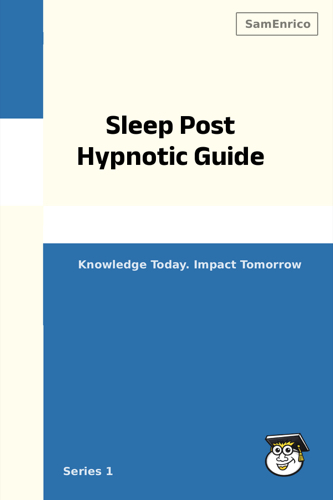
Sleep Post Hypnotic Guide eBook
Suggestions that activate automatically when you l
Suggestions that activate automatically when you lie down for rest.
Formats
Free sample
Chapter 1: The 3AM Prison--–- The clock on your nightstand reads 3:14 AM. You’ve been awake for forty-seven minutes. Your mind is not wandering—it is sprinting. A conversation from work six years ago is playing on loop. Tomorrow’s to-do list has transformed into a horror movie.
Your body is exhausted, heavy as concrete, but your brain is a pinball machine of catastrophic what-ifs. You’ve tried counting breaths, reciting mantras, even the old trick of naming every capital city you can remember. Nothing works. You are trapped in the 3AM prison, and the only escape is to wait for dawn, function on fumes, and do it all again tonight.If this sounds familiar, you are not broken. You are not weak-willed.
And you do not have a sleep disorder that requires medication for the rest of your life. You have, instead, a very specific wiring problem—one that your brain learned, practiced, and perfected over months or years. The good news is that what can be learned can be unlearned. The better news is that the unlearning process does not require willpower, meditation apps, or another exhausting sleep hygiene checklist.This book introduces a radically different approach: post-hypnotic sleep automation. You will learn to program your subconscious mind so that the mere act of lying down becomes an automatic trigger for deep, restorative rest.
No effort. No counting. No trying. Just an off-switch that your brain flips without asking for your permission.But before we get to the solution, we must understand the cage. And the key to understanding the cage is a single, uncomfortable truth: you have been trying too hard, and that trying is exactly what has been keeping you awake.The Performance Paradox of Sleep Imagine being told that you must fall in love within the next eight minutes.
Not gradually, not naturally—on command. The pressure alone would make genuine connection impossible. Sleep operates under the same cruel logic. The moment you declare “I must sleep now,” your brain interprets that command as a threat. Threat activates arousal.
Arousal releases cortisol and adrenaline. Cortisol and adrenaline are chemically incompatible with sleep. You are now awake because you demanded otherwise.This is the Performance Paradox of Sleep: the more effort you invest, the less sleep you receive. Your insomnia is not a failure of effort. It is a predictable consequence of effort applied to a biological process that evolved to unfold automatically, behind the scenes, like digestion or breathing.Consider your breath for a moment.
Right now, you are breathing without conscious control. But if I asked you to take exactly fourteen perfect breaths per minute, to monitor each inhalation, to critique each exhalation—you would suddenly become breathless, awkward, and anxious. Sleep works the same way. Your subconscious mind knows exactly how to sleep. It has done so successfully for thousands of nights.
The problem is that your conscious mind has hijacked the controls and refuses to let go.The Alarm Clock Mind: Proof That Automation Exists Here is the most important concept in this book, one that will reframe everything you believe about your sleep problem.Think about the last time you needed to wake up at an unusual hour—say, 4:45 AM for an early flight. You set an alarm, of course. But what happened? You woke up at 4:43 AM, two minutes before the alarm sounded. This has happened to most adults at least a dozen times.
It is not coincidence. It is not luck. It is a demonstration of your Alarm Clock Mind.Your subconscious mind possesses a near-perfect internal clock. It can track the passage of time without any conscious input. More importantly, it can execute complex commands—like “wake up at this precise moment”—without your conscious awareness or effort.
You do not lie in bed repeating “wake at 4:45” like a mantra. You simply decide, and your subconscious handles the rest.Now consider the logical extension of this ability. If your subconscious can be programmed to wake you at a specific time, why can it not be programmed to put you to sleep the moment your head touches the pillow? Why can it not be programmed to return you to sleep within ninety seconds of a nighttime awakening? Why can it not be programmed to deepen your sleep cycles automatically?The answer is that it can.
It absolutely can. You have simply never been taught the correct programming language.What Post-Hypnotic Sleep Automation Actually Means The term “hypnosis” conjures images of swinging pocket watches, stage performers making volunteers cluck like chickens, and a loss of control. That is entertainment hypnosis. Therapeutic hypnosis—and specifically post-hypnotic suggestion—is something else entirely.Post-hypnotic suggestion is a simple mechanism: a suggestion is implanted in the subconscious mind during a state of focused relaxation. That suggestion is paired with a specific trigger.
Later, when the trigger occurs, the suggestion activates automatically, without conscious deliberation or effort.In this book, the trigger is the physical act of lying down for rest. Specifically, the moment your head contacts the pillow and your body assumes a supine position (on your back, or your preferred sleep posture). The suggestions are various sleep-inducing commands: relaxation, heaviness, slowed breathing, reduced heart rate, visualizations of darkness, and ultimately, the onset of sleep.Here is what post-hypnotic sleep automation is not:It is not mind control. You remain fully aware and in control of your choices.It is not magical thinking. It is a well-documented neurological phenomenon studied for over a century.It is not a substitute for treating underlying medical conditions (sleep apnea, restless leg syndrome, severe trauma).
Those require medical attention, which you should seek if suspected.Here is what it is:A conditioning process similar to how Pavlov’s dogs learned to salivate at a bell.A method to transfer control of sleep from your anxious conscious mind to your capable subconscious mind.A skill that you will learn, practice, and eventually perform automatically.Why Your Sleep Hygiene Checklist Failed You By now, you have likely tried the standard recommendations. You have bought blackout curtains. You have installed blue-light-blocking apps. You have avoided caffeine after noon. You have taken melatonin, magnesium, glycine, and a dozen other supplements recommended by wellness influencers.
You have tried white noise, pink noise, brown noise, and the sound of rain on a tin roof.None of it worked. Or it worked for three nights and then stopped.Why? Because sleep hygiene treats the environment and ignores the programmer. You can have the perfect bedroom—cool, dark, silent—and still lie awake for hours because your brain has been conditioned to associate the bed with frustration, vigilance, and performance anxiety. The problem is not the room.
The problem is the script running in your subconscious.Think of your brain as a computer. Sleep hygiene adjusts the physical conditions—the temperature of the room, the brightness of the screen. But the operating system remains corrupted. Every time you lie down, the corrupted OS runs a background process called “Will I sleep tonight?” That process consumes massive mental resources, generates anxiety, and prevents the shutdown sequence from initiating.Post-hypnotic sleep automation rewrites the operating system. It does not just change…
This is the end of the free sample. Get the eBook to keep going. Buy now
About this book
Details
- Author
- Simonson Pattie
- Publisher
- SamEnrico
- Language
- English
- Genre
- Non-Fiction, Self-Help, Sleep
- Released
- 2026-06-09
- Pages (approx.)
- 133
- Available as
- eBook, Audiobook

Read better in the ZLOADR app
Your eBooks on your phone or tablet. Sign in with your SamEnrico account and start reading.
More by Simonson Pattie
 PCOS Partner Support GuideSimonson Pattie$11.99
 Famous TM Practitioners GuideSimonson Pattie$11.99
 Peterson Fresno Search Voluminous TipsSimonson Pattie$11.99
 The Senior Digital Asset GuideSimonson Pattie$11.99
 The Silk & Shadow: How 18th-Century Fashion Photographers Lit Up EuropeSimonson Pattie$11.99
 Bulk Domain Registration GuideSimonson Pattie$12.99
 Northrop Grumman GuideSimonson Pattie$12.99
 Onboarding SpecialistSimonson Pattie$11.99
 How to Become a Spreader ISimonson Pattie$11.99
 Understanding Pelizaeus–merzbacher LeukodystrophySimonson Pattie$17.99
You may also like
 Sleep Meditation For PainOakes Earnestine$11.99
 The MBSR for Insomnia WorkbookCoker Bret$11.99
 Spending Addiction and InsomniaBrooks Marco$11.99
 Sleep Log ReviewMontoya Latesha$11.99
 Sleep Anxiety Affirmations GuideBergman Norene$11.99
 Senior Sleep ConfidenceFinch Keshia$11.99
 Parental Insomnia SolutionsMorrow Taryn$11.99
 Breath Awareness for InsomniaHefner Sheilah$11.99
 Bedtime Letting Go Breath GuideDwyer Beula$11.99
 TM for Insomnia ReliefShipley Nanci$11.99
 The Parent Anger Sleep GuideDietz Tosha$11.99
 The Sleep and Memory GuideGalvez Jamar$11.99