
Non-FictionMental WealthSleepPreparation
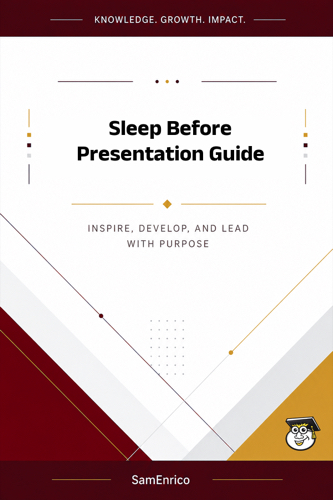
Sleep Before Presentation Guide eBook
Optimize rest the night before speaking for peak c
Optimize rest the night before speaking for peak cognitive performance.
Formats
Free sample
Chapter 1: The 3:00 AM Spiral--It is 3:00 in the morning. You are not asleep.You have been lying here for what feels like hours, though your phone—which you have checked three times despite knowing better—reads 3:04. The presentation is in six hours. Your heart is hammering against your ribcage. Your mind is not thinking about your opening slide or your closing statistic or even the difficult question you anticipate from the audience.
Your mind is doing something far more destructive.Your mind is telling you that you are not ready. That you have never been ready. That everyone will see through you. That you will stand in front of those people—colleagues, clients, strangers, people whose opinions matter to you—and your voice will crack, your hands will shake, your carefully rehearsed words will vanish like smoke, and you will be exposed as exactly what you fear you are: a fraud.And then, because your brain is cruel at 3:00 AM, it adds the final twist. You realize that you are awake.
You are lying here, awake, while the clock ticks toward sunrise. And now you know—with the absolute certainty that only sleep deprivation can provide—that even if you were prepared, you have ruined it. You haven't slept. You will be exhausted. The exhaustion will make you forget.
The forgetting will make you fail. The failure will define you.This is the 3:00 AM spiral. And if you have ever had a high-stakes presentation, a job interview, an important exam, a first date, a championship game, or any moment that mattered to you, you know exactly what it feels like.Here is what no one tells you: the night before your presentation is not a passive void between practice and performance. It is not a waiting room. It is not a rest period before the real work begins.
The night before your presentation is, in fact, the most active cognitive rehearsal you will ever do. And whether you sleep or not, your brain is working.The question is: will you work with it, or against it?The Myth of Cramming Let us begin with a lie that nearly every high-achiever believes. The lie is this: the more you practice, the better you will perform. This seems self-evident. It is the foundation of everything we have been taught about preparation.
If you want to be good at something, you practice. If you want to be great, you practice more. And if you have a critical presentation tomorrow morning, you should practice until you cannot keep your eyes open, and then you should practice some more.This is wrong.Not slightly wrong. Not oversimplified. Fundamentally, neurologically, counterproductively wrong.The problem is not with practice itself.
Practice is essential. The problem is with the timing of practice relative to sleep. Here is what happens when you rehearse your presentation at 10:00 PM, or 11:00 PM, or—God help you—midnight. Your brain takes the information you are practicing and stores it in a region called the hippocampus. The hippocampus is like a temporary holding tank.
It is fast, flexible, and useful, but it has a critical limitation: it has very little capacity. Think of it as a whiteboard. You can write on it, erase it, rewrite it, but if you keep writing without ever transferring the information somewhere else, the whiteboard fills up, and new information pushes out old information.The transfer of information from the hippocampus to long-term storage happens during sleep. Specifically, it happens during a stage of sleep called slow-wave sleep—deep, dreamless rest. During slow-wave sleep, your brain replays the events of the day, identifies which information is important, and moves that information from the temporary whiteboard of the hippocampus to the permanent storage of the cortex.
The cortex is enormous. It is the hard drive. Once information reaches the cortex, it is not easily lost.Here is the cruel irony. When you cram at midnight, you are filling your hippocampus with information. But you are not giving your brain the opportunity to transfer that information to the cortex.
So when you wake up in the morning, that information is still sitting in the temporary holding tank. And what happens to information in the hippocampus during the day? It gets overwritten. By breakfast. By the commute.
By the small talk in the hallway. By the very anxiety that is now coursing through your veins.The person who practices until midnight and sleeps four hours has, in a very real sense, practiced for nothing. The information never made it to long-term storage. The person who stops practicing at 7:00 PM and sleeps seven hours has transferred that practice to the cortex. They have less practice, but more retention.This is the first law of the Last Night: sleep is not rest from practice.
Sleep is practice.The Sleep-Cortisol Seesaw Now let us talk about cortisol. You have heard of cortisol. It is the stress hormone. It is released by your adrenal glands in response to threat, real or imagined. Cortisol is not evil.
It is essential. It sharpens your senses, mobilizes glucose, and prepares your body for action. Without cortisol, you would not have the energy to run from danger or confront a challenge.But cortisol has a dark side. Cortisol and sleep exist in a seesaw relationship. When cortisol is high, sleep is difficult.
When sleep is insufficient, cortisol rises. And when cortisol rises, sleep becomes even more difficult. This is the Sleep-Cortisol Seesaw, and it is the reason that one bad night often leads to another, which leads to another, which leads to a week of exhaustion and a presentation that feels like a death march.Here is the specific mechanism. Your body follows a circadian rhythm, a 24-hour internal clock that regulates when you feel alert and when you feel sleepy. Cortisol follows this rhythm: it peaks in the early morning, around 8:00 AM, to help you wake up, and it bottoms out in the late evening, around 10:00 PM, to allow sleep to begin.
That evening drop in cortisol is not optional. It is a prerequisite for sleep onset. Your brain will not allow you to fall asleep if your cortisol is too high.When you have a presentation the next day, your body perceives a threat. Not a physical threat—there is no predator chasing you—but a social threat, which your brain treats almost identically. Your amygdala, the brain's threat-detection center, activates.
It signals your hypothalamus. Your hypothalamus signals your pituitary gland. Your pituitary gland signals your adrenal glands. And your adrenal glands release cortisol.This is the pre-presentation cortisol spike. It is natural.
It is evolutionarily conserved. It is the reason your ancestors survived public gatherings where social rejection meant exclusion from the group and exclusion from the group meant death. Your body does not know the difference between a tribal council and a boardroom. It only knows that many eyes are watching, and that is dangerous.The problem is that this cortisol spike often happens before you go to bed. You lie there, thinking about tomorrow, and your amygdala keeps firing.
Your cortisol stays high. Your brain refuses to initiate sleep. You become frustrated. Frustration is also a stressor, so your…
This is the end of the free sample. Get the eBook to keep going. Buy now
About this book
Details
- Author
- Doughty Laquita
- Publisher
- SamEnrico
- Language
- English
- Genre
- Non-Fiction, Mental Wealth, Sleep, Preparation
- Released
- 2026-06-09
- Pages (approx.)
- 134
- Available as
- eBook, Audiobook

Read better in the ZLOADR app
Your eBooks on your phone or tablet. Sign in with your SamEnrico account and start reading.
More by Doughty Laquita
 The Iron Deficiency Anemia GuideDoughty Laquita$11.99
 Divorce Journal WorkbookDoughty Laquita$11.99
 The Teen Resilience HandbookDoughty Laquita$11.99
 Anger After WhistleblowingDoughty Laquita$11.99
 The Scandal of the Century: The Impeachment of President Andrew Johnson and the Love Triangle That Shook WashingtonDoughty Laquita$11.99
 Buttercup Chicken BreedingDoughty Laquita$11.99
 A Beginners Guide to English billiards (Volume 1)Doughty Laquita$11.99
 YouTube Storytelling for BrandsDoughty Laquita$12.99
 Sustainable Travel Spending GuideDoughty Laquita$12.99
 Understanding Polydactyly Visceral Anomalies Cleft Lip PalateDoughty Laquita$17.99
You may also like
 Hong Kong Handover 1997Dunn Johnnie$11.99
 Zumba For Postnatal Recovery CourseNeal Christian$11.99
 Zumba for BeginnersLadner Nikia$11.99
 YouTube Comment Mining GuideHumes Pandora$12.99
 Worry Box MeditationCarlin Rudy$11.99
 Workplace Stress MeditationNguyen Lynn$11.99
 Workplace Stress and Sleep RepairHawley Ivory$11.99
 Workplace Perfectionism CureDelaney Jeffry$11.99
 Workplace Injustice Anger GuideWallen Isabelle$11.99
 Work Addiction and Burnout LinkGreenwood Ester$11.99
 Women in Yoga and WellnessBeattie Galina$11.99
 Women in Stand Up ComedyChun Evangeline$11.99