
Non-FictionSelf-HelpFocus Improvement
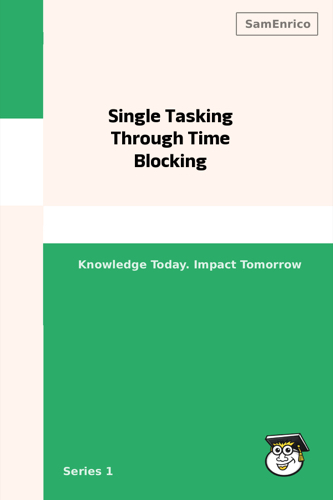
Single Tasking Through Time Blocking eBook
Eliminate multitasking by dedicating blocks to sin
Eliminate multitasking by dedicating blocks to single activities.
Formats
Free sample
Chapter 1: The Distraction Machine--You are not lazy. You are not undisciplined. And you are certainly not alone in your inability to focus.Let me say that again, because most productivity books begin by subtly blaming you. They imply that if you just tried harder, woke up earlier, or deleted more apps, you would finally become the laser-focused warrior you were meant to be. That is not only unhelpful—it is false.The truth is far more uncomfortable: your brain is behaving exactly as it was designed to behave in the environment you have placed it in.
And that environment has been engineered, by some of the smartest people in the world, to keep you distracted.Welcome to the attention economy. This chapter is going to make you uncomfortable. It will show you that your struggle to focus is not a personal failing but a predictable response to a world designed for fragmentation. And by the end, you will understand why willpower alone will never be enough—and what actually works instead.The Slot Machine in Your Pocket Imagine a slot machine. The lights flash, the reels spin, and every so often—just often enough to keep you hooked—you win.
The uncertainty is what makes it addictive. If you won every single time, you would get bored. If you never won, you would walk away. But the variable reward—the maybe this time—is neurologically irresistible.Now look at your phone.Every time you pull it out of your pocket, you are pulling the lever on a slot machine. Did you get a notification?
A like? A message from someone you care about? Maybe. Maybe not. But you will not know until you check.
That uncertainty triggers a dopamine release in your brain's reward centers. Dopamine is not the chemical of pleasure; it is the chemical of anticipation. It is what keeps you pulling the lever.The engineers who built your phone’s operating system, your social media apps, and your email client know this. They studied the same behavioral psychology that made slot machines profitable. They learned that variable rewards produce the highest rates of engagement.
They learned that notifications—even useless ones—hijack the brain's orienting response, a primitive mechanism that automatically directs your attention toward novelty because, on the savanna, a new sound might be a predator or a meal.You cannot ignore a notification any more than your ancestors could ignore a rustle in the bushes. That is not a character flaw. That is 200,000 years of evolution being exploited by a piece of software.The Dopamine Loop of Busyness Here is where it gets especially insidious. Checking your email, scrolling through Slack, or glancing at social media feels productive. You are doing something.
Your fingers are moving. Messages are being processed. Tasks are being triaged. The loop goes like this:You feel a twinge of anxiety or boredom.You check a communication channel.You see something new (even if trivial).The anxiety briefly subsides.Repeat every three to five minutes.This is what I call the dopamine loop of busyness. It rewards action, not accomplishment.
It confuses motion with progress. And it is the single greatest enemy of single-tasking because it trains your brain to crave the switch itself.Let me prove it to you.The 5-Day Attention Audit Before we go any further, you need data. Not theories, not feelings—actual numbers about how you spend your attention. For the next five days, you are going to complete the Attention Audit. This is a single integrated exercise that combines two kinds of tracking: task-switch logging and activity logging.Here is how it works.Days 1 through 3: Track every task switch.Get a small notepad or open a blank document.
For three full days, every single time you switch from one activity to another, make a tally mark. That means:– Moving from email to a document? That is a switch.– Answering a Slack message then returning to your report? Two switches (one away, one back).– Checking your phone while on a call? That is a switch.– Looking up from your work because a colleague asked a question?
That is a switch.Do not judge yourself. Do not try to change your behavior. Just track. At the end of each day, count your total switches and calculate your average time between switches. Most people discover they switch every two to four minutes.
Some switch every 45 seconds.Days 4 and 5: Log every activity in 30-minute increments.Now you need to know what you are doing between those switches. Using the Attention Audit Template (see Appendix B), divide your waking work hours into 30-minute blocks. For each block, write down:– The primary activity (e.g., "drafting email response to client")– Any interruptions that occurred– A value rating: High (directly advances a top goal), Medium (necessary but not strategic), or Low (could be eliminated or delegated)At the end of Day 5, you will have a complete map of how you actually spend your time—not how you think you spend it.What the Audit Reveals I have guided hundreds of professionals through this audit. The results are remarkably consistent, regardless of industry or seniority. Here is what most people discover.First, the frequency of switching is horrifying.
The average knowledge worker switches tasks every three minutes. That means in an eight-hour day, they switch roughly 160 times. Each switch carries a task-switching penalty of up to 40% of productive time. Do the math: 160 switches at, say, 30 seconds of lost time per switch equals 80 minutes of pure overhead before you have done any actual work. That is an entire lunch break gone.
Every day.Second, high-value work gets the smallest share. Most participants find that less than 30% of their logged 30-minute blocks are rated High value. The remaining 70% is consumed by email, meetings, administrative tasks, and the switching itself. In other words, you spend most of your day being busy without being productive.Third, the interrupters follow predictable patterns. When you track interruptions, patterns emerge.
Maybe every day at 10:15 AM, Slack pings with a standup update. Maybe every afternoon around 2 PM, a specific colleague drops by your desk. Maybe you check your phone every time you finish a paragraph because your brain has learned that finishing is a cue to seek a reward. These patterns are not random. They are learned loops—and they can be unlearned.The Open Office Disaster Before we talk about solutions, we need to name another culprit: the modern open office.
In theory, open offices encourage collaboration and transparency. In practice, they are attention-fragmentation machines.Research from the University of California, Irvine found that it takes an average of 23 minutes and 15 seconds to fully return to a task after an interruption. Not two minutes. Not five. Twenty-three minutes.
That is because of attentional residue—a concept we will explore in depth in Chapter 2. When you are interrupted, a piece of your brain stays stuck on whatever you were just doing while simultaneously trying to process the interruption and then find your place again.Open offices create constant, low-grade interruptions. A conversation two desks over. Someone walking past your peripheral vision. The phone ringing across the room.
Each of these micro-interruptions might last only a few seconds, but each one steals a piece of your attention and…
This is the end of the free sample. Get the eBook to keep going. Buy now
About this book
Details
- Author
- Arrington Karon
- Publisher
- SamEnrico
- Language
- English
- Genre
- Non-Fiction, Self-Help, Focus Improvement
- Released
- 2026-06-08
- Pages (approx.)
- 129
- Available as
- eBook, Audiobook

Read better in the ZLOADR app
Your eBooks on your phone or tablet. Sign in with your SamEnrico account and start reading.
More by Arrington Karon
 Interpol CooperationArrington Karon$11.99
 BED Support GroupsArrington Karon$11.99
 Body Scan for Post SurgeryArrington Karon$11.99
 Emotional Reasoning in AngerArrington Karon$11.99
 Atomic Habits For Public PledgeArrington Karon$11.99
 Korean Dry Cleaner Success StoryArrington Karon$11.99
 Body Peg System GuideArrington Karon$11.99
 The Nobel Laureates of Black Genius: Pioneers in Science and DiscoveryArrington Karon$11.99
 The Midnight Lanterns: Harriet Tubman’s Secret Routes RevealedArrington Karon$11.99
 Growing Calodendrum (Cape Chestnut)Arrington Karon$11.99
 How to Produce Air Purifier PartsArrington Karon$11.99
 US LLC for Non Resident DropshippersArrington Karon$12.99
You may also like
 Hong Kong Handover 1997Dunn Johnnie$11.99
 Zumba For Postnatal Recovery CourseNeal Christian$11.99
 Zumba for BeginnersLadner Nikia$11.99
 YouTube Comment Mining GuideHumes Pandora$12.99
 Worry Box MeditationCarlin Rudy$11.99
 Workplace Stress MeditationNguyen Lynn$11.99
 Workplace Stress and Sleep RepairHawley Ivory$11.99
 Workplace Perfectionism CureDelaney Jeffry$11.99
 Workplace Injustice Anger GuideWallen Isabelle$11.99
 Work Addiction and Burnout LinkGreenwood Ester$11.99
 Women in Yoga and WellnessBeattie Galina$11.99
 Women in Stand Up ComedyChun Evangeline$11.99