
Non-FictionSelf-HelpIdea Generation
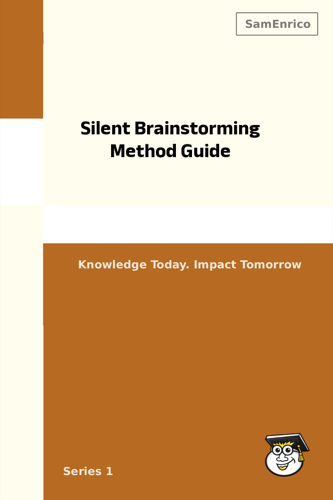
Silent Brainstorming Method Guide eBook
Generate more ideas with less social pressure usin
by Kuhn Yukiko
Generate more ideas with less social pressure using this group creativity technique workbook.
Formats
Free sample
Chapter 1: The Meeting That Killed Innovation--–- Maria had been with the company for eleven years. She knew the product inside and out, had survived three reorgs, and had been named Employee of the Month twice. But on a Tuesday afternoon in March, sitting in a conference room with twelve of her colleagues, she did something she had never done before: she completely checked out.The agenda said "Brainstorming Session: Q3 Innovation Priorities." The facilitator, a well-meaning director named Paul, had printed the rules on a flip chart: defer judgment, go for quantity, encourage wild ideas, build on others' ideas. Classic Alex Osborn. Maria had seen these rules at least forty times over her career.For the first ten minutes, she tried.
She really did. She had an idea about customer onboarding that had been percolating for weeks. But every time she opened her mouth, someone else was already speaking. Derek, the senior product manager, had a habit of speaking in paragraphs. He would start an idea, meander through three tangents, and land somewhere far from where he began.
By the time he finished, Maria had forgotten her own thought.Then there was the status problem. The VP of Engineering, a quiet woman named Chen, rarely spoke in meetings. But when she did, everyone listened—and everyone's subsequent ideas magically aligned with whatever Chen had said. It wasn't malicious. It was just human nature.
Chen had budget authority. Chen decided which projects got staffed. So when Chen mentioned "reducing technical debt" as a theme, suddenly every idea on the wall had something to do with technical debt.Maria watched the clock. Ninety minutes. Eleven ideas on the whiteboard.
Nine of them were variations on Derek's original thought or Chen's technical debt theme. Two were from junior team members who spoke so quietly that people had to lean in. Maria's idea never left her head.Three weeks later, a competitor launched a feature that was almost exactly what Maria had been thinking. It was a modest innovation—nothing revolutionary—but it captured a niche market that her company had been ignoring. The competitor's stock jumped 8 percent.
Maria's company held an emergency meeting to ask: "Why didn't we think of that?"Maria knew why. But when she raised her hand to explain, Derek was already talking.This scene plays out every day in thousands of conference rooms around the world. Not because the people involved are stupid or lazy or malicious. They aren't. They are smart, hardworking, well-intentioned professionals who genuinely want to solve problems.
The problem isn't the people. The problem is the process.Alex Osborn, the advertising executive who invented brainstorming in 1953, had good intentions. He wanted to break free from the rigid, hierarchical meeting cultures of mid-century corporate America. His four rules—defer judgment, go for quantity, encourage wild ideas, build on others' ideas—were radical for their time. And for a certain kind of problem, with a certain kind of group, they worked.But here is what Osborn didn't know in 1953: the cognitive psychology of group dynamics.
He didn't have the research from Diehl and Stroebe (1987) showing that verbal brainstorming actually produces fewer ideas than having people work alone. He didn't know about production blocking, evaluation apprehension, social loafing, conformity bias, or free riding. These weren't concepts yet. They were just things that happened in meetings, invisible to the people sitting in them.Now we know. Over the past four decades, researchers have run hundreds of studies comparing verbal brainstorming to silent, written alternatives.
The results are remarkably consistent. Silent methods—brainwriting, the 6-3-5 method, written ideation—consistently outperform verbal brainstorming by margins that should embarrass anyone who still runs traditional brainstorming sessions.Thirty to fifty percent more ideas. Fifteen to twenty-five percent more novel solutions. And here is the kicker: participants in silent sessions enjoy the process more. They feel less anxious, more creative, and more likely to contribute.
The introverts love it. The extroverts learn to love it when they see the results.So why does traditional brainstorming persist?Because it feels productive. The room is loud. People are talking. Ideas are flying.
The energy is high. It feels like creativity. But feeling productive and being productive are not the same thing. A loud room full of talking people is not evidence of innovation. It is evidence of noise.The silent brainstorming method is the opposite of what feels natural.
It asks people to stop talking. It asks them to write. It asks them to work alone, in a group. It is counterintuitive, uncomfortable, and—according to the data—dramatically more effective.This book will teach you the silent brainstorming method. Not as a theory, but as a practice.
You will learn the Basic Silent Sprint (the 10-minute protocol that generates more ideas than a 90-minute verbal session). You will learn the six variations of brainwriting, from the structured 6-3-5 method to the visual Braindrawing technique. You will learn how to cluster ideas without bias, build on ideas without ownership battles, and evaluate ideas without humiliation.But first, you need to understand why traditional brainstorming fails. Not because it's a bad idea, but because it ignores how human brains actually work.The Five Fatal Flaws of Verbal Brainstorming Flaw #1: Production Blocking In any verbal group, only one person can speak at a time. This seems obvious, almost trivial.
But the implications are devastating for creativity.When you are waiting to speak, you are not generating ideas. You are rehearsing, filtering, or forgetting. You are listening to someone else's idea, which may be good or bad, but either way it hijacks your attention. The cognitive cost of switching between listening and thinking is real. Every time the speaker changes, your brain has to shift gears.
By the time it's your turn, the idea you had three minutes ago has either been said by someone else, been judged by your own internal critic, or simply evaporated.Research by Diehl and Stroebe (1987) quantified this. In a 10-minute verbal brainstorming session with six people, the average participant gets only 3 to 5 minutes of actual speaking time. The other 5 to 7 minutes are spent listening, waiting, or being distracted. That is not a brainstorming session. That is a talking session with occasional breaks for thinking.Now compare that to silent brainstorming.
In a 10-minute silent sprint, every participant generates ideas for the entire 10 minutes. No waiting. No listening. No switching costs. The difference is not incremental; it's exponential.
Six people in a verbal session produce, at best, 18-30 minutes of cumulative idea-generation time (3-5 minutes each). Six people in a silent session produce 60 minutes of cumulative idea-generation time. That is a 100 to 200 percent increase in raw thinking time.Production blocking is the primary reason that nominal groups (individuals working alone whose ideas are later combined) outperform real groups. It's not that groups are bad. It's that verbal groups are structurally inefficient.Flaw #2: Evaluation Apprehension Here is a uncomfortable truth: even when facilitators say "no judgment," participants judge themselves and each other.
They can't help it. The human brain is a pattern-recognition machine that constantly evaluates stimuli as threatening or rewarding. A novel idea is ambiguous. Ambiguity is threatening. Threat triggers caution.Evaluation…
This is the end of the free sample. Get the eBook to keep going. Buy now
About this book
Details
- Author
- Kuhn Yukiko
- Publisher
- SamEnrico
- Language
- English
- Genre
- Non-Fiction, Self-Help, Idea Generation
- Released
- 2026-06-06
- Pages (approx.)
- 155
- Available as
- eBook, Audiobook

Read better in the ZLOADR app
Your eBooks on your phone or tablet. Sign in with your SamEnrico account and start reading.
More by Kuhn Yukiko
 Menopause Nightmare GuideKuhn Yukiko$11.99
 Cody Johnson Texas Country GuideKuhn Yukiko$11.99
 The Workaholism And Depression CycleKuhn Yukiko$11.99
 Family Anger Patterns WorkbookKuhn Yukiko$11.99
 Grimnir’s Last Stand: The Troll King of the Northern WastesKuhn Yukiko$11.99
 Frozen Echoes: The Antarctic Forensic Mystery of the Terra Nova ExpeditionKuhn Yukiko$11.99
 How to Start a Bag Clasp Business (Beginners Guide)Kuhn Yukiko$11.99
 Anti-kidnapping DrivingKuhn Yukiko$11.99
 Understanding Frontonasal DysplasiaKuhn Yukiko$17.99
 Shipping Pricing InflationKuhn Yukiko$12.99
 Twitter Odeo Failure GuideKuhn Yukiko$12.99
You may also like
 Hong Kong Handover 1997Dunn Johnnie$11.99
 Zumba For Postnatal Recovery CourseNeal Christian$11.99
 Zumba for BeginnersLadner Nikia$11.99
 YouTube Comment Mining GuideHumes Pandora$12.99
 Worry Box MeditationCarlin Rudy$11.99
 Workplace Stress MeditationNguyen Lynn$11.99
 Workplace Stress and Sleep RepairHawley Ivory$11.99
 Workplace Perfectionism CureDelaney Jeffry$11.99
 Workplace Injustice Anger GuideWallen Isabelle$11.99
 Work Addiction and Burnout LinkGreenwood Ester$11.99
 Women in Yoga and WellnessBeattie Galina$11.99
 Women in Stand Up ComedyChun Evangeline$11.99