
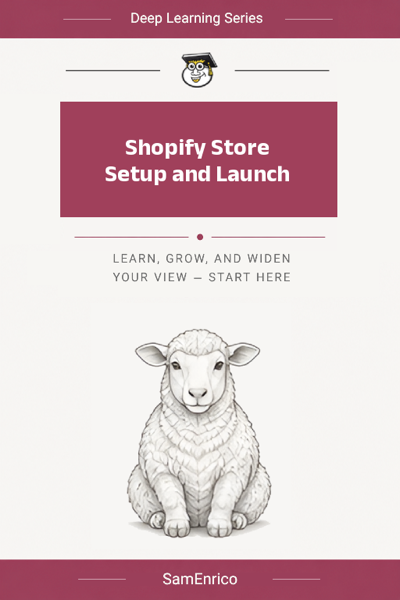
Non-FictionInformativeEducational
Shopify Store Setup and Launch eBook
A Coursebook on Shopify Store Setup and Launch
A Coursebook on Shopify Store Setup and Launch
Formats
Free sample
Chapter 1: The Rent Trap...--Most entrepreneurs discover the hard way that they don't actually own their own business. They own a permission slip. And permission slips can be revoked at any time.In 2015, a man named Ben started selling high-end leather bags on Amazon. Within eighteen months, he was doing 40,000permonthinsales.Hehadasmallwarehouse,twopart−timeemployees,andagrowinglistofrepeatcustomers.Hethoughthehadbuiltabusiness.Then,ona Tuesdaymorningin March,hewokeuptoanemailfrom Amazon′ssellerperformanceteam.Hisaccounthadbeensuspendedfor"violatingpricingpolicies."Theviolation?Hehadlistedabagfor40,000 per month in sales. He had a small warehouse, two part-time employees, and a growing list of repeat customers.
He thought he had built a business. Then, on a Tuesday morning in March, he woke up to an email from Amazon's seller performance team. His account had been suspended for "violating pricing policies." The violation? He had listed a bag for 40,000permonthinsales.Hehadasmallwarehouse,twopart−timeemployees,andagrowinglistofrepeatcustomers.Hethoughthehadbuiltabusiness.Then,ona Tuesdaymorningin March,hewokeuptoanemailfrom Amazon′ssellerperformanceteam.Hisaccounthadbeensuspendedfor"violatingpricingpolicies."Theviolation?Hehadlistedabagfor10 less on his own website than on Amazon. Amazon's algorithm interpreted this as "price inconsistency" and banned him.
Not a warning. Not a temporary hold. A permanent suspension. Ben lost access to his entire inventory sitting in Amazon's warehouses, his customer list, and ninety percent of his revenue. Overnight.
He spent six months fighting the ban, hiring lawyers, and begging for reinstatement. Eventually, Amazon let him back in, but the damage was done. He had learned the most expensive lesson in ecommerce: when you rent space in someone else's mall, the landlord can change the locks whenever they want.This chapter is about why that happens, how to avoid it, and why Shopify—not Amazon, not Etsy, not e Bay—is the only platform that lets you own your customer relationships, your data, and your future. By the end of this chapter, you will understand the seismic shift from marketplace selling to direct-to-consumer (DTC) brands, the history of Shopify as the engine powering this shift, and exactly which Shopify plan you need to start your own independent store. More importantly, you will never again confuse "access to traffic" with "owning a business."The Illusion of Easy Money Let us be brutally honest about why you are reading this book.
You have heard stories of people making fortunes on Amazon, Etsy, or e Bay. Perhaps you have even made some money there yourself. The appeal is obvious: these platforms come with built-in traffic. Millions of people type "leather bag" into Amazon's search bar every day, and if you optimize your listing correctly, some of those people will buy from you. You do not need to learn about SEO, advertising, or brand building.
You just need a product and a price.This is the siren song of marketplaces. And like all sirens, it leads to shipwreck.The fundamental problem with marketplace selling is that you are not the customer's destination. Amazon is the destination. Etsy is the destination. The customer says, "I need a leather bag.
Let me see what Amazon has." They find your bag, they buy it, and then they close their browser. They never think about you again. When they need another bag six months later, they do not type your website into their address bar. They type "Amazon" again. Amazon remembers their credit card and their shipping address.
Amazon shows them a dozen other bags from your competitors. And Amazon, not you, gets the credit for the next sale.This is what we call the Lifetime Value Trap. On a marketplace, the platform captures the lifetime value of your customers. You capture only the margin on the first sale. Every repeat purchase, every upsell, every cross-sell—all of that revenue flows through the marketplace, which takes its cut every single time.
Meanwhile, you cannot email those customers, you cannot offer them loyalty discounts, and you cannot build a community around your brand. You are a interchangeable supplier to a platform that has no loyalty to you.Consider the numbers. A typical customer on a marketplace might buy from you three times over two years, spending a total of 200.Atatwentypercentmarketplacefee,youpay200. At a twenty percent marketplace fee, you pay 200.Atatwentypercentmarketplacefee,youpay40 just for the privilege of accessing that customer. But the real cost is the lost relationship.
If you owned that customer, you could email them directly, spend 5onaretargetingad,andgenerateanother5 on a retargeting ad, and generate another 5onaretargetingad,andgenerateanother60 in sales. Instead, the marketplace takes that 60sale,chargesyouanother60 sale, charges you another 60sale,chargesyouanother12 in fees, and then uses your purchase data to recommend your competitors.The Anonymity Tax There is a second, more insidious problem with marketplaces: you are anonymous. When a customer buys from you on Amazon, they rarely remember your brand name. They remember that they bought "a leather bag on Amazon." If the bag falls apart after three months, they complain to Amazon, not to you. If the bag becomes their favorite possession, they tell their friends to "check Amazon," not to visit your website.This anonymity has real financial consequences.
In the direct-to-consumer world, a brand's value is measured by something called brand equity—the premium customers will pay because they trust your name. A Starbucks coffee costs 4whenthesamecoffeefromanunknowncafemightcost4 when the same coffee from an unknown cafe might cost 4whenthesamecoffeefromanunknowncafemightcost2.50. That $1.50 difference is brand equity. On marketplaces, you cannot build brand equity because customers never see your brand as the hero. They see Amazon or Etsy as the hero.
You are just the supplier.Shopify founder Tobias Lütke understood this problem before most people even had smartphones. In 2004, he tried to open an online store for his snowboard business. He found every existing platform frustrating, limited, and designed to capture his customers rather than empower his brand. So he built his own platform. That platform became Shopify.
Six years later, Shopify went public. Today, it powers over four million stores across 175 countries, from small independent makers to global giants like Gymshark, Allbirds, and Kylie Cosmetics. The common thread? Every single one of these brands understands that you cannot build a lasting business on rented land.The Rent Versus Buy Analogy Let us make this concrete with an analogy you will remember. Imagine you want to sell handmade candles.
You have two options.Option A: Rent a booth in a busy mall. The mall has thousands of shoppers every day. You pay a percentage of every sale to the mall owner. The mall owner handles the lights, the security, and the parking. You just show up with your candles.
Sounds great, right? But there are hidden costs. The mall owner decides which booths are visible and which are hidden in the back hallway. The mall owner can raise your rent at any time. The mall owner collects customer emails when they use the mall's Wi-Fi.
And if you ever violate the mall's rules—even by accident—you can be evicted with no warning. When you leave, you take your candles, but you leave behind every customer's email address, every sale record, and every bit of data about what people bought. You start from zero at the next mall.Option B: Buy a small building on Main Street. You own the walls, the floors, and the front door. You install your own sign, your own lighting, and your own cash register.…
This is the end of the free sample. Get the eBook to keep going. Buy now
About this book
Details
- Author
- Baer Julieann
- Publisher
- SamEnrico
- Language
- English
- Genre
- Non-Fiction, Informative, Educational
- Released
- 2026-05-11
- Pages (approx.)
- 145
- Available as
- eBook, Audiobook

Read better in the ZLOADR app
Your eBooks on your phone or tablet. Sign in with your SamEnrico account and start reading.
More by Baer Julieann
 Alcohol and Antidepressants GuideBaer Julieann$11.99
 Walking Meditation For Grief HandbookBaer Julieann$11.99
 Driving Safety Memory AssessmentBaer Julieann$11.99
 Forgiving Your Younger SelfBaer Julieann$11.99
 The Body Scan for Tinnitus GuideBaer Julieann$11.99
 The Djinn’s Oath: A Viking’s Forgotten Pact with the SandsBaer Julieann$11.99
 Understanding Nut AllergyBaer Julieann$17.99
 Dow Inc Manufacturing SWOTBaer Julieann$12.99
 German Language Requirements for AdmissionBaer Julieann$12.99
 How to Start a Orthopaedic Footwear Business (Beginners Guide)Baer Julieann$11.99
You may also like
 Hong Kong Handover 1997Dunn Johnnie$11.99
 Zumba For Postnatal Recovery CourseNeal Christian$11.99
 Zumba for BeginnersLadner Nikia$11.99
 YouTube Comment Mining GuideHumes Pandora$12.99
 Worry Box MeditationCarlin Rudy$11.99
 Workplace Stress MeditationNguyen Lynn$11.99
 Workplace Stress and Sleep RepairHawley Ivory$11.99
 Workplace Perfectionism CureDelaney Jeffry$11.99
 Workplace Injustice Anger GuideWallen Isabelle$11.99
 Work Addiction and Burnout LinkGreenwood Ester$11.99
 Women in Yoga and WellnessBeattie Galina$11.99
 Women in Stand Up ComedyChun Evangeline$11.99