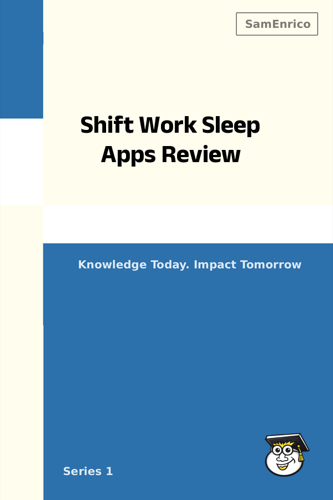
Shift Work Sleep Tracking Apps eBook
Use technology to monitor and improve your sleep p
by Hutton Shyla
Use technology to monitor and improve your sleep patterns.
Formats
Free sample
Chapter 1: The 3 AM Graveyard--–- The first time I watched a seasoned ICU nurse walk into a supply closet instead of a patient’s room at 3:47 AM, I thought she was having a stroke. Her eyes were open. Her hand was reaching for a bedpan that wasn’t there. She stood frozen for seven seconds—an eternity in a hospital—before shaking her head and muttering, “I was just getting gauze.” She hadn’t slept more than three hours in the past forty-eight. She was, by every physiological measure, legally drunk without having touched a drop of alcohol.That moment, witnessed in a brightly lit corridor of a Chicago hospital, is what forced me to stop treating shift work as an inconvenience and start treating it as a medical emergency.
And it is the reason this chapter exists: to convince you, before we talk about a single app or tracking device, that the advice “sleep when you’re tired” is not just useless—it is dangerous.The Myth of the Willpower Warrior We have been sold a lie. The lie is that shift work is a test of character. That if you are groggy at 4 AM, you simply lack discipline. That a cold shower, a second espresso, or a motivational podcast can override biology. This lie kills people.Every year, the National Highway Traffic Safety Administration attributes approximately 6,000 fatal crashes to drowsy driving—a number most experts agree is a dramatic undercount because there is no breathalyzer for fatigue.
After a night shift, your risk of crashing on the drive home is increased by nearly 500 percent. Not 50 percent. Five hundred percent. That is not a character flaw. That is a predictable, measurable, and inevitable consequence of a body whose internal clocks have been ripped out of alignment.The truth, which the next three chapters will drill into your nervous system, is that shift work creates a specific, diagnosable medical condition.
The World Health Organization classified shift work as a “probable carcinogen” in 2007—placing it in the same risk category as ultraviolet radiation and diesel engine exhaust. The reason is not mystery. It is circadian disruption. And circadian disruption is not a feeling. It is a physiological state as real and measurable as a fever.What This Chapter Will Do For You By the end of this chapter, you will understand three things that will change how you see every night shift for the rest of your career.First, you will learn about the circadian trough—that deadly two-to-four-hour window between approximately 2 AM and 6 AM when your brain is literally not the same organ it was at 2 PM.
Second, you will understand the anatomy of your internal clocks—not just the master clock in your brain, but the rogue clocks in your liver, heart, and gut that are fighting each other every time you eat a meal at the wrong biological time. Third, you will confront the long-term price of misalignment, from metabolic syndrome to cancer to the quiet erosion of your memory and mood.This chapter has no apps in it. No tracking metrics. No optimization hacks. You cannot optimize a system you do not understand.
First, we must walk through the graveyard of good intentions—the shift workers who did everything “right” according to common advice and still found themselves falling asleep at stoplights.The Circadian Trough: Your Brain’s 3 AM Suicide Window Let me introduce you to the most dangerous phrase in shift work: “I’m fine.”At 2 PM, after a full night of sleep and a reasonable lunch, your body temperature is near its daily peak. Your cortisol levels—the alertness hormone—are elevated but stable. Your reaction time is approximately 250 milliseconds. Your ability to detect a peripheral motion (a child running into the street, a flashing alarm on a control panel) is sharp. You are, objectively, fine.At 3 AM, after a night shift, everything changes.
Your core body temperature drops to its lowest point of the 24-hour cycle. Your pineal gland is flooding your brain with melatonin—the darkness hormone that signals sleep. Your digestive system has slowed to a crawl. And your prefrontal cortex, the part of your brain responsible for judgment, impulse control, and risk assessment, is operating at roughly half its daytime capacity.This is the circadian trough. It is not a metaphor.
It is a measurable, repeatable, universal feature of human biology. Every human being, regardless of chronotype or training or caffeine tolerance, experiences a trough. In day workers, it manifests as the classic “post-lunch dip” around 2 PM—a mild lull in alertness. In night shift workers, that trough shifts and deepens into the 3 AM graveyard window.Here is what happens inside your brain during the trough.Your suprachiasmatic nucleus—a tiny cluster of approximately 20,000 neurons located just above the optic chiasm—is the master conductor of your circadian orchestra. It receives direct input from your eyes, specifically from a class of photoreceptors called intrinsically photosensitive retinal ganglion cells that contain a photopigment called melanopsin.
These cells do not see images. They see light. And they tell your SCN one thing: is it day or night?When those cells detect blue-wavelength light (morning sunlight), the SCN sends a cascade of signals that raise body temperature, increase cortisol, and suppress melatonin. When they detect darkness, the SCN does the opposite. This system evolved over hundreds of millions of years to lock you into a predictable rhythm: awake in the light, asleep in the dark.Shift work breaks that lock.
And when the lock breaks, the trough becomes a weapon.During the trough, your brain enters a state of microsleep vulnerability. A microsleep is not falling asleep. It is a three-to-fifteen-second lapse in consciousness where your eyes may remain open, your body may continue performing automatic movements, but your brain stops processing new information. In a microsleep, you can walk into a closet. You can drive through a red light.
You can pull the wrong lever at a power plant. You can miss the beeping of a patient’s IV pump.The terrifying truth about microsleeps is that you do not know you are having them. The brain is remarkably good at filling in gaps. You will not feel yourself “falling asleep.” You will simply have seven missing seconds and a strange certainty that you were awake the whole time.This is why the 3 AM to 6 AM window accounts for a disproportionate share of catastrophic errors in every 24-hour industry. The Exxon Valdez ran aground at 12:04 AM.
The Chernobyl meltdown began at 1:23 AM. Three Mile Island’s accident unfolded between 4 AM and 6 AM. These are not coincidences. They are the circadian trough, written in disaster.The Master Clock and Its Rebellious Children The SCN is the master clock, but it is not the only clock. This is the second critical concept you must understand before any app or tracking device can help you.Every cell in your body contains its own circadian oscillator.
Your liver cells have clocks. Your heart cells have clocks. Your fat cells, your pancreatic beta cells, your gut epithelial cells—all of them keep time. Under ideal conditions, these peripheral clocks are synchronized by the master clock. The SCN sends a…
This is the end of the free sample. Get the eBook to keep going. Buy now
About this book
Details
- Author
- Hutton Shyla
- Publisher
- SamEnrico
- Language
- English
- Genre
- Non-Fiction, Health & Wellness, Sleep Tech
- Released
- 2026-06-10
- Pages (approx.)
- 126
- Available as
- eBook, Audiobook

Read better in the ZLOADR app
Your eBooks on your phone or tablet. Sign in with your SamEnrico account and start reading.
More by Hutton Shyla
 The Relationship LedgerHutton Shyla$11.99
 Self Esteem for Infertility WorkbookHutton Shyla$11.99
 Germanium Health Claims ExaminedHutton Shyla$11.99
 Self Esteem Same Sex RelationshipHutton Shyla$11.99
 Divine Decree: The Breaking of Gods and MarriagesHutton Shyla$11.99
 The Phantom North: How Soviet Scientists Faked an Arctic DiscoveryHutton Shyla$11.99
 Understanding Exogenous Lipoid PneumoniaHutton Shyla$17.99
 Procurement Automation HandbookHutton Shyla$12.99
 Executive Summary Checklist Before You SendHutton Shyla$12.99
 Non-negative Matrix Factorization OperatorHutton Shyla$11.99
 How to Become a Molder HelperHutton Shyla$11.99