
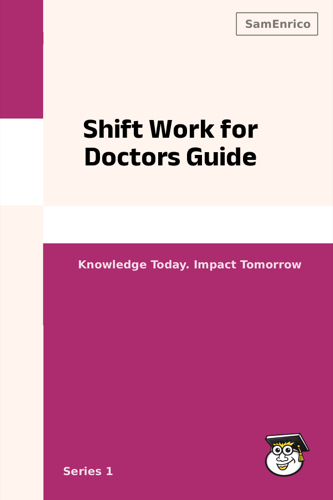
Shift Work for Doctors Guide eBook
Manage on call schedules, long rounds, and sleep d
Manage on call schedules, long rounds, and sleep deprivation.
Formats
Free sample
Chapter 1: The Hidden Epidemic...–- The 5 AM pager tone cut through the silence like a scalpel. Dr. Sarah Chen, a third-year internal medicine resident, had been awake for 22 hours. Her hands trembled slightly as she reached for the phone. Another admission.
Another decision. Another chance to make a mistake that could cost a life. She had stopped feeling tired twelve hours ago. Now she felt something worse: numb. As she reviewed the chest pain patient's EKG, she realized she had read the same lead three times.
The ST segments looked elevated. Or maybe they didn't. She couldn't trust her own eyes anymore. She signed the note anyway. That night, a patient died.
Not because Sarah was incompetent. Because Sarah was drunk on sleep deprivation—and no one had ever told her that was a medical emergency.The Problem We Refuse to Name For decades, medical training has operated on a single, unexamined assumption: suffering builds character. The resident who stays awake the longest, who takes the most call, who never complains about the 28-hour shift—that person is celebrated. They are the "hero." They are the "dedicated one." They are the future chief resident.But there is a problem hiding in plain sight. Every 28-hour shift, every back-to-back night rotation, every morning spent rounding after a sleepless night is not building character.
It is damaging organs. It is impairing cognition. It is shortening lives—both the doctor's and the patient's.This chapter exists to draw a line in the sand. We must distinguish between two things that medical culture has dangerously conflated: psychological toughness and physiological toxicity.Psychological toughness is the ability to handle stress, grief, high-stakes decisions, and the emotional weight of patient care. It is learned through experience, mentorship, and deliberate reflection.
It makes you a better doctor.Physiological toxicity is the measurable damage caused by chronic circadian disruption—the forced misalignment between your body's internal clock and the external demands of shift work. It includes cognitive impairment, metabolic disease, mood disorders, and increased cancer risk. It makes you a sicker, slower, and more dangerous doctor.The tragedy is that we have confused the two. We have told young doctors that enduring a 28-hour shift is a rite of passage, when in fact it is a biological insult. We have celebrated the resident who never sleeps, when we should be protecting them from themselves.This chapter will expose the hidden epidemic of sleep deprivation in medicine.
We will examine the data showing that a doctor who has been awake for 24 hours is as impaired as a drunk driver. We will explore the "culture of suffering" that normalizes this danger. And we will debunk the single most destructive myth in medical training: that pulling all-nighters makes you a better physician.By the end of this chapter, you will understand that endurance is not excellence. Endurance is endangerment—for both you and your patients.The Culture of Suffering: Where "Toughness" Became Toxic Every profession has its origin story. In medicine, the origin story of shift work begins with a man named Dr.
William Stewart Halsted, the father of modern surgical residency. In the 1880s, Halsted believed that surgeons should live in the hospital. He created the first residency system at Johns Hopkins, where residents worked every day, all day, with no scheduled time off. Halsted himself was addicted to cocaine and morphine, which may explain some of his judgment. But his system endured.
For over a century, the Halstedian model—total immersion, complete availability, and the complete erasure of a life outside the hospital—became the gold standard.That model persists today, not because it produces better doctors, but because it produces compliant ones. And because every generation of attendings says the same thing: "I did it, so you can too."Consider the story of Dr. James, a surgical chief resident quoted in the burnout literature. After a 36-hour shift, he bragged to his interns, "I haven't slept since Tuesday. That's how you know I care." His interns laughed nervously.
They did not know that Dr. James had already made three medication errors that week, including ordering insulin for a patient with a blood glucose of 65. They did not know that he had fallen asleep standing up during a Whipple procedure, saved only by the scrub nurse who nudged him. They did not know that he had driven home that morning and run a red light, remembering nothing of the intersection.Dr. James was not a hero.
He was a hazard. But his hospital had no mechanism to recognize that. His fatigue was invisible. His impairment was unmeasured. His "dedication" was celebrated.Or consider the emergency department nurse quoted in Survive Shift Work by Stephen Wilmot.
She worked back-to-back night shifts, then drove 45 minutes home on a highway known for deer crossings. She later told a researcher, "I started seeing things on the road. Shadows that weren't there. I would blink and realize I had driven two miles with no memory of it. But I was too afraid to pull over because I thought they'd fire me for being weak."This is the culture of suffering.
It is not enforced by written policy. It is enforced by nods and winks, by the quiet expectation that you will show up, that you will not complain, that you will sacrifice your biology on the altar of the hospital's schedule.And it is killing us.The Data That Cannot Be Ignored: Sleep Deprivation as Legal Intoxication In 1997, researchers Dawson and Reid published a landmark study that should have ended the debate about sleep deprivation in safety-critical professions. They compared the cognitive performance of sleep-deprived individuals to that of individuals with known blood alcohol concentrations (BAC). The results were staggering.After 17 hours of sustained wakefulness, participants performed as poorly on reaction time, working memory, and executive function tasks as someone with a BAC of 0.05%. After 19 hours, performance equivalent to 0.05–0.07% BAC.
After 24 hours of wakefulness, cognitive impairment reached the equivalent of 0.10% BAC—legally drunk in every state in the United States.Let that sink in. A doctor who has been awake for 24 hours is as cognitively impaired as a driver who would be arrested for DUI.A follow-up study by Williamson and Feyer (2000) confirmed these findings across multiple cognitive domains. They found that 24 hours of wakefulness produced impairment comparable to 0.10% BAC on tasks measuring:Reaction time (delayed by 30–50%)Working memory (capacity reduced by 40%)Sustained attention (vigilance decrement of 60% after 2 hours on task)Executive function (error rates increased 3-5x on complex decision-making)For doctors, the implications are direct and deadly. A meta-analysis of medication error studies found that after 24 hours awake, clinicians are 36% more likely to make a dosing error—including 10x errors (writing "10 mg" instead of "1 mg") and decimal point errors (writing ".5 mg" when "5 mg" was intended). These errors are not "small mistakes." They kill patients.Similarly, a study of laboratory errors found that sleep-deprived physicians are 54% more likely to miss a critical lab value—a potassium of 6.5, a hemoglobin of 6, a troponin of 10.
The lab value is there, on the screen, in black and white. But the fatigued brain literally does not see it. The visual cortex processes the image, but the prefrontal…
This is the end of the free sample. Get the eBook to keep going. Buy now
About this book
Details
- Author
- Comstock Apryl
- Publisher
- SamEnrico
- Language
- English
- Genre
- Non-Fiction, Health & Wellness, Medical
- Released
- 2026-06-09
- Pages (approx.)
- 136
- Available as
- eBook, Audiobook

Read better in the ZLOADR app
Your eBooks on your phone or tablet. Sign in with your SamEnrico account and start reading.
More by Comstock Apryl
 Biotin For Hair And NailsComstock Apryl$11.99
 Method of Loci for MusiciansComstock Apryl$11.99
 Remote Background Checks GuideComstock Apryl$11.99
 Self Esteem for Highly Sensitive People WorkbookComstock Apryl$11.99
 The Last Queen of Atlantis: How a Forgotten Civilization Changed the WorldComstock Apryl$11.99
 The Midnight Code: How Nikola Tesla’s Dreams Powered the FutureComstock Apryl$11.99
 Understanding Escherichia Coli InfectionComstock Apryl$17.99
 Terms of Service Template GuideComstock Apryl$12.99
 LinkedIn Profile Audit ToolComstock Apryl$12.99
 Manioc HarvestingComstock Apryl$11.99
 How to Start a Dancing Master Business (Beginners Guide)Comstock Apryl$11.99
You may also like
 The Doctor Visit Sleep GuideHumes Pandora$11.99
 Hospital Resident Nap GuideBell Hugh$11.99
 Hospital Toxin Exposure GuideLudwig Janine$11.99
 The ED Doctor Visit GuideMerrill Bettye$11.99
 Gambling for Healthcare WorkersWinkler Loise$11.99
 Nap Before Surgery GuideKeeton Denita$11.99
 The Hospital Toxin GuideSykes Olimpia$11.99
 The IBS Doctor Communication GuideMcclain Elin$11.99
 Medical Causes DepressionHalverson Leesa$11.99
 HGH Replacement Therapy RisksColby Tyra$11.99
 Gaming for Healthcare WorkersFrias Malorie$11.99
 HRT Benefits And RisksSimons Charlsie$11.99