
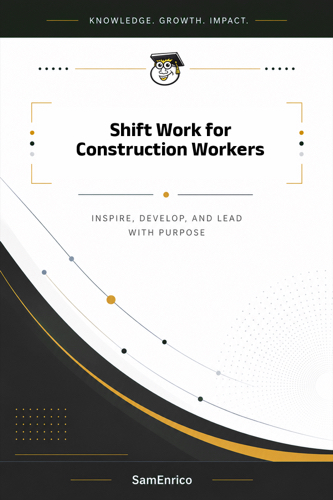
Non-FictionHealth & WellnessConstruction
Shift Work for Construction Workers eBook
Handle early starts and outdoor physical labour sl
Handle early starts and outdoor physical labour sleep needs.
Formats
Free sample
Chapter 1: Your Body Thinks You’re Crazy--–- The alarm screams at 4:00 AM. You reach out, muscle memory doing the work before your brain even registers the sound. Snooze. Nine minutes later, it screams again. This time you sit up—slowly, because your lower back reminds you of yesterday’s concrete pour.
Your mouth tastes like yesterday’s coffee and last night’s dinner. Your eyes feel like someone poured sand in them while you slept. You swing your feet to the floor, and for the first thirty seconds of the day, you ask yourself the same question you’ve asked a thousand times: Why is this so hard?You’re not weak. You’re not lazy. You’re not “just not a morning person.”Your body thinks you’re crazy.Not metaphorically.
Biologically. Deep in your brain, in a cluster of cells smaller than a grain of rice, your internal clock is screaming at you. It’s 4:00 AM. According to every evolutionary program written into your DNA over hundreds of thousands of years, you should be asleep. Not just asleep—in your deepest, most restorative sleep.
Instead, you’re putting on boots that smell like diesel and dried mud, about to go lift heavy things in the dark.This chapter is not about fixing you. You’re not broken. This chapter is about understanding the war you’re fighting every single day—the war between your body’s ancient operating system and the modern reality of a 4:00 AM start time. Once you understand why that alarm feels like an act of violence, you can stop fighting yourself and start working with the body you actually have.The Grain of Rice That Runs Your Life Deep inside your brain, tucked behind your eyes and slightly above the roof of your mouth, sits a tiny structure called the suprachiasmatic nucleus. Let’s call it the SCN, because nobody wants to say that mouthful at 4:00 AM.
The SCN is about the size of a grain of rice, and it is the most important part of your body that you’ve never heard of.The SCN is your master clock. It doesn’t guess what time it is. It doesn’t check your phone. It runs on a genetically programmed cycle that lasts approximately 24 hours and 15 minutes—slightly longer than a real day, which is why your body naturally wants to stay up a little later each night if left to its own devices. Every morning, light hits your eyes (specifically, a special type of cell in your retina that has nothing to do with vision and everything to do with timekeeping), and that light signal travels straight to the SCN.
The SCN then sends out a cascade of signals to every organ in your body: liver, kidneys, heart, muscles, even your fat cells. Each of those organs has its own little clock, but they all take orders from the SCN.Here’s what that means for you: when your alarm goes off at 4:00 AM, your SCN is not ready. It’s not even close. Depending on your genetics—and we’ll get to that in a moment—your SCN is programmed to start releasing wake-up signals sometime between 6:30 AM and 8:30 AM. Before that, it’s still in night mode.
Your core body temperature is at its lowest point of the day (about 1.5 degrees cooler than your afternoon temperature). Your digestive system is shut down. Your muscles are stiff because blood flow has been redirected to your core. Your reaction time is about 30 percent slower than it will be at 10:00 AM. Your decision-making ability is comparable to someone with a blood alcohol level of 0.05 percent.You’re not imagining the struggle.
You’re not “bad at mornings.” You are literally fighting your own biology.The Lark, The Owl, and The Construction Worker Now let’s make things more complicated. Not everyone’s SCN runs on the same schedule. This is where chronotypes come in—a fancy word for whether you’re a morning person or an evening person. About 40 percent of people are morning types, or “larks.” Their SCN runs fast. They naturally wake up early, feel alert in the morning, and start losing steam around 9:00 PM.
Another 30 percent are evening types, or “owls.” Their SCN runs slow. They struggle to wake up before 8:00 AM, hit their stride in the afternoon, and feel most alert between 9:00 PM and midnight. The remaining 30 percent fall somewhere in the middle.Here’s the problem that nobody talks about: construction work doesn’t care about your chronotype. The job starts when the job starts. Usually that’s between 5:00 AM and 6:00 AM, which means waking up between 3:30 AM and 4:30 AM.
For a lark, that’s early but manageable—maybe an hour before their natural wake-up time. For an owl, that’s a four-hour mismatch. That’s the equivalent of asking a lark to wake up at midnight and go frame a house.If you’re an owl working construction, you are fighting a harder battle than your lark coworkers. They don’t understand why you’re still groggy at 8:00 AM. You don’t understand how they can bounce out of bed at 3:30 AM.
Neither of you is wrong. You’re just wired differently, and the job favors one wiring over the other.But here’s the good news: whether you’re a lark or an owl, your body can adapt. Not completely—you’ll never turn an owl into a true lark—but you can shift your clock by about two hours with consistent, disciplined habits. The rest of this book is about how to do that. First, you need to understand what you’re up against.The Two Crashes: Morning and Afternoon Every construction worker knows two specific moments of the day when everything falls apart.
The first is between 9:00 AM and 10:00 AM, about an hour after you’ve been working hard. The second is between 1:30 PM and 3:00 PM, the infamous post-lunch slump. These aren’t coincidences. They’re not about what you ate (though that matters—see Chapter 4). They’re built into your biology.The morning crash happens because your body is still trying to finish its wake-up process.
When you force yourself awake at 4:00 AM, your SCN releases cortisol to get you moving. Cortisol is a stress hormone, but in the morning, it’s a good thing—it raises your blood sugar, increases alertness, and gets you ready for the day. The problem is that cortisol spike doesn’t last. About four to five hours after you wake up, cortisol levels drop sharply. If you woke up naturally at 7:00 AM, that drop would happen around 11:00 AM or noon—right before lunch.
You’d feel a little tired, eat something, and recover. But if you woke up at 4:00 AM, that drop happens around 8:00 AM or 9:00 AM. You’re already on the job, already working hard, and suddenly your body pulls the rug out from under you. That’s not a lack of coffee. That’s a cortisol crash.The afternoon crash is different.
Around 2:00 PM, your core body temperature drops slightly—about half a degree. This is your body’s natural siesta signal. Every human on the…
This is the end of the free sample. Get the eBook to keep going. Buy now
About this book
Details
- Author
- Staggs Lindsay
- Publisher
- SamEnrico
- Language
- English
- Genre
- Non-Fiction, Health & Wellness, Construction
- Released
- 2026-06-10
- Pages (approx.)
- 142
- Available as
- eBook, Audiobook

Read better in the ZLOADR app
Your eBooks on your phone or tablet. Sign in with your SamEnrico account and start reading.
More by Staggs Lindsay
 Give First NetworkerStaggs Lindsay$11.99
 Method of Loci for Speeches GuideStaggs Lindsay$11.99
 Self Esteem for Veterans HandbookStaggs Lindsay$11.99
 The Hair Mineral Analysis GuideStaggs Lindsay$11.99
 Whispers from the Silk Road: The Lost Diaries of a Nomad ScholarStaggs Lindsay$11.99
 The Day the Music Died... Again: The Forgotten Concert That Changed HistoryStaggs Lindsay$11.99
 How to Become a Mother RepairerStaggs Lindsay$11.99
 Understanding Ethylmalonic AciduriaStaggs Lindsay$17.99
 MoSCoW Method PractitionerStaggs Lindsay$11.99
 CV Writer Podcast MarketingStaggs Lindsay$12.99
 Enterprise ToS GuideStaggs Lindsay$12.99
You may also like
 Hong Kong Handover 1997Dunn Johnnie$11.99
 Zumba For Postnatal Recovery CourseNeal Christian$11.99
 Zumba for BeginnersLadner Nikia$11.99
 YouTube Comment Mining GuideHumes Pandora$12.99
 Worry Box MeditationCarlin Rudy$11.99
 Workplace Stress MeditationNguyen Lynn$11.99
 Workplace Stress and Sleep RepairHawley Ivory$11.99
 Workplace Perfectionism CureDelaney Jeffry$11.99
 Workplace Injustice Anger GuideWallen Isabelle$11.99
 Work Addiction and Burnout LinkGreenwood Ester$11.99
 Women in Yoga and WellnessBeattie Galina$11.99
 Women in Stand Up ComedyChun Evangeline$11.99