
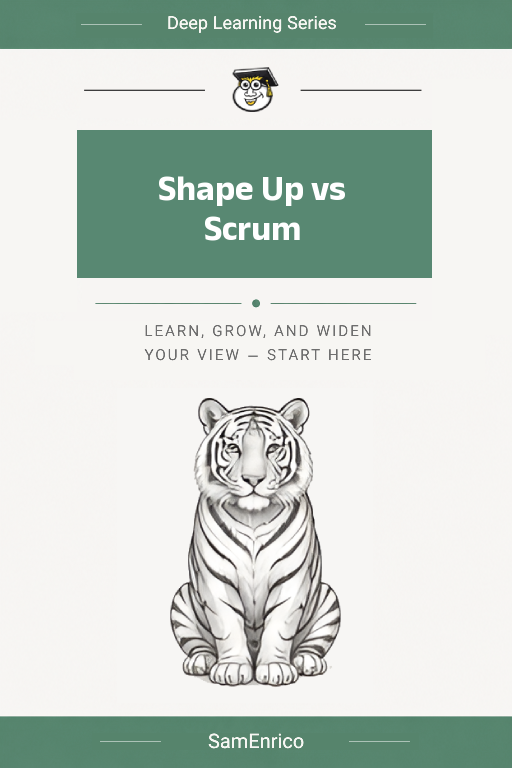
Non-FictionStartup GuideAgile Methods
Shape Up vs Scrum eBook
Compare Basecamp Shape Up with Scrum for startup t
Compare Basecamp Shape Up with Scrum for startup teams. Six-week cycles vs fixed sprints.
Formats
Free sample
Chapter 1: The Estimation Lie--–- The Monday morning sprint planning meeting had entered its third hour. Eleven people sat in a cramped conference room (six on Zoom, their faces frozen in various states of exhaustion), staring at a Jira board that displayed exactly 142 tickets. The product manager, a well-intentioned former consultant named Sarah, was trying to explain why a "small" database migration was actually a 5, not a 3, because of "unknown dependencies." The lead engineer, Marcus, had stopped listening forty-five minutes ago and was now silently calculating how many days of his life he had lost to estimation meetings. The founder, Lena, sat at the head of the table with her head in her hands, wondering why the feature she had promised investors three sprints ago still had not shipped.This scene plays out every single day in startup offices around the world. Not because the people are incompetent.
Not because the product is too complex. But because most startups adopt Scrum without ever asking a fundamental question: Is this actually the right tool for the job?Scrum is the default answer to "How should we manage our software development?" It is taught in bootcamps, preached by agile coaches, and embedded in every project management tool from Jira to Asana to Linear. It has become so ubiquitous that many founders do not even realize they have made a choice. They simply assume that "agile" means "Scrum," and that "Scrum" means "two-week sprints with story points and daily standups."But here is the uncomfortable truth that the agile industrial complex does not want you to hear: Scrum was not designed for startups.Scrum was invented in the early 1990s by Jeff Sutherland and Ken Schwaber to solve a specific problem: how to help large, bureaucratic organizations deliver software more reliably. It was designed for IBM.
For Bell Labs. For companies where the biggest risk was not "building the wrong thing" but "building nothing at all because of endless waterfall requirements documents." Scrum was a revolutionary response to corporate paralysis.A startup is not a large corporation. A startup does not suffer from corporate paralysis. A startup suffers from the opposite problem: chaos, uncertainty, and the terrifying reality that nobody knows what to build. And yet, founders keep forcing their nimble, chaotic, beautiful startups into the rigid corset of Scrum ceremonies.
The result is not agility. It is what the industry has come to call Zombie Scrum—the living dead of product development, where teams shuffle tickets across boards, moan about velocity, and never ship anything that actually matters.This chapter is a diagnosis. Before we can prescribe a cure—whether that is Shape Up, a hybrid model, or even a better way to do Scrum—we must first understand exactly why the default framework is failing you. We will dissect three specific Scrum ceremonies that create friction in the startup environment: estimation meetings (story points), the daily standup, and sprint commitments. We will then perform a complete Backlog Autopsy to understand how backlogs become graveyards of dead features.
Finally, we will introduce the central dichotomy that will guide the rest of this book: the difference between output (tickets closed) and outcomes (customer value created).By the end of this chapter, you will have a clear diagnostic framework to determine whether your team is suffering from Zombie Scrum—and you will understand why the alternative, Shape Up, might be the lifeline you did not know you needed.The Three Ceremonies That Kill Startup Speed Let us start with a simple observation: every ceremony in Scrum was added for a reason. The daily standup was designed to replace the status report. Sprint planning was designed to replace the three-month waterfall planning phase. Retrospectives were designed to create continuous improvement. These were all good intentions.But good intentions do not survive contact with reality.
In a startup, where requirements change hourly and the only constant is uncertainty, these ceremonies become what I call ceremonial debt—the accumulated time cost of process that no longer serves its original purpose.Estimation Meetings: The Theater of Pretend Knowledge The first and most damaging ceremony is the estimation meeting. In Scrum, every ticket—every user story, every bug, every technical chore—must be assigned a story point. Story points are a relative measure of effort, typically on a Fibonacci scale (1, 2, 3, 5, 8, 13). The team sits together, discusses the ticket, and votes on a number. Then they argue about the number.
Then they re-vote. Then they finally agree on a 5, even though half the team thought it was a 3 and the other half thought it was an 8.Here is what estimation meetings assume: that the team has enough information to make a meaningful prediction.In a startup, this assumption is almost always false. You are building something that has never been built before. You are entering unknown technical territory. The requirements are shifting because you are still discovering what customers actually want.
The idea that you can look at a ticket for a new machine learning feature and say "that is an 8" is not just optimistic. It is a lie.I call this estimation theater—the collective performance of pretending to know something you do not know, because the process demands it. The team performs estimation theater for the same reason people perform the Macarena at weddings: everyone hates it, nobody wants to be there, but the social pressure to participate is overwhelming.The damage of estimation theater is not just the time wasted in the meeting itself. That is bad enough—a one-hour estimation meeting for a team of six people costs six person-hours, which at a typical startup burn rate is hundreds of dollars. The real damage is the cognitive overhead of thinking in story points.
Every time a developer finishes a task, they must stop and think: "How many points was this? Did we estimate correctly? Should I adjust future estimates based on this new information?" This is mental friction. It pulls developers out of flow state, the deep concentration where real creative work happens.Worse, story points create a perverse incentive structure. Teams learn to game velocity.
They inflate estimates to create safety padding. They split large tickets into multiple small tickets to make the numbers look better. They refuse to take on genuinely hard problems because "that ticket is too big to estimate." The measure becomes the goal, and the goal—shipping valuable software—is forgotten.I once worked with a startup that had been doing Scrum for two years. Their velocity chart was beautiful—a smooth upward trend showing a team becoming more "productive" every sprint. But when I asked to see what they had actually shipped to customers in the last six months, the product manager went quiet.
They had shipped exactly two minor features and a handful of bug fixes. Their velocity had gone up while their impact had gone down. The team was running faster and faster on a treadmill going nowhere.That is estimation theater.The Daily Standup: The Meeting That Eats the Morning The daily standup was originally designed as a 15-minute, standing-only (hence the name) synchronization meeting. Each team member answers three questions: What did I do yesterday? What will I do…
This is the end of the free sample. Get the eBook to keep going. Buy now
About this book
Details
- Author
- Barbour Randy
- Publisher
- SamEnrico
- Language
- English
- Genre
- Non-Fiction, Startup Guide, Agile Methods
- Released
- 2026-06-01
- Pages (approx.)
- 148
- Available as
- eBook, Audiobook

Read better in the ZLOADR app
Your eBooks on your phone or tablet. Sign in with your SamEnrico account and start reading.
More by Barbour Randy
 Customer Service Mobile App GuideBarbour Randy$11.99
 Burnout Recovery Art TherapyBarbour Randy$11.99
 Teresa of Ávila Health StrugglesBarbour Randy$11.99
 Low Carb Grocery List GuideBarbour Randy$11.99
 The Clara Schumann PianistBarbour Randy$11.99
 The Golden Couple: How Jesse Owens and His Wife Defied Hitler’s Shadow (1936)Barbour Randy$11.99
 How to Become a Line MoverBarbour Randy$11.99
 Faceless YouTube Tech ReviewsBarbour Randy$12.99
 Learn to Play the Dunun (Dundun)Barbour Randy$11.99
 Underwater Videography PhotographyBarbour Randy$11.99
You may also like
 Hong Kong Handover 1997Dunn Johnnie$11.99
 Zumba For Postnatal Recovery CourseNeal Christian$11.99
 Zumba for BeginnersLadner Nikia$11.99
 YouTube Comment Mining GuideHumes Pandora$12.99
 Worry Box MeditationCarlin Rudy$11.99
 Workplace Stress MeditationNguyen Lynn$11.99
 Workplace Stress and Sleep RepairHawley Ivory$11.99
 Workplace Perfectionism CureDelaney Jeffry$11.99
 Workplace Injustice Anger GuideWallen Isabelle$11.99
 Work Addiction and Burnout LinkGreenwood Ester$11.99
 Women in Yoga and WellnessBeattie Galina$11.99
 Women in Stand Up ComedyChun Evangeline$11.99