
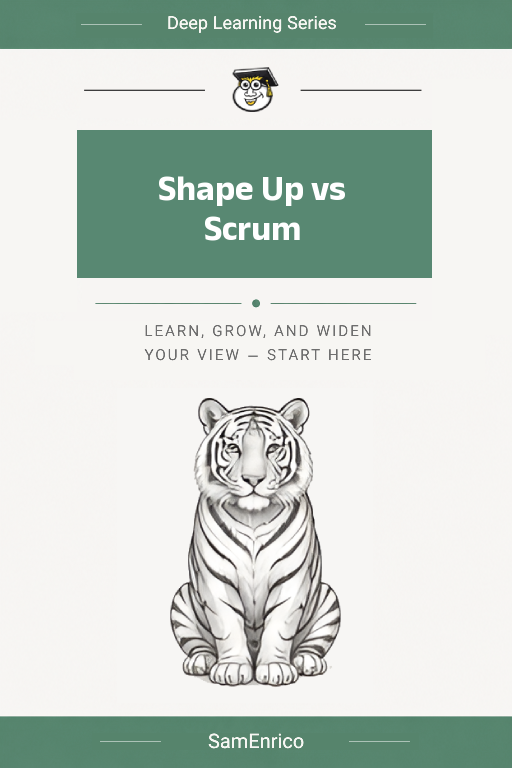
Shape Up vs Scrum
Compare Basecamp Shape Up with Scrum for startup t
Compare Basecamp Shape Up with Scrum for startup teams. Six-week cycles vs fixed sprints.
Formats
About this book
Free sample
Chapter 1: The Estimation Lie--–- The Monday morning sprint planning meeting had entered its third hour. Eleven people sat in a cramped conference room (six on Zoom, their faces frozen in various states of exhaustion), staring at a Jira board that displayed exactly 142 tickets. The product manager, a well-intentioned former consultant named Sarah, was trying to explain why a "small" database migration was actually a 5, not a 3, because of "unknown dependencies." The lead engineer, Marcus, had stopped listening forty-five minutes ago and was now silently calculating how many days of his life he had lost to estimation meetings. The founder, Lena, sat at the head of the table with her head in her hands, wondering why the feature she had promised investors three sprints ago still had not shipped.This scene plays out every single day in startup offices around the world. Not because the people are incompetent.
Not because the product is too complex. But because most startups adopt Scrum without ever asking a fundamental question: Is this actually the right tool for the job?Scrum is the default answer to "How should we manage our software development?" It is taught in bootcamps, preached by agile coaches, and embedded in every project management tool from Jira to Asana to Linear. It has become so ubiquitous that many founders do not even realize they have made a choice. They simply assume that "agile" means "Scrum," and that "Scrum" means "two-week sprints with story points and daily standups."But here is the uncomfortable truth that the agile industrial complex does not want you to hear: Scrum was not designed for startups.Scrum was invented in the early 1990s by Jeff Sutherland and Ken Schwaber to solve a specific problem: how to help large, bureaucratic organizations deliver software more reliably. It was designed for IBM.
For Bell Labs. For companies where the biggest risk was not "building the wrong thing" but "building nothing at all because of endless waterfall requirements documents." Scrum was a revolutionary response to corporate paralysis.A startup is not a large corporation. A startup does not suffer from corporate…
This is the end of the free sample. Get the eBook to keep going. Buy now
Contents
- Chapter 1
- Chapter 2
- Chapter 3
- Chapter 4
- Chapter 5
- Chapter 6
- Chapter 7
- Chapter 8
- Chapter 9
- Chapter 10
- Chapter 11
- Chapter 12
Details
- Author
- Barbour Randy
- Publisher
- SamEnrico
- Language
- English
- Genre
- Non-Fiction, Startup Guide, Agile Methods
- Released
- 2026-06-01
- Pages (approx.)
- 148
- Available as
- eBook, Audiobook

Read better in the ZLOADR app
Your eBooks on your phone or tablet. Sign in with your SamEnrico account and start reading.
More by Barbour Randy
 Customer Service Mobile App GuideBarbour Randy$11.99
 Burnout Recovery Art TherapyBarbour Randy$11.99
 Teresa of Ávila Health StrugglesBarbour Randy$11.99
 Low Carb Grocery List GuideBarbour Randy$11.99
 The Clara Schumann PianistBarbour Randy$11.99
 The Golden Couple: How Jesse Owens and His Wife Defied Hitler’s Shadow (1936)Barbour Randy$11.99
 How to Become a Line MoverBarbour Randy$11.99
 Faceless YouTube Tech ReviewsBarbour Randy$12.99
 Learn to Play the Dunun (Dundun)Barbour Randy$11.99
 Underwater Videography PhotographyBarbour Randy$11.99
You may also like
 Two Pizza Team ScrumHammett Diamond$12.99Two Pizza Team ScrumHammett Diamond$12.99Two Pizza Team ScrumHammett Diamond$12.99Two Pizza Team ScrumHammett Diamond$12.99Two Pizza Team ScrumHammett Diamond$12.99Two Pizza Team ScrumHammett Diamond$12.99Two Pizza Team ScrumHammett Diamond$12.99Two Pizza Team ScrumHammett Diamond$12.99
 Story Points EstimationLindgren Trinh$12.99
 Spotify Engineering Model WorkbookBonds Nakita$12.99
 Shape Up vs KanbanMcfadden Sun$12.99
 Shape Up for StartupsDelarosa Marine$12.99