
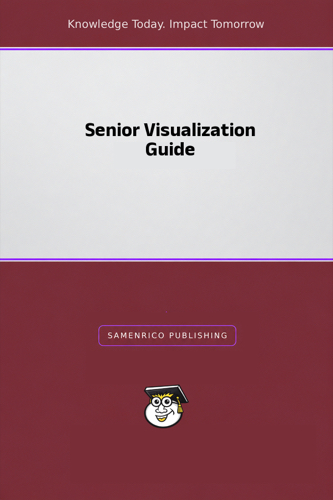
Senior Visualization Guide eBook
Uses imagery for calm and confidence.
by Harden Tisa
Uses imagery for calm and confidence.
Formats
Free sample
Chapter 1: The 3 AM Fear Spiral--–- The bedroom is dark. The clock reads 3:17. You have been awake for forty-seven minutes, staring at the ceiling, your mind racing through a catalog of worries you cannot solve and cannot escape. The knee surgery scheduled for next month. The unfamiliar lump you felt last week.
The adult child who has not returned your last three calls. The growing realization that your body does not move the way it used to, and the quiet terror that this is the beginning of a long, slow decline. You have tried everything to fall back asleep: counting breaths, adjusting pillows, getting up for a glass of water, scrolling through your phone (which only made it worse). Nothing works. The fear spiral tightens.If this scene feels familiar, you are not alone.
And you are not broken.Welcome to the first chapter of The Senior Visualization Guide. Before we teach you a single technique, before we ask you to close your eyes or take a single breath, we need to address the elephant in the room: the widespread, deeply ingrained belief that aging means decline, that anxiety is inevitable after sixty, and that the best you can hope for is to manage your symptoms with medication, distraction, or gritted teeth. That belief is not only wrong—it is actively harming you.This chapter will dismantle three dangerous myths about aging and the brain. Then it will introduce you to a concept that will guide every practice in this book: Joyspan, the intentional use of mental imagery to improve the quality of your later years, not merely their length. Finally, you will meet the part of your brain that has been keeping you awake at 3 AM—the amygdala, or what we will call your brain's smoke detector—and you will learn why visualization is uniquely powerful for calming it.By the end of this chapter, you will understand why your brain is not only capable of learning new skills after sixty, but actually better at certain kinds of learning than it was at twenty.
You will have a clear picture of how this book will transform your 3 AM fear spiral into a 10-minute morning routine that rebuilds calm and confidence from the inside out. And you will have taken the first step toward reclaiming your second half of life.Let us begin.The Myth of the Aging Brain The single most damaging belief about getting older is also the most widespread: the idea that after a certain age, the brain stops growing, stops learning, and begins an inexorable slide into fog, forgetfulness, and rigidity. This belief is so common that it has its own folk expression: "You can't teach an old dog new tricks."It is also, by every measure of modern neuroscience, completely false.For most of the twentieth century, scientists believed that the adult brain was fixed and unchanging—a machine that slowly wore down with use. If you lost neurons, they were gone forever. If you failed to learn a skill in childhood, you would never master it as an adult.
This view, now called the "static brain" model, was convenient for researchers but catastrophic for seniors, who internalized it as a personal limitation rather than a scientific error.The revolution began in the 1990s with the discovery of neuroplasticity: the brain's lifelong ability to reorganize itself by forming new neural connections throughout life. When you learn something new, your brain physically changes. When you practice a skill, the neural pathways involved in that skill grow stronger and more efficient. When you stop using a skill, those pathways weaken—but they do not disappear entirely. They can be reactivated.This is not abstract theory.
It is observable, measurable, and repeatable. Researchers at the University of California, Irvine, used functional MRI scans to watch seniors learn to juggle. After just one week of practice, the participants' brains showed increased gray matter in regions responsible for visual attention and motor coordination. When they stopped practicing, the gray matter decreased—but when they picked up the juggling balls again months later, the neural pathways reactivated far faster than they had formed initially. The brain remembered.Here is what neuroplasticity means for you, reading this book at sixty, seventy, eighty, or beyond: your brain is not in decline.
It is in transition. Some abilities do slow down with age. Your processing speed—how quickly you can solve a simple puzzle or recall a name—may take a few extra seconds. But other abilities actually improve. Pattern recognition, the ability to see connections between seemingly unrelated pieces of information, peaks in late middle age and remains high into the eighties.
Emotional regulation, the capacity to respond to stress without being overwhelmed, improves steadily throughout life. Crystallized wisdom—the accumulated knowledge and judgment that comes from decades of experience—is unavailable to the young and abundant in the old.Think of it this way: a twenty-year-old brain is a sprinter—fast, reactive, explosive. A sixty-year-old brain is a marathon runner—enduring, strategic, wise. They are not the same, but they are also not in competition. The sprinter cannot do what the marathoner does, and the marathoner would be foolish to try to sprint.
The goal is not to pretend you are twenty. The goal is to use the unique strengths of your sixty-year-old brain to solve the problems that matter most to you.And what problems matter most? According to surveys of thousands of seniors across North America and Europe, the answers are remarkably consistent: I want to sleep through the night. I want to stop worrying about my health. I want to feel confident in social situations.
I want to move without fear of falling. I want to feel like I still matter.These are not cognitive problems. They are emotional and physical problems with cognitive solutions. And the sixty-year-old brain, with its superior pattern recognition and emotional regulation, is actually better equipped to solve them than the twenty-year-old brain. You have more experience identifying false alarms.
You have more practice calming yourself down after a scare. You have more stored memories of success to draw upon.The only thing standing between you and that capacity is the belief that you have lost it. That belief—internalized ageism—is the real enemy of this book. And visualization is the weapon we will use to defeat it.Introducing Joyspan: A New Way to Measure Your Later Years Before we go any further, we need a new vocabulary. The words we use to talk about aging are almost exclusively negative: decline, loss, frailty, dependence, slowing down, winding down, letting go.
Even well-intentioned phrases like "aging gracefully" imply that the natural state of getting older is ungainly, and that grace requires effort.This book rejects that vocabulary entirely. We propose a new term: Joyspan.Joyspan is defined as the intentional use of mental imagery to extend not the length of your life, but the quality of your peace, purpose, and poise in your later years. Where "lifespan" measures quantity (how many birthdays you have), Joyspan measures quality (how many moments of genuine calm, confidence, and clarity you experience). Where "healthspan" measures the absence of disease, Joyspan…
This is the end of the free sample. Get the eBook to keep going. Buy now
About this book
Details
- Author
- Harden Tisa
- Publisher
- SamEnrico
- Language
- English
- Genre
- Non-Fiction, Self-Help, Visualization
- Released
- 2026-06-06
- Pages (approx.)
- 148
- Available as
- eBook, Audiobook

Read better in the ZLOADR app
Your eBooks on your phone or tablet. Sign in with your SamEnrico account and start reading.
More by Harden Tisa
 Mind Mapping For StudyHarden Tisa$11.99
 Homicide Detective Stress GuideHarden Tisa$11.99
 Anger Management Online CourseHarden Tisa$11.99
 Snowboarder Self HypnosisHarden Tisa$11.99
 CPR for Trauma VictimsHarden Tisa$11.99
 Goal Setting for Data ScientistsHarden Tisa$11.99
 Eugène Atget: The Ghostly Streets of Old ParisHarden Tisa$11.99
 Byzantium Echoes: The Golden Voice of KassiaHarden Tisa$11.99
 The Essential Guide to Chicago BluesHarden Tisa$11.99
 How to Produce Print ServersHarden Tisa$11.99
 How to Produce Egg CookersHarden Tisa$11.99
 Niger Seed: NyjerHarden Tisa$11.99
You may also like
 White Room InductionHostetler Vasiliki$11.99
 The Gambling Free Identity VisualizationFinn Clement$11.99
 Spending Visualization ExerciseCantwell Michaele$11.99
 Guided Imagery for RestGuillen Stevie$11.99
 Financial Visualization PracticeIsbell Gerri$11.99
 Emotional Regulation VisualizationFelix Lanell$11.99
 Anger Visualization TechniquesYounger Verona$11.99
 Visualization Sleep MeditationStull Dodie$11.99
 Visualization for ConfidenceMilliken Bok$11.99
 Road Rage Visualization GuideStratton Latrina$11.99
 The Affirmation Visualization ComboHopper Nyla$11.99
 Teen Visualization Self EsteemClick Jere$11.99