
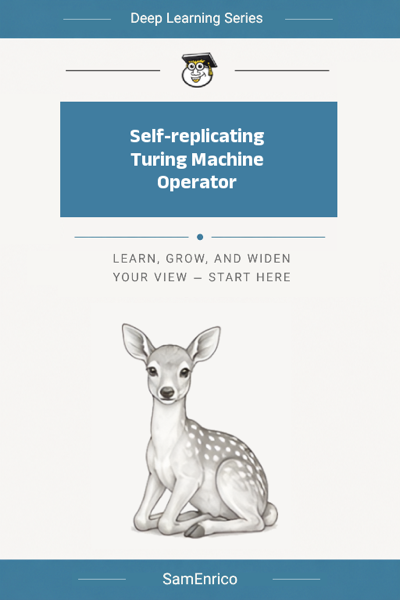
Non-FictionInformativeEducational
Self-replicating Turing Machine Operator eBook
A Coursebook on Self-replicating Turing Machine Op
A Coursebook on Self-replicating Turing Machine Operator
Formats
Free sample
Chapter 1: The Dying Mathematician--In the autumn of 1955, a man who had already reshaped the twentieth century sat propped against hospital pillows, his body betraying him cell by cell. John von Neumann, the genius who had helped invent the atomic bomb, develop game theory, design the modern computer, and formalize quantum mechanics, was dying of bone cancer. The disease had spread to his brain. He could no longer recognize his closest friends. He spoke in fragments, sometimes in Hungarian, sometimes in German, sometimes in the cold precise English of mathematical proof.
But in his lucid moments, he kept returning to one question. It was not about nuclear deterrence. It was not about computing. It was a question so strange, so abstract, so seemingly impractical that only a man with nothing left to lose would spend his final days on it: Could a machine build a copy of itself?The question sounds like science fiction. It sounds like the opening scene of a B-movie about robots taking over the world.
But von Neumann was not a science fiction writer. He was one of the most rigorous mathematicians of his era, a man who refused to speculate without proof. And he had discovered something alarming. The problem of self-replication was not a technological challenge—not about motors or gears or programming languages. It was a logical challenge, a paradox hiding in plain sight, an infinite hole at the center of every attempt to make a machine that could make itself.This book is about that hole.
It is about the thing that falls into the hole, and the thing that climbs back out. It is about the Operator.The Copy Machine in the Empty Warehouse Let me begin with a puzzle. It is the same puzzle that von Neumann posed to his colleague Stanislaw Ulam in 1948, seven years before the cancer took hold. The puzzle is deceptively simple, and I want you to solve it yourself before reading further.Imagine you own a perfect copy machine. Not a Xerox machine that copies paper—a universal copier that can copy any physical object.
You put a coffee mug in the left tray, and an identical coffee mug emerges from the right tray. You put a wristwatch, you get a wristwatch. You put a bicycle, you get a bicycle. The machine works flawlessly, with atomic precision, every single time.Now imagine you place this machine in a large, empty warehouse. Alongside it, you place a complete set of blueprints for the machine itself—every gear, every wire, every circuit board, every screw.
The blueprints are perfect. They describe exactly how to build a second machine, identical to the first.You walk out of the warehouse, close the door, and return one year later. What do you expect to find?Most people imagine two copy machines sitting side by side. The first machine read the blueprints and assembled the second. You now have two.
The machine has replicated.But that is wrong. That is not what happens. And the reason it is wrong is the entire subject of this book.Here is what actually happens: You open the warehouse door and find one copy machine, exactly where you left it, surrounded by a pile of scrap metal. The blueprints are untouched. The machine never moved.
Because the machine does not know how to read blueprints. It is a copier of objects, not a reader of descriptions. You left it a recipe but no chef.The First Infinite Staircase So you try again, but this time you are clever. You modify the machine. You add a scanner that can read blueprints.
You add an instruction-following system that can translate the blueprint's symbols into commands for the machine's robotic arm. Now the machine can read its own description and build what it reads.You close the door. One year later, you return. Two machines? Not quite.You find one machine and a heap of partially assembled parts.
Because while the machine was reading the blueprint and building a second machine, it was not copying the scanner. The new machine has a robotic arm, a set of gears, a power supply—all the parts described in the blueprint. But it does not have a scanner. The scanner was part of the first machine, not part of the description. To copy the scanner, the first machine would need a blueprint that includes the scanner's description.
But if the blueprint includes the scanner, then the first machine's scanner would need to read that part of the blueprint, which would require a scanner inside the blueprint describing the scanner, which would require a scanner inside that blueprint, and so on.This is the first infinite staircase. Every time you add a component to the blueprint, you need another component to read that part of the blueprint. The chain never ends. It is staircases all the way down.The Second Infinite Staircase Perhaps you anticipate this problem. You design the first machine so that its blueprint includes the scanner.
The blueprint is now complete: it describes the entire machine, scanner and all. The first machine's scanner reads the part of the blueprint that describes how to build a scanner. The first machine builds a second machine that has a scanner of its own.You close the door. One year later, you return. Two machines!
Victory!No. Because you have forgotten about the interpreter. The scanner does not read blueprints directly. It converts light patterns into digital signals. Those signals must be interpreted by a program that knows what the signals mean.
That program is stored in the machine's memory. And that program was not on the blueprint. The blueprint described the hardware. It did not describe the software that interprets the hardware's outputs.So you add the program to the blueprint. Now the blueprint describes the scanner, the constructor arm, and the entire operating system that coordinates them.
The first machine reads this blueprint and builds a second machine that has the program. Two machines! Now you have it.No. Because the program itself needs an interpreter. The program is written in a language—assembly code, perhaps, or machine code.
The machine's processor executes that code. The processor is hardware. The blueprint includes the processor. But the processor's microcode—the low-level instructions that tell the processor how to execute machine code—is stored in ROM. The ROM was not on the blueprint.
To copy the ROM, you would need to include its contents in the blueprint. But those contents are themselves a program, which requires an interpreter, which requires microcode, which requires...You see the pattern. Every time you add a layer of description, you reveal another layer of interpretation below it. The staircase never terminates because there is no bottom floor. Every interpreter requires another interpreter, ad infinitum.The Third Infinite Staircase Perhaps you take a different approach.
You stop trying to build a machine that copies itself from a separate blueprint. Instead, you build the machine so that its blueprint is stored inside the machine. The machine reads its own internal memory to build a copy. This is how biological cells work: DNA is a blueprint stored inside the cell, and…
This is the end of the free sample. Get the eBook to keep going. Buy now
About this book
Details
- Author
- Griswold Justine
- Publisher
- SamEnrico
- Language
- English
- Genre
- Non-Fiction, Informative, Educational
- Released
- 2026-05-07
- Pages (approx.)
- 150
- Available as
- eBook, Audiobook

Read better in the ZLOADR app
Your eBooks on your phone or tablet. Sign in with your SamEnrico account and start reading.
More by Griswold Justine
 The Arthritis Supplement GuideGriswold Justine$11.99
 Palauan Jellyfish LabGriswold Justine$11.99
 Toyota Reliability vs StatusGriswold Justine$11.99
 Burnout Recovery Aromatherapy GuideGriswold Justine$11.99
 The B Vitamin Memory GuideGriswold Justine$11.99
 Billionaire’s Gamble: The Untold Story of the World’s Most Expensive YachtGriswold Justine$11.99
 Understanding Short Broad Great Toe MacrocraniumGriswold Justine$17.99
 Japanese Study Abroad PartnersGriswold Justine$12.99
 Coffee Export Insurance GuideGriswold Justine$12.99
 How to Become a Polishing Machine TenderGriswold Justine$11.99
You may also like
 Hong Kong Handover 1997Dunn Johnnie$11.99
 Zumba For Postnatal Recovery CourseNeal Christian$11.99
 Zumba for BeginnersLadner Nikia$11.99
 YouTube Comment Mining GuideHumes Pandora$12.99
 Worry Box MeditationCarlin Rudy$11.99
 Workplace Stress MeditationNguyen Lynn$11.99
 Workplace Stress and Sleep RepairHawley Ivory$11.99
 Workplace Perfectionism CureDelaney Jeffry$11.99
 Workplace Injustice Anger GuideWallen Isabelle$11.99
 Work Addiction and Burnout LinkGreenwood Ester$11.99
 Women in Yoga and WellnessBeattie Galina$11.99
 Women in Stand Up ComedyChun Evangeline$11.99