
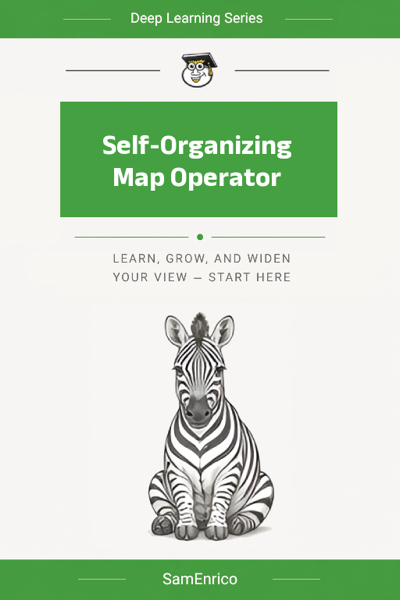
Non-FictionInformativeEducational
Self-Organizing Map Operator eBook
A Coursebook on Self-Organizing Map Operator
by Laporte Cruz
A Coursebook on Self-Organizing Map Operator
Formats
Free sample
Chapter 1: The Map That Sees--It was 1982 when Teuvo Kohonen, a soft-spoken Finnish engineer, watched his computer screen display something that should not have existed. The numbers on his screen—initially random, meaningless—had begun to organize themselves into a pattern. Not a pattern he had programmed. Not a pattern he had explicitly taught. A pattern that emerged from the data itself, like stars coalescing from cosmic dust. He had not told the system what to learn. He had only given it a simple rule: neighbors influence neighbors. And from that single, almost childlike instruction, order had appeared.This was the birth of the Self-Organizing Map. And in the decades since, this elegant algorithm has remained one of artificial intelligence's best-kept secrets.You have likely heard about deep learning. You have read about transformers and large language models. You have been told that the future belongs to massive neural networks with billions of parameters, trained on trillions of words. But here is a truth the hype cycle rarely mentions: most of the world's data does not come with labels. Most of the world's data is not text. Most of the world's data is high-dimensional, messy, and unstructured—the kind of data that deep learning, for all its power, struggles to understand without enormous human effort.This book is about a different kind of intelligence. Not the brute-force pattern matching of deep networks, but the elegant self-organization of maps that learn to see the shape of your data with no supervision at all.What This Chapter Will Do For You By the time you finish this chapter, you will understand why Kohonen's discovery matters more today than it did in 1982. You will learn what makes Self-Organizing Maps unique among neural networks, and you will master a new way of thinking about algorithms—as operators that can be composed, shared, and deployed like building blocks. You will write your first working SOM code. And you will never look at unsupervised learning the same way again.If you have ever run k-means and received clusters that made no sense. If you have ever looked at a PCA plot and wondered what the axes actually mean. If you have ever wished for a machine learning method that shows you what it learned, instead of hiding inside a black box—this chapter is for you.The 1982 Breakthrough That Changed Everything Before 1982, neural networks were largely theoretical curiosities. The perceptron had been discredited. Backpropagation was still four years away from widespread adoption. And unsupervised learning—the idea that a system could learn patterns without a teacher—was considered by many to be wishful thinking.Kohonen was not trying to revolutionize artificial intelligence. He was trying to solve a practical problem: how to map high-dimensional signals onto low-dimensional representations while preserving the relationships between them. His solution was almost embarrassingly simple.Imagine you have a sheet of rubber. You scatter a handful of pebbles across it. Now imagine that the rubber sheet is elastic, and each pebble represents a data point in your dataset. As you stretch and pull the sheet, the pebbles move. But here is the key: nearby pebbles stay nearby. The sheet preserves neighborhood relationships even as it deforms to fit the shape of the data.That is the Self-Organizing Map. A flexible grid of nodes that stretches and warps until it matches the underlying distribution of your data. Nodes that start randomly positioned end up arranged in an orderly topology—clusters of similar data points mapping to nearby regions of the grid.What Kohonen discovered was that this self-organization emerges naturally from a simple learning rule: when a data point arrives, find the node closest to it, and move that node and its neighbors a little bit closer to the data point. Repeat this thousands of times. The result is a map that organizes itself.Why This Matters Right Now In 1982, this was a curious research result. In 2024, it is practically essential. Consider what has changed:First, the volume of unlabeled data has exploded. Every sensor, every transaction, every user interaction generates data. But labeling that data—teaching a supervised learning system what each data point means—is expensive, time-consuming, and often impossible. Self-Organizing Maps learn from unlabeled data. They do not need teachers.Second, interpretability has become a crisis. Deep learning models routinely outperform humans at specific tasks, but no one can explain why they make the decisions they do. Regulators demand explanations. Customers demand transparency. And black boxes, however accurate, are increasingly unacceptable. SOMs are inherently interpretable. The map itself is the explanation.Third, high-dimensional data has become normal. Your customer database has hundreds of columns. Your sensor array streams thousands of signals. Your genomic data has tens of thousands of features. Classical statistical methods collapse under this dimensionality. Self-Organizing Maps thrive.This book teaches you how to use SOMs as operators—composable building blocks that you can deploy in data pipelines, combine with other algorithms, and scale to real-world problems. But before we build, we must understand.The Three Pillars of Self-Organizing Maps Every Self-Organizing Map rests on three foundational ideas. Master these, and everything else follows.Pillar One: Topology Preservation The most distinctive feature of SOMs is topology preservation. In simple terms: if two data points are similar in the original high-dimensional space, they will be close together on the map. If they are different, they will be far apart.This is not true of most dimensionality reduction methods. Principal Component Analysis (PCA) preserves variance, not neighborhood relationships. t-SNE preserves local structure but can distort global relationships. Autoencoders learn to reconstruct inputs, not to preserve topology.Topology preservation matters because it makes the map interpretable. When you look at a SOM visualization, the spatial arrangement of clusters tells you something true about the structure of your data. Neighboring regions represent neighboring concepts. Gaps between clusters represent genuine separations in the data.We will explore topology in depth in Chapter 4, including how to measure it using metrics like topographic product, trustworthiness, and continuity. For now, understand this: topology preservation is what separates SOMs from ordinary clustering algorithms.Pillar Two: Vector Quantization The second pillar is vector quantization—the representation of data using prototype vectors. Each node in the SOM contains a weight vector of the same dimensionality as your data. When you map a data point to the SOM, you are replacing that high-dimensional point with the coordinates of the node whose weight vector is most similar.This is a form of compression. Instead of storing every customer's complete transaction history, you store which prototype node they belong to. Instead of comparing every pixel of an image, you compare which prototype vector it activates.But vector quantization in SOMs has a unique property that ordinary codebook methods lack: the prototypes are arranged topologically. Similar prototypes are neighbors on the grid. This means you can navigate the space of prototypes by moving across the map, revealing relationships that would be invisible in an unordered codebook.We will develop the vector quantization perspective in Chapter 2, building on the foundation laid here.Pillar Three: Unsupervised Learning The third pillar is unsupervised learning. SOMs require no labels, no target variables, no human-provided answers. They learn solely from the structure of the data itself.This is both a strength and a constraint. The strength is obvious: you can apply SOMs to any dataset, regardless of…
This is the end of the free sample. Get the eBook to keep going. Buy now
About this book
Details
- Author
- Laporte Cruz
- Publisher
- SamEnrico
- Language
- English
- Genre
- Non-Fiction, Informative, Educational
- Released
- 2026-06-02
- Pages (approx.)
- 160
- Available as
- eBook, Audiobook

Read better in the ZLOADR app
Your eBooks on your phone or tablet. Sign in with your SamEnrico account and start reading.
More by Laporte Cruz
 Medical Resident Imposter SyndromeLaporte Cruz$11.99
 The Self Talk Override MethodLaporte Cruz$11.99
 Incubating Solutions For Fibromyalgia WorkbookLaporte Cruz$11.99
 TM for Wedding Day CalmLaporte Cruz$11.99
 The Sudden Pet Death GuideLaporte Cruz$11.99
 The Great Barrier Bleach: A Coral Reef on the BrinkLaporte Cruz$11.99
 Understanding Tibia Absent Polydactyly Arachnoid CystLaporte Cruz$17.99
 How to Become a Leather StamperLaporte Cruz$11.99
 Bangladesh Invoice FactoringLaporte Cruz$12.99
 Free Teachable Validation GuideLaporte Cruz$12.99
You may also like
 Hong Kong Handover 1997Dunn Johnnie$11.99
 Zumba For Postnatal Recovery CourseNeal Christian$11.99
 Zumba for BeginnersLadner Nikia$11.99
 YouTube Comment Mining GuideHumes Pandora$12.99
 Worry Box MeditationCarlin Rudy$11.99
 Workplace Stress MeditationNguyen Lynn$11.99
 Workplace Stress and Sleep RepairHawley Ivory$11.99
 Workplace Perfectionism CureDelaney Jeffry$11.99
 Workplace Injustice Anger GuideWallen Isabelle$11.99
 Work Addiction and Burnout LinkGreenwood Ester$11.99
 Women in Yoga and WellnessBeattie Galina$11.99
 Women in Stand Up ComedyChun Evangeline$11.99