
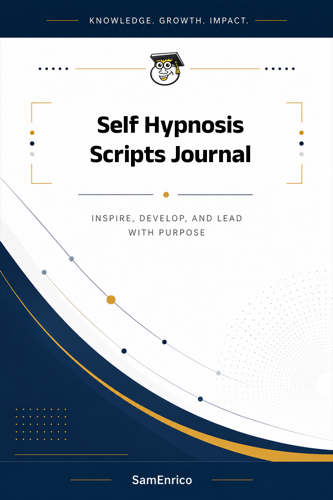
Self Hypnosis Scripts Journal eBook
Blank templates to write your own inductions.
Blank templates to write your own inductions.
Formats
Free sample
Self Hypnosis Scripts Journal: Fixed Edition Revised In-Depth Chapter Summaries (Minimum 250 Words Each)Part I: The Architecture of Trance (The Foundations)Chapter 1: The Syntax of Suggestion – How to Speak to Your Subconscious Core Purpose: To establish the fundamental "grammar" of self-hypnosis and introduce the single perspective rule that governs every script in this book.In-Depth Summary:Most self-hypnosis books provide finished scripts written by an author who has never met you. They assume that one voice, one set of metaphors, and one pacing will work for every reader. This chapter rejects that premise entirely. Before the reader writes a single word, they learn the linguistic rules that separate effective suggestions from wasted breath.The chapter opens with The Golden Rule of Self-Scripting, displayed in a highlighted box: Always write in first person, present tense. You are not commanding someone else.
You are guiding yourself. ("I close my eyes" not "You close your eyes.") This rule is then enforced across every template in the remaining 11 chapters, eliminating the confusion found in other books that mix "I" and "you" indiscriminately.Next, the chapter analyzes the linguistic DNA of two bestselling approaches: The Silva Mind Control Method (direct, commanding language that works well for logical minds) and Allen Carr's Easy Way (reframing and paradoxical logic that undermines resistance). The reader learns the concept of the critical factor—the conscious mind's gatekeeper that rejects suggestions it perceives as external commands. Permissive language ("I notice that...", "I find myself...", "Perhaps I...") bypasses this gatekeeper by making the suggestion feel like the reader's own discovery.The chapter introduces a key distinction: Thematic Scripts (long-form metaphors that create a general mood of change, such as "I am a tree with deep roots") versus Specific Suggestion Scripts (direct behavioral commands such as "When my hand touches the doorknob, I feel calm"). The reader learns when to use each type.The Template: The *3-Sentence Patterning Template* (all in first person):Sentence 1 (The Setup): "I notice that..." (observational, non-demanding)Sentence 2 (The Action): "And as I [verb], I find that..." (links two experiences)Sentence 3 (The Identity Shift): "Which means I am someone who..." (deep structure change)The Critical Factor Box: A one-paragraph definition of the conscious mind's filter, with an example of how a direct command ("I will stop biting my nails") triggers resistance, while a permissive observation ("I notice how often my hands find their way to my mouth...") slips past.Journal Prompt: "Think of one habit you want to change.
Write three versions of a suggestion using direct language ('I will...'). Then rewrite them using permissive language ('I notice that...', 'I find myself...', 'Perhaps I...'). Read both versions aloud. Which one creates less internal resistance? Write that version down as your working draft."Safety Footer (first appearance): At the end of every template chapter (Chapters 5–11), a standard safety clause appears: "If at any point I feel uncomfortable, I can simply open my eyes and be fully present in this room, safe and aware."Chapter 2: The Induction Blueprint – 3 Ways to Lower the Drawbridge Core Purpose: To provide three interchangeable first-person "openers" for any self-hypnosis session, matched to the reader's personality via a diagnostic quiz.In-Depth Summary:An induction is the method used to move from waking beta brainwaves (alert, analytical) to relaxed alpha and theta states (receptive, suggestible).
Without a reliable induction, the user either remains stuck in a light, critical trance or—more commonly—gives up entirely, believing "hypnosis doesn't work for me."This chapter synthesizes classical (eye fixation), somatic (body scan), and Ericksonian (confusion) approaches into three distinct templates. The reader first completes a 5-question diagnostic quiz (see sidebar below) that scores them into one of three categories: Analytical Mind, Skeptical Mind, or Anxious Mind. Each category is then directed to a specific induction template.The Quiz (appears at chapter opening):When you can't sleep, do you most often (a) replay every detail of the day, (b) doubt that anything will help, or (c) feel your heart race?You prefer instructions that are: (a) numbered and clear, (b) weird and surprising, (c) slow and physical.If a guided meditation says "imagine floating on a cloud," you: (a) try to calculate cloud density, (b) roll your eyes, (c) feel dizzy.Your ideal relaxation method is: (a) a checklist, (b) a puzzle, (c) a body scan.When someone says "just breathe," you: (a) analyze your breathing pattern, (b) wonder if breathing even helps, (c) realize you've been holding your breath.Scoring: Mostly A = Countdown Method. Mostly B = Confusion Script. Mostly C = 4-7-8 Breathing Bridge.Template A: The Countdown Method (for Analytical Minds).
A structured, numbered script from 10 to 1, written in first person: "At 10, I notice my jaw... at 7, I feel my shoulders release... at 4, my hands grow heavy... at 1, I am exactly where I need to be." The numbers provide a cognitive track for a mind that otherwise overanalyzes.Template B: The Sensory Overload/Confusion Script (for Skeptics). Uses rapid, contradictory, or nonsensical first-person phrases: "Purple elephants swim sideways while my left ear listens to yesterday...
my right foot knows the taste of Tuesday..." This fatigues the conscious mind into yielding, as discussed in Chapter 1's explanation of the critical factor.Template C: The 4-7-8 Breathing Bridge (for Anxiety). A purely physiological induction: inhale for 4 counts, hold for 7, exhale for 8. The hypnotic language attaches to the breath: "With each exhale, the word 'deeper' floats down my spine... with each inhale, I breathe permission into my chest."Cross-reference note: The term "critical factor" was defined in Chapter 1. Readers unfamiliar should review that section.Important warning: Numeric countdowns (10 to 1) are reserved exclusively for induction.
Do not use numeric countdowns in deepening (Chapter 3) or pain management (Chapter 7). Your subconscious will confuse the purposes.Journal Prompt: "Take the quiz above. Which category received your highest score? Based on that result, which induction will you build your first full script around? Write one sentence explaining why this method feels like a match for your mind."Safety Footer: (Same as Chapter 1)Chapter 3: Deepening the Trance – The Elevator Down Core Purpose: To move the user from a light trance (focused attention) to a medium or deep trance (somnambulism), where major change work is most effective, using spatial descent rather than numeric countdowns.In-Depth Summary:A light trance feels pleasant but is the equivalent of standing at the edge of a swimming pool.
Deep trance—where suggestions actually rewire automatic behaviors—requires getting all the way in. Bestsellers by Robert Monroe (Journeys Out of the Body) emphasize that trance depth is not binary but a ladder. Without a deepening technique, users hover in a light, critical state where suggestions bounce off the surface.This chapter explains escalator imagery: repetitive, downward-moving metaphors (stairs, elevators, sinking into a warm bath, floating down a river) that utilize the brain's reticular activating system to anchor the sensation of "down." Importantly, this chapter does not use numeric countdowns (10 to 1, 20 to 1, etc.) because numeric countdowns are reserved for induction (Chapter 2). Instead, deepening uses spatial and sensory descent: "I step onto the first stair... then the next...
the railing feels cool under my palm... the air grows softer with each step down..."The Journal Exercise: The "My Safe Place" Generator.…
This is the end of the free sample. Get the eBook to keep going. Buy now
About this book
Details
- Author
- Mcelroy Yolonda
- Publisher
- SamEnrico
- Language
- English
- Genre
- Non-Fiction, Self-Help, Journaling
- Released
- 2026-06-05
- Pages (approx.)
- 160
- Available as
- eBook, Audiobook

Read better in the ZLOADR app
Your eBooks on your phone or tablet. Sign in with your SamEnrico account and start reading.
More by Mcelroy Yolonda
 Personal Branding for Real Estate AgentsMcelroy Yolonda$11.99
 In Law Visit Stress GuideMcelroy Yolonda$11.99
 Digital Calendar Time BlockingMcelroy Yolonda$11.99
 Menopause Solo Living GuideMcelroy Yolonda$11.99
 Email Week Batching StrategyMcelroy Yolonda$11.99
 Senate Floor Deal Making SecretsMcelroy Yolonda$11.99
 Power Hour Scheduling GuideMcelroy Yolonda$11.99
 The First Olympic Torch: How a Frenchman Lit the Modern Games (1896)Mcelroy Yolonda$11.99
 The Octopus Who Remembered: How Inky Escaped the Lab and Changed Science ForeverMcelroy Yolonda$11.99
 Exploring Fresco Painting: Buon Fresco & SeccoMcelroy Yolonda$11.99
 Mastering Value Added Tax: Vat Filing & RatesMcelroy Yolonda$11.99
 How to Produce Diving BoardsMcelroy Yolonda$11.99
You may also like
 Stress Journaling for TwoPoirier Melodie$11.99
 Workaholism Recovery JournalParis Cheyenne$11.99
 The Self Esteem Journal for WorkStock Cherrie$11.99
 The Mindset Shift JournalForman Marine$11.99
 The Assertiveness Journal MethodEdgar Ruthanne$11.99
 Sugar Addiction Recovery Journal WorkbookHelms Letitia$11.99
 Student Journaling for StressWagoner Joetta$11.99
 Procrastination Journal PromptsDover Delmar$11.99
 Procrastination Journal MethodShank Dona$11.99
 Pet Bereavement JournalEuler Ross$11.99
 Loneliness Journal WorkbookLoveless Rosanne$11.99
 Habit Journaling WorkbookLancaster Valentine$11.99