
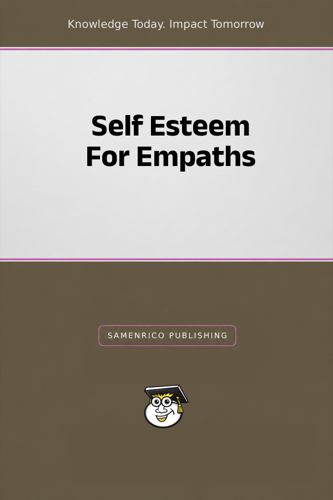
Self Esteem For Empaths eBook
Protect your energy while valuing your gift of fee
by Mahan Foster
Protect your energy while valuing your gift of feeling deeply.
Formats
Free sample
Chapter 1: The Borrowed Suitcase--You wake up in the morning and the first thing you feel is not your own pulse. It is the weight of something you cannot name. You check your phone. A friend texted at 2:00 a.m. about a fight with her partner.
Your mother left a voicemail that sounded tight and anxious. The news cycle is already screaming about another tragedy. You have not even brushed your teeth yet, and you are already carrying the emotional equivalent of a suitcase packed by someone else.This is the life of the untaught empath. You wake up and immediately begin absorbing. You scan the emotional environment the way a lifeguard scans a crowded pool, looking for distress, looking for danger, looking for someone who needs you.
And by the time you have finished your morning coffee, you are already exhausted.The problem is not that you care. The problem is that you have never learned to tell the difference between caring for someone and carrying them. You have confused empathy with ownership. You have mistaken absorption for love.This chapter is called The Borrowed Suitcase because that is what you have been doing your entire life. You have been picking up the emotional luggage of everyone around you and carrying it as if it were your own.
You have been walking through the world bent double under the weight of feelings that were never yours to begin with.It is time to set the suitcase down.The Myth of the Stable Empath Let me tell you something that will sound strange at first. There is no such thing as a stable empath who has not learned energetic hygiene. Just as there is no such thing as a healthy person who never brushes their teeth, there is no such thing as a thriving empath who does not practice daily discernment between self and other.The empaths you admire—the ones who seem calm in a crisis, who can sit with suffering without drowning in it, who love deeply but do not collapse—are not different from you. They have simply learned one skill that you have not yet been taught. They have learned to ask, before they feel, Is this mine?That question is the single most important sentence you will ever speak to yourself.
It is the gatekeeper between your gift and your destruction. When you forget to ask it, you become a sponge. When you remember to ask it, you become a tuned receiver.A sponge absorbs everything. A sponge does not choose. A sponge does not filter.
A sponge does not have a self. It simply takes in whatever liquid surrounds it, and eventually, it becomes heavy, saturated, and useless. That is where you have been living. That is why you are exhausted.A tuned receiver, by contrast, is an instrument. It can calibrate.
It can turn up the volume on some signals and turn down the volume on others. It can even turn off entirely when it needs to rest. A tuned receiver does not absorb. It listens. And listening is a choice.The rest of this chapter will teach you how to recognize when you have been operating as a sponge.
The rest of this book will teach you how to become a tuned receiver. But first, you have to see the pattern clearly. You cannot fix what you will not admit.The Five Signs You Are Carrying Borrowed Luggage You may believe that your emotional state is simply who you are. You may have told yourself, I am an anxious person. I am a sad person.
I am a heavy person. But what if that is not true? What if the anxiety, sadness, and heaviness you feel most days are not yours at all? What if they belong to the people around you, and you have simply been carrying them for so long that you have forgotten where they came from?Here are five signs that you are carrying borrowed luggage.Sign One: You feel dramatically different depending on who you are with.Pay attention to this. Notice how your mood shifts when you leave one person and enter another’s presence.
If you feel light and open with your sister but heavy and contracted with your coworker, that is not random. That is not your personality shifting. That is absorption. You are feeling your sister’s relative lightness and your coworker’s buried heaviness. And because you do not have a filter, you are mistaking their emotional weather for your own.Sign Two: You are exhausted after social interactions, even when nothing “happened.”You spend two hours with a friend.
No conflict. No bad news. No dramatic story. And yet, when you get home, you feel like you have run a marathon. This is not a mystery.
You have been absorbing their emotional state the entire time. They may have felt perfectly fine, or they may have felt a low-grade tension they did not express. Either way, you took it in. And carrying someone else’s emotional energy, even at a low volume, is draining.Sign Three: You feel guilty when you are happy and someone near you is not.This is The Empath’s Guilt, introduced in the previous chapter but worth repeating here because it is so central to the empath’s experience. You are having a good day.
Then you encounter someone who is struggling. Within minutes, your happiness evaporates, and on top of the original heaviness, you feel guilty for having been happy at all. This guilt is not compassion. It is a symptom of poor boundaries. You have not learned to hold your own joy while someone else holds their pain.
You have learned to drop your joy and pick up their pain instead.Sign Four: You know how people are feeling before they tell you.This one feels like a superpower, and in the right context, it is. But in the context of low self-esteem, it becomes a trap. You know your partner is angry before they say a word. You know your friend is lying before they finish the sentence. You know the room is tense before anyone speaks.
And because you know, you feel responsible. You feel like you have to fix it. You feel like their unexpressed emotion is a problem you are supposed to solve. That is not intuition serving you. That is hypervigilance wearing a mask.Sign Five: You have trouble identifying your own needs.When someone asks you what you want, you draw a blank.
When someone asks you how you feel, you have to pause and think about it. You are so accustomed to feeling what others feel that you have lost the signal of your own interior life. This is the deepest cost of the borrowed suitcase. You have carried so many other people’s emotions that you no longer know where your own begin.If you recognize yourself in three or more of these signs, you are not broken. You are not weak.
You are an empath who has never been taught how to filter. And that is about to change.The Biology of Borrowing: Why You Do What…
This is the end of the free sample. Get the eBook to keep going. Buy now
About this book
Details
- Author
- Mahan Foster
- Publisher
- SamEnrico
- Language
- English
- Genre
- Non-Fiction, Self-Help, Empath
- Released
- 2026-06-06
- Pages (approx.)
- 124
- Available as
- eBook, Audiobook

Read better in the ZLOADR app
Your eBooks on your phone or tablet. Sign in with your SamEnrico account and start reading.
More by Mahan Foster
 Ecuador Living Abroad GuideMahan Foster$11.99
 French Revolutionary Army GuideMahan Foster$11.99
 The Difficult Patient TalkMahan Foster$11.99
 The Hypervigilant Adult GuideMahan Foster$11.99
 Pelvic Floor After HysterectomyMahan Foster$11.99
 Opioid Recovery Medication Assisted Treatment ManualMahan Foster$11.99
 Anger and Social MediaMahan Foster$11.99
 Postpartum Depression Return to WorkMahan Foster$11.99
 The Ballot Thieves: How a Shadow War Changed a NationMahan Foster$11.99
 The Ballad of the Unbroken: The Untold Story of the 1968 Mexico City Olympic ProtestMahan Foster$11.99
 The Sleeping Conspiracy: The CIA's Secret War on DreamsMahan Foster$11.99
 Understanding Anemia Sideroblastic Spinocerebellar AtaxiaMahan Foster$17.99
You may also like
 Hong Kong Handover 1997Dunn Johnnie$11.99
 Zumba For Postnatal Recovery CourseNeal Christian$11.99
 Zumba for BeginnersLadner Nikia$11.99
 YouTube Comment Mining GuideHumes Pandora$12.99
 Worry Box MeditationCarlin Rudy$11.99
 Workplace Stress MeditationNguyen Lynn$11.99
 Workplace Stress and Sleep RepairHawley Ivory$11.99
 Workplace Perfectionism CureDelaney Jeffry$11.99
 Workplace Injustice Anger GuideWallen Isabelle$11.99
 Work Addiction and Burnout LinkGreenwood Ester$11.99
 Women in Yoga and WellnessBeattie Galina$11.99
 Women in Stand Up ComedyChun Evangeline$11.99