
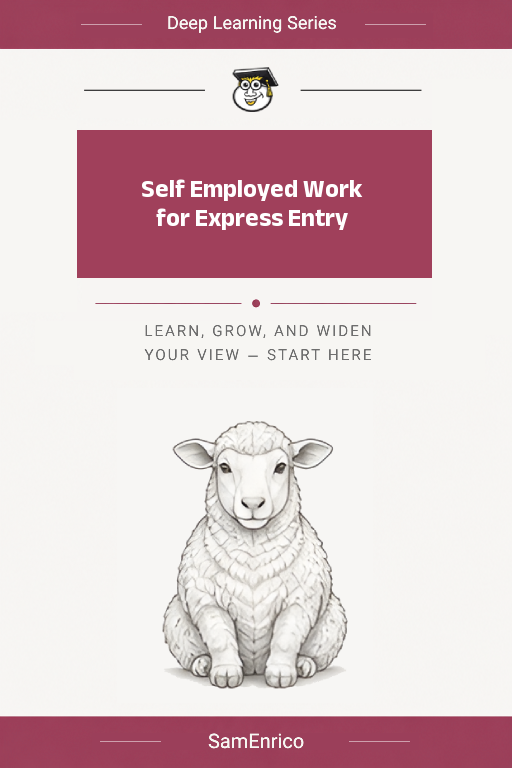
Self Employed Work for Express Entry eBook
Determine if self-employed Canadian work counts fo
by Robson Lauri
Determine if self-employed Canadian work counts for CEC, understanding requirements for incorporation and arm's length clients.
Formats
Free sample
Chapter 1: The Zero-Hour Bomb--–- The email arrived at 11:47 AM on a Tuesday. I remember exactly where I was—sitting in my home office in Vancouver, drinking lukewarm coffee, waiting for what I thought would be the best news of my immigration journey. Instead, I got a gut punch that would cost me two years, $18,000 in legal fees, and countless sleepless nights.The subject line read: "Immigration, Refugees and Citizenship Canada – Application for Permanent Residence – Decision." I clicked open with trembling fingers. The first paragraph was standard bureaucratic language. The second paragraph contained the words that changed everything: *"Your period of work experience in Canada has been assessed as self-employment.
As per section 87.1(3) of the Immigration and Refugee Protection Regulations, any period of self-employment shall not be included in calculating a period of work experience for the Canadian Experience Class. Therefore, you do not meet the minimum requirements."*I had worked in Canada for three years. Three full years. I had accumulated over 4,500 hours of skilled work experience. I had paid my taxes.
I had filed T4 slips. I had a perfect IELTS score. And in that single moment, all of it vanished. The officer had determined that I was "self-employed," and under the rules of the Canadian Experience Class—CEC, for short—self-employment counts for exactly zero hours. Not reduced hours.
Not partial credit. Zero.That was my introduction to the most misunderstood, most dangerous, and least-publicized trap in Canadian immigration law. This book exists because I eventually won—but only after learning that the difference between approval and rejection has almost nothing to do with how many hours you worked or how much tax you paid, and everything to do with two words: control and ownership.This chapter will establish the fundamental framework that governs every other chapter in this book. By the time you finish reading, you will understand exactly why the email I received was possible, how thousands of qualified applicants receive similar refusals every year, and—most importantly—why the traditional advice you've heard from accountants, friends, and even some immigration consultants is dangerously wrong.The $1,560 Illusion: Why Meeting the Hour Requirement Isn't Enough The Canadian Experience Class was created in 2008 to help temporary foreign workers and international graduates transition to permanent residence. The logic was simple: if you've already lived and worked in Canada, you're more likely to integrate successfully than someone coming from abroad.
The eligibility criteria appear straightforward on IRCC's website.To qualify for CEC, you need to meet three core requirements:Work Experience: At least 12 months of full-time skilled work experience in Canada (or the equivalent in part-time hours—1,560 hours total) within the 36 months before you apply.Language Ability: Minimum Canadian Language Benchmark (CLB) scores, ranging from CLB 5 for skilled trades to CLB 7 for TEER 0, 1, or 2 occupations.Intention to Live Outside Quebec: You must intend to live in a province or territory other than Quebec.That's it. At least, that's what the public-facing website says. But hidden beneath these simple requirements is a devastating exclusion that most applicants discover only after they've already wasted years of their lives.Section 87.1(3) of the Immigration and Refugee Protection Regulations states, in full: "For the purposes of subsection (1), any period of self-employment shall not be included in calculating a period of work experience."Read that sentence again. It doesn't say that self-employment counts for less. It doesn't say that self-employment requires additional documentation.
It says that any period of self-employment "shall not be included." Zero. Null. Void.Here's where the illusion begins. Most business owners, freelancers, and contractors in Canada work for years, accumulate thousands of hours, and assume they qualify. They might own a small marketing agency.
They might drive for Uber or Door Dash. They might incorporate and pay themselves a salary. They might work as a long-term contractor for a single client. In each of these cases, they are building Canadian work experience—or so they believe.But if IRCC determines that their work constitutes "self-employment," all of those hours vanish. Not some of them.
Not the ones that don't meet a certain threshold. Every single hour. You could have 10,000 hours of Canadian work experience, and if an officer determines you were self-employed, your qualifying work experience total becomes zero.I've seen this happen to software engineers who incorporated their own consulting companies. I've seen it happen to franchise owners who worked 60-hour weeks for years. I've seen it happen to doctors—before the 2023 exception—who were told that their fee-for-service work didn't count.
In every case, the applicant believed that because they were working hard, paying taxes, and contributing to Canada, their experience would be recognized. In every case, they were wrong.The Employee vs. Independent Contractor Distinction: A Legal Framework To understand why IRCC treats self-employment so harshly, you need to understand the legal distinction between an "employee" and an "independent contractor." This distinction has existed in common law for centuries, long before Canadian immigration law existed. It forms the backbone of employment standards, tax law, and now—immigration.An employee works under a contract of service. In plain English, this means the employee agrees to work for an employer, and the employer has the right to control not just what work is done, but how, when, and where it is done.
The employer bears the financial risk of the business. The employer provides tools, equipment, and workspace. The employee is integrated into the employer's business and cannot subcontract the work to others without permission.An independent contractor, by contrast, works under a contract for services. The contractor agrees to produce a specific result or deliver a specific service, but the person hiring them—the client—does not control how the work is performed. The contractor bears their own financial risk.
The contractor provides their own tools and equipment. The contractor is operating their own business, separate from the client's business, and can typically subcontract the work to others.Here's why this distinction is critical for CEC: IRCC has determined, as a matter of policy, that independent contractors are self-employed, and self-employment does not count. Employees, by contrast, are generally eligible, provided they meet the other requirements.But here's where the trap becomes truly dangerous. Many people who believe they are employees are actually independent contractors under the legal test. And many people who are independent contractors believe they can "fix" this by incorporating, issuing T4 slips to themselves, or creating employment contracts.
They cannot. The legal test looks past these formalities to the underlying reality of the working relationship.Consider three scenarios:Scenario A: Maria works as a marketing manager for a tech company. The company sets her hours, provides her laptop and software, reimburses her expenses, and has the right to fire her if her performance is unsatisfactory. Maria is an employee. Her CEC application will likely succeed.Scenario B: David runs his own graphic design business.
He has a single client that accounts for 90% of his revenue. He works from his home office, uses his own equipment, sets his own hours, and hires subcontractors when he's overbooked. David is an independent contractor. Even if his client calls him a "freelance employee" in their contract, IRCC will…
This is the end of the free sample. Get the eBook to keep going. Buy now
About this book
Details
- Author
- Robson Lauri
- Publisher
- SamEnrico
- Language
- English
- Genre
- Non-Fiction, Student's Shortcut
- Released
- 2026-06-01
- Pages (approx.)
- 160
- Available as
- eBook, Audiobook

Read better in the ZLOADR app
Your eBooks on your phone or tablet. Sign in with your SamEnrico account and start reading.
More by Robson Lauri
 New Choice GameRobson Lauri$11.99
 Morning Routine for PoliceRobson Lauri$11.99
 SR 71 Blackbird ReconRobson Lauri$11.99
 Sam Sheppard Burial LocationRobson Lauri$11.99
 The Retirement Housing Dual Agency RiskRobson Lauri$11.99
 Crucial Conversations SummaryRobson Lauri$11.99
 Tom Kenny SpongeBob LifeRobson Lauri$11.99
 Thyroid And Menopause OverlapRobson Lauri$11.99
 Tipu Sultan's Last Stand: The Siege of Seringapatam (1799)Robson Lauri$11.99
 The 1996 Unabomber Manifesto: How a 23,000-Word Essay Almost Ended a Decade of TerrorRobson Lauri$11.99
 Service Providers Guide to Beauty ConsultantsRobson Lauri$11.99
 How to Produce Vehicle Door Lock KnobsRobson Lauri$11.99
You may also like
 Hong Kong Handover 1997Dunn Johnnie$11.99
 Zumba For Postnatal Recovery CourseNeal Christian$11.99
 Zumba for BeginnersLadner Nikia$11.99
 YouTube Comment Mining GuideHumes Pandora$12.99
 Worry Box MeditationCarlin Rudy$11.99
 Workplace Stress MeditationNguyen Lynn$11.99
 Workplace Stress and Sleep RepairHawley Ivory$11.99
 Workplace Perfectionism CureDelaney Jeffry$11.99
 Workplace Injustice Anger GuideWallen Isabelle$11.99
 Work Addiction and Burnout LinkGreenwood Ester$11.99
 Women in Yoga and WellnessBeattie Galina$11.99
 Women in Stand Up ComedyChun Evangeline$11.99