
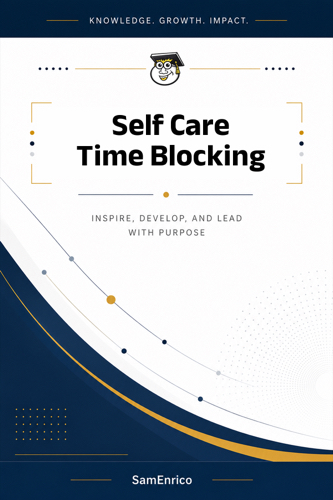
Self Care Time Blocking eBook
Schedule exercise, rest, and hobbies as non-negoti
Schedule exercise, rest, and hobbies as non-negotiable calendar blocks.
Formats
Free sample
Chapter 1: The Good Worker’s Death Wish--–- The first time I died, I was holding my phone.Not metaphorically. Not “a part of me died.” My heart stopped for eleven seconds in a fluorescent-lit exam room at Mount Sinai Hospital while a resident named Dr. Patel pressed two cold electrodes to my chest and said, “Try to breathe slowly, Ms. Chen.”I was thirty-two years old. I was a senior vice president at a Fortune 500 company.
I led two hundred people across fourteen time zones. I had not slept eight consecutive hours in over a decade. And in the moment my heart went into arrhythmia and my blood pressure hit 178 over 112, I was mid-sentence on a Slack message.The message, which I never sent, read: “Can you review the Q3 deck? I’ll work on it tonight.”That was the entire eulogy I almost wrote for myself: I’ll work on it tonight.The doctors called it adrenal failure complicated by severe burnout syndrome. My boss called it “a wake-up call.” My mother called it “what happens when you don’t listen to your body.” My therapist later called it “a predictable outcome of a life organized around the false promise that exhaustion is a virtue.”But I have another name for it.
I call it The Good Worker’s Death Wish.The Lie You Were Hired to Believe Let me tell you something that no performance review will ever admit: Your employer did not hire you to be healthy. Your employer hired you to produce. And the most efficient way to extract production from a human being, in the short term, is to convince that human being that their worth is measured in hours of suffering.This is not a conspiracy. It is not malicious. It is simply the logic of a system that was built before we understood the biology of rest, the neuroscience of attention, or the epidemiology of burnout.
The modern workplace inherited its values from the Protestant work ethic, the Industrial Revolution’s time clocks, and the 1980s “greed is good” culture of sixty-hour workweeks. None of those inheritance sources knew what we know now: that exhaustion is not a badge of honor. Exhaustion is a predictor of early death.And yet.And yet you have probably felt it yourself. That small, secret thrill when you say “I’m so busy” and someone nods with respect. That quiet pride when you cancel your vacation because “the team needs me.” That strange comfort of collapsing into bed at midnight after a sixteen-hour day, thinking, I earned this exhaustion.
I am a good worker.That feeling? That is the Good Worker’s Death Wish.I coined this term after reviewing the medical literature on burnout and realizing that the psychological reward system for overwork operates exactly like a mild addiction. Dopamine is released when you receive social approval for overworking. Cortisol spikes when you try to stop. Your brain literally learns to associate exhaustion with safety because exhaustion means you are performing.
Rest, by contrast, feels dangerous. Rest means you might be seen as lazy. Rest means you might fall behind. Rest means you might discover who you are without the job – and that person might be a stranger.The Good Worker’s Death Wish is the unconscious belief that self-destruction is a prerequisite for self-worth.The Hospital Bed That Changed Everything I want to tell you what happened after my heart stopped, because it matters for everything that follows in this book.When I woke up – and I did wake up, obviously, or you would be reading a very different kind of book – I was hooked to an IV drip of magnesium and potassium. My phone was on the bedside table.
It had 247 unread messages. I remember looking at the red notification bubbles and feeling something I had never felt before in my adult life: nothing.Not exhaustion. Not panic. Not the usual frantic I need to respond immediately or the world will end.Nothing.Dr. Patel came in with my lab results.
She was young, maybe twenty-nine, with the kind of direct eye contact that told me she had delivered bad news before. She said, “Ms. Chen, your cortisol levels are below measurable threshold. Your adrenal glands have essentially shut down. Your body has been producing stress hormones at maximum capacity for so long that it has run out of raw materials.
If you continue your current lifestyle, you will be back here within six months. Next time, we might not be able to restart your heart.”I asked, “What do I need to change?”She said, “Everything.”I asked, “How much time do I have to change it?”She said, “You already ran out of time. You just didn’t know it.”That night, lying in the hospital bed with my phone face-down on the table, I did something I had not done in years. I closed my eyes and did not think about work. I did not think about the Q3 deck.
I did not think about the fourteen time zones or the two hundred people or the Slack messages I was not answering. I thought about my body. I thought about how strange it felt to be still. I thought about how my hands, which had been typing for sixteen hours a day for a decade, were empty.And then I thought about a question that would become the foundation of this book:What would my calendar look like if my health was non-negotiable?Not a nice-to-have. Not a “when things calm down.” Not a reward for finishing a project.
Non-negotiable. Like a mortgage payment. Like a court date. Like a flight departure.I did not know the answer that night. But I knew that the answer was the only thing standing between me and another hospital bed.The Martyrdom Bonus: A Secret Reward System Over the next three years, as I recovered, left my executive role, and began coaching other burned-out high achievers, I noticed a pattern.
Almost every single one of my clients – doctors, lawyers, startup founders, teachers, nurses, software engineers, parents of young children – had the same hidden reward system operating in their minds.I call it the Martyrdom Bonus.The Martyrdom Bonus is the unconscious psychological payoff you receive when you sacrifice your well-being for productivity. It works like this:You skip lunch to finish a report.Your boss praises your dedication.You feel a surge of validation – I am valuable because I suffer.Your brain encodes the connection: suffering = approval.Next time, you skip not just lunch but also your evening workout.The cycle repeats, each time demanding more sacrifice for the same reward.The Martyrdom Bonus is why you feel anxious when you take a vacation. It is why you check email in the bathroom. It is why you say “I’m so busy” with a hint of pride rather than a cry for help. You have been trained – by your workplace, by your family, by your own neural pathways – to believe that exhaustion is evidence of worth.But here is what the Martyrdom Bonus hides from you: Exhaustion is not evidence of worth.
Exhaustion is evidence of depletion.When you are depleted, you make worse decisions. You are less creative. You are more reactive.…
This is the end of the free sample. Get the eBook to keep going. Buy now
About this book
Details
- Author
- Hutcherson Leta
- Publisher
- SamEnrico
- Language
- English
- Genre
- Non-Fiction, Self-Help, Self-Care
- Released
- 2026-06-06
- Pages (approx.)
- 151
- Available as
- eBook, Audiobook

Read better in the ZLOADR app
Your eBooks on your phone or tablet. Sign in with your SamEnrico account and start reading.
More by Hutcherson Leta
 Edge Computing CapitalHutcherson Leta$11.99
 Sleep Disturbance TriggersHutcherson Leta$11.99
 Essential Vitamins Daily GuideHutcherson Leta$11.99
 Sheppard Case Bloody HandprintHutcherson Leta$11.99
 The Sales Presentation PlaybookHutcherson Leta$11.99
 Permissive vs Authoritarian ScriptsHutcherson Leta$11.99
 Sound Sensitivity MigraineHutcherson Leta$11.99
 Anger And Trauma BondHutcherson Leta$11.99
 The Iron Poet: Isambard Kingdom Brunel and the Victorian Age of IngenuityHutcherson Leta$11.99
 Silk and Sabotage: The Duchess Who Outmaneuvered the CrownHutcherson Leta$11.99
 The Lost Excalibur: Secrets of the Forgotten SwordHutcherson Leta$11.99
 Mastering MortgagesHutcherson Leta$11.99
You may also like
 Sick Day Guilt Elimination GuideMcdonald Violet$11.99
 Self-Care as a Relapse ShieldWiles Mandi$11.99
 Eisenhower For Self Care GuideHutcheson Jere$11.99
 Self Care Comparison CureCody Zofia$11.99
 Self Care For Burnout Prevention GuideGaither Gricelda$11.99
 Emotional Self Care GuideNolen Lester$11.99
 The Anger Vulnerability LinkDancy Jovita$11.99
 Scheduling Self Care BlocksPeltier Garret$11.99
 Trigger Self Care After ActivationWard Earnest$11.99
 Self Care Time Blocking GuideGalvez Dian$11.99
 Mental Health Days from SchoolMccune Irwin$11.99
 Financial Self Care PlanConnell Rebbecca$11.99