
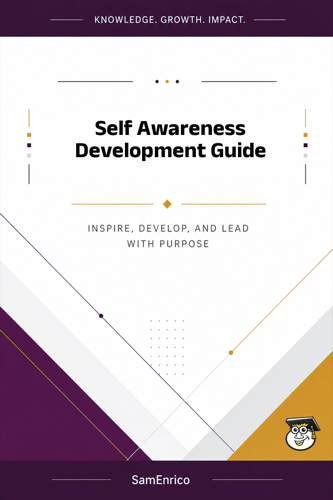
Non-FictionSelf-HelpSelf-Awareness
Self Awareness Development Guide Audiobook
Identify your emotional triggers, patterns, and bl
by Trice Jinny
Identify your emotional triggers, patterns, and blind spots effectively.
Formats
Free sample
Chapter 1: The Mirror That Lies--Most people believe they know themselves better than anyone else could. This assumption feels unshakable, almost sacred. After all, who has spent more time with you than you? Who has witnessed your private thoughts, your midnight regrets, your secret hopes? The answer seems obvious.
And yet, a growing body of psychological research reveals a disturbing paradox: the very act of thinking about yourself often makes you less self-aware, not more.This is the central deception of introspection. You sit down, perhaps with a journal or a glass of wine, and you ask yourself the big questions: Why did I snap at my partner today? Why do I feel so stuck in my career? Why does that colleague always get under my skin? You search your memory, you analyze your feelings, and eventually, you arrive at an answer.
It feels like progress. It feels like wisdom. But according to Tasha Eurich, an organizational psychologist who spent years studying self-awareness, those answers are frequently wrong—and worse, they can actually reinforce the very patterns you are trying to break.In her seminal book Insight, Eurich and her team reviewed decades of research and conducted their own studies involving thousands of participants. The findings were sobering. People who scored high on measures of introspection—meaning they spent a lot of time thinking about themselves—were often less self-aware than those who rarely introspected.
They were more anxious, more depressed, and more likely to feel trapped in their own narratives. Why? Because they were asking the wrong question. They were asking "Why?" when they should have been asking "What?"This chapter dismantles the most dangerous myth in personal development: that all self-reflection is good reflection. You will learn the critical difference between Internal Awareness (seeing your own values, emotions, and aspirations clearly) and External Awareness (understanding how your behavior lands on others).
You will discover why the people closest to you are likely lying to you about your blind spots—and how to finally get them to stop. Most importantly, you will be introduced to the single most important tool in this entire book: the distinction between Destructive Introspection (the "Why" trap that leads to rumination) and Constructive Introspection (the "What" shift that leads to data and change).By the end of this chapter, you will never approach self-reflection the same way again. You will have a new relationship with your own…
This is the end of the free sample. Get the Audiobook to keep going. Buy now
About this book
Details
- Author
- Trice Jinny
- Publisher
- SamEnrico
- Language
- English
- Genre
- Non-Fiction, Self-Help, Self-Awareness
- Released
- 2026-06-10
- Pages (approx.)
- 156
- Available as
- eBook, Audiobook

Listen in the VoxFlicks app
Audiobooks and audio dramas wherever you go. Sign in with your SamEnrico account and press play.
More by Trice Jinny
 Relationship Building CRM GuideTrice Jinny$11.99
 Loneliness Tennis Partner GuideTrice Jinny$11.99
 Hypnosis Meditation FusionTrice Jinny$11.99
 The Travel Tech Capital ForecastTrice Jinny$11.99
 Admitting Mistakes to BossTrice Jinny$11.99
 The Exhaustion Diary MethodTrice Jinny$11.99
 Kennedy CamelotTrice Jinny$11.99
 Bladder Cancer VictoryTrice Jinny$11.99
 The Ghost in the Machine: How AI Almost Triggered WWIIITrice Jinny$11.99
 The Timbuktu Gold Heist: The Philanthropic Gambit of the Songhai EmpireTrice Jinny$11.99
 The Jungle Alchemist: How a Forgotten Explorer Unlocked the Secrets of QuinineTrice Jinny$11.99
 How to Start a Credit or Finance Broking Business (Beginners Guide)Trice Jinny$11.99
You may also like
 Hong Kong Handover 1997Dunn Johnnie$11.99
 Zumba For Postnatal Recovery CourseNeal Christian$11.99
 Zumba for BeginnersLadner Nikia$11.99
 YouTube Comment Mining GuideHumes Pandora$12.99
 Worry Box MeditationCarlin Rudy$11.99
 Workplace Stress MeditationNguyen Lynn$11.99
 Workplace Stress and Sleep RepairHawley Ivory$11.99
 Workplace Perfectionism CureDelaney Jeffry$11.99
 Workplace Injustice Anger GuideWallen Isabelle$11.99
 Work Addiction and Burnout LinkGreenwood Ester$11.99
 Women in Yoga and WellnessBeattie Galina$11.99
 Women in Stand Up ComedyChun Evangeline$11.99