
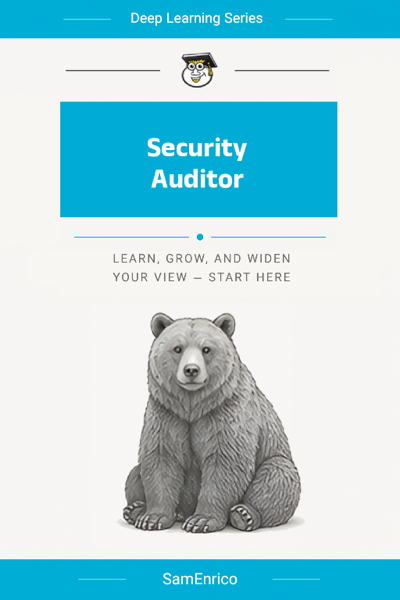
Security Auditor eBook
A Coursebook on Security Auditor
A Coursebook on Security Auditor
Formats
Free sample
Chapter 1: Beyond the Checklist...--The first time Maria Chen watched a company burn, she was sitting in a perfectly air-conditioned conference room, eating a complimentary muffin, and checking boxes on an audit work paper that had been used without meaningful change for eleven years.The muffin was blueberry. She remembers that detail with uncomfortable clarity because it was the last normal moment before her career shattered. The client, a regional bank with $47 billion in assets, had provided the usual evidence: policies, screen shots, organizational charts, and a signed statement from the CISO affirming that all controls were operating effectively. Maria had reviewed every document. She had interviewed the IT staff.
She had verified that the bank held a valid ISO 27001 certificate issued just four months earlier by a reputable certification body. Her work papers were pristine. Every box was checked. Every control was marked "compliant."Three weeks after she signed off on the audit report, a threat actor walked through an unsecured VPN gateway that had been misconfigured for four years. The firewall rule that allowed the access had been flagged as "not in use" in the bank's own documentation, but no one had ever tested whether it actually did anything.
Maria had not tested it either. Her audit program had asked for the firewall rule-base export, which she received and filed. It had not asked her to verify whether the rules matched the network's actual behavior. No one had ever taught her to ask that question.The breach exposed 1.2 million customer records. The bank's stock price fell 34 percent in two days.
The CISO was fired. The internal audit director was reassigned. And Maria's firm, a mid-sized consultancy that had built its reputation on "thorough, compliance-focused audits," found itself named in a shareholder lawsuit alleging that the audit had been performed with gross negligence.Maria was not sued. She was too junior, too invisible, too easy to blame without formal consequences. But she was called into a conference room by the firm's managing partner, a woman named Diane who had started as an auditor in the 1990s and had never quite trusted the shift toward pure compliance work.
Diane did not yell. She did not fire Maria on the spot. Instead, she slid a single piece of paper across the table. On it was written a question that Maria would later recognize as the only question that actually matters in security auditing."What would have happened if you had tested the control instead of just checking for its existence?"Maria did not have an answer. She had never been trained to think that way.She spent the next three months reading everything she could find about security auditing that was not a compliance checklist.
She studied the major breaches of the previous decade—Target, Equifax, Solar Winds, Colonial Pipeline. In every single case, the victim had passed a compliance audit shortly before the breach. In every single case, the auditor had checked boxes but had not asked whether the controls actually worked under real conditions. In every single case, someone had confused paperwork with security.By the end of those three months, Maria had a new philosophy, a new approach, and a new mission. She also had a new job offer from a different firm—one that specialized in what Diane called "strategic auditing" rather than compliance verification.
But before she accepted it, Diane gave her one more piece of advice."You are going to write a book someday," Diane said. "When you do, start with this lesson. And start with a story about a muffin."This chapter is that lesson.The Great Lie of Compliance Auditing Let us begin with an uncomfortable truth that most security audit textbooks will not tell you: Compliance does not equal security, and in many cases, compliance auditing actively undermines security by creating a false sense of safety.This is not an opinion. It is an empirical observation supported by decades of breach data. The 2013 Target breach occurred while the retailer held a valid PCI DSS compliance certificate.
The 2017 Equifax breach occurred after the company had passed multiple audits against NIST standards. The 2020 Solar Winds breach occurred in an organization that had achieved ISO 27001 certification. The 2021 Colonial Pipeline ransomware attack occurred in a company that passed annual audits for pipeline security regulations.The pattern is unmistakable. Organizations that treat audits as a compliance exercise—a box to check, a certificate to display, a report to file away—consistently suffer breaches that their audits should have prevented. And the auditors who perform those checkbox audits consistently find themselves explaining, after the fact, why their perfectly compliant reports did not stop the inevitable.The problem is not that audit standards are useless.
The problem is that most organizations—and most auditors—misunderstand what an audit is supposed to do. A compliance audit asks: "Does this organization have documentation that matches the standard?" A strategic audit asks: "Does this organization have controls that actually stop real attacks under real conditions?"Those two questions are not the same. They are not even close.A documented firewall rule does nothing if the rule is misconfigured. A signed policy does nothing if employees ignore it. A tested backup plan does nothing if the backups are themselves vulnerable to ransomware.
A completed training module does nothing if employees still click on phishing links. Documentation is a necessary starting point, but it is never a sufficient endpoint.The security auditor who stops at documentation is like a building inspector who verifies that blueprints exist but never visits the construction site. The blueprints might be beautiful. They might comply with every building code on paper. But if the workers ignored them, if the materials were faulty, if the foundation was poured incorrectly, the building will collapse regardless of the quality of the documentation.The critical distinction: This book is not anti-checklist.
Checklists, properly designed, are essential tools for ensuring repeatability, consistency, and defensibility. The problem is not checklists themselves. The problem is bad checklists—tick-box exercises that demand no thinking, capture no evidence, and create a false sense of completion. Throughout this book, you will learn to create and use good checklists: traceable, evidence-based work papers that force you to document what you tested, how you tested it, and what you actually observed. The Appendix provides downloadable templates.
But you will also learn to recognize when a checklist is becoming a substitute for thinking—and that is the moment to put it down and ask the harder question.The Three Lines of Defense: Where the Auditor Stands Before we go further, we need to establish where the security auditor fits within an organization's overall governance structure. The model most widely used by professional audit bodies—including the Institute of Internal Auditors and ISACA—is called the Three Lines of Defense.First Line: Management. This includes the business owners, IT operators, and security practitioners who own and manage risk on a day-to-day basis. They implement controls, respond to incidents, and make operational decisions about security. In a well-run organization, the first line is where most security work actually happens.Second Line: Risk Oversight.
This includes functions like compliance, risk management, and quality assurance. They monitor the first line, establish policies and standards, and…
This is the end of the free sample. Get the eBook to keep going. Buy now
About this book
Details
- Author
- Mcmanus Coreen
- Publisher
- SamEnrico
- Language
- English
- Genre
- Non-Fiction, Informative, Educational
- Released
- 2026-06-03
- Pages (approx.)
- 155
- Available as
- eBook, Audiobook

Read better in the ZLOADR app
Your eBooks on your phone or tablet. Sign in with your SamEnrico account and start reading.
More by Mcmanus Coreen
 Hyperpalatable Food AvoidanceMcmanus Coreen$11.99
 TM For Dental AnxietyMcmanus Coreen$11.99
 The Asha Degree MemorialMcmanus Coreen$11.99
 The Child Death Anniversary GuideMcmanus Coreen$11.99
 Apology And Repair After BlowupMcmanus Coreen$11.99
 The Betrayal of Ayutthaya: Siam's Fall to the Burmese (1767)Mcmanus Coreen$11.99
 Understanding Warburton–anyane–yeboa SyndromeMcmanus Coreen$17.99
 How to Start a Bast Fibres and Special Yarns Weaving Business (Beginners Guide)Mcmanus Coreen$11.99
 Venture Debt Tax TreatmentMcmanus Coreen$12.99
 Madrid Renewal ProcessMcmanus Coreen$12.99