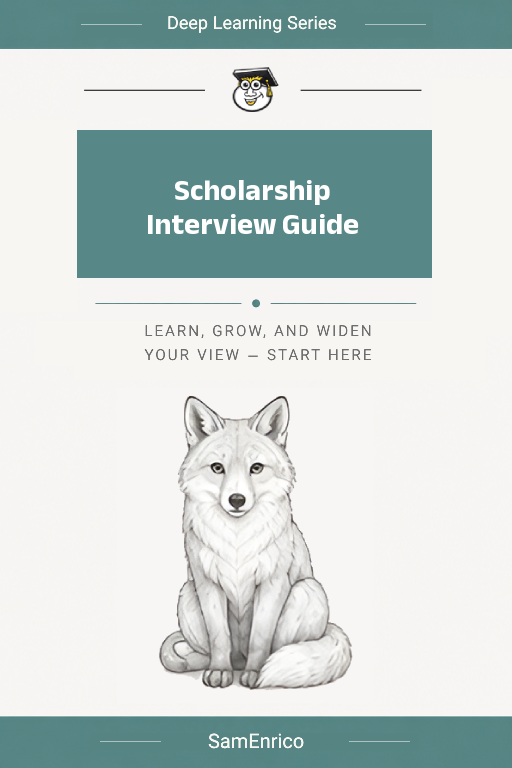
Scholarship Interview Guide eBook
Ace scholarship interviews for African students in
Ace scholarship interviews for African students including common questions and panel preparation.
Formats
Free sample
Chapter 1: The Invisible Scorecard...--–- Every scholarship interview begins long before you enter the room—or click the Zoom link. While you are nervously rehearsing your answers about leadership and career goals, the panelists are already scoring you on a rubric you have never seen. This chapter reveals that hidden scorecard, dismantles the myths that sink most African applicants, and gives you the exact framework to prepare not for a conversation, but for a test you can finally understand.Most applicants walk into a scholarship interview believing it is a conversation. They think the panel wants to “get to know them” or “see if they are a good fit.” This belief is the single most dangerous mistake you can make, and it is the reason brilliant students with perfect grades walk out empty-handed while seemingly less accomplished candidates win the funding.The truth is harsher but far more useful: a scholarship interview is not a conversation. It is a structured evaluation against a hidden scorecard.
Every panel—whether for Chevening, DAAD, Commonwealth, Australia Awards, or a local bursary like NSFAS or NNPC—has a rubric. They are filling it out in real time, awarding points, subtracting points, and comparing you to every other candidate who sits in that same chair.This chapter will show you exactly what is on that scorecard. You will learn why generic confidence tips fail African applicants specifically. You will discover the three universal layers of evaluation that every panel uses, how different scholarships weight those layers differently, and why your preparation must begin not with practicing answers but with decoding the test you are about to take.The Myth of the Friendly Conversation Imagine two candidates. Candidate A has a 3.9 GPA, eloquent English, and a polished suit.
Candidate B has a 3.5 GPA, a heavier accent, and a slightly wrinkled shirt. Who wins? If you said Candidate A, you have fallen into the conversation trap.In a real scholarship interview, Candidate B often wins—not because of luck, but because Candidate B understood the scorecard. Candidate B knew that the panel was not evaluating charisma or vocabulary. They were evaluating three specific things, and Candidate B had prepared evidence for each one while Candidate A simply tried to be likable.The conversation trap convinces you that your job is to impress the panel with your personality, your story, or your passion.
But panels are not your friends, your mentors, or your audience. They are evaluators with a budget, a mandate, and a limited number of scholarships to award. Every question they ask maps to a line on their rubric. When you treat the interview like a chat, you are guessing. When you treat it like a test, you are prepared.This distinction matters more for African applicants than for any other group.
Why? Because the expectations placed on you are different. An American student applying for a domestic scholarship may never be asked, “Will you come back to your community?” A European student may never need to justify why their country deserves their talent. But you will. And if you do not know that question is coming—and that it is worth 30 to 60 percent of your total score—you will fumble it even though you have the right answer somewhere inside you.The Three Layers of the Hidden Scorecard After analyzing rubrics from over forty scholarships and interviewing panelists from Chevening, DAAD, Commonwealth, Australia Awards, Mastercard Foundation, and six African government bursaries, a clear pattern emerges.
Every scholarship panel evaluates you across three universal layers.The first layer is Academic and Professional Potential. This is what you think they care about most. Your grades, your research experience, your work history, your technical competence. But here is the shock: for most scholarships, this layer is only 20 to 30 percent of the total score. You need to clear a minimum bar, but after that, your transcript stops mattering.
The panel assumes you are smart enough because you would not have reached the interview otherwise. From this point forward, they are evaluating something else.The second layer is Leadership and Character. This is worth 30 to 50 percent of your score, depending on the scholarship. Chevening famously weights leadership at 60 percent. Mandela Rhodes looks almost entirely at leadership potential.
Mastercard Foundation prioritizes “service-minded leadership.” This layer asks: Have you moved people toward a goal? Have you taken initiative without being told? Have you solved a problem that was not your responsibility? Have you led when you had no formal authority?The third layer is Development Impact or Reintegration Plan. This is the layer that most generic interview guides miss entirely, and it is where African applicants either win or lose.
This layer asks: What will change in your community, your country, or your field because of this scholarship? For Australia Awards, this layer is 60 percent of the score. For Commonwealth, it is 55 percent. For local bursaries like NSFAS, this layer includes your family’s financial need and your commitment to working in South Africa after graduation.Every question you are asked maps to one of these three layers. “Tell me about yourself” maps to Layer Two (Leadership) and Layer Three (Development Impact).
“Why this course?” maps to Layer One (Potential) but also Layer Three (How will you use it?). “Describe a leadership failure” maps purely to Layer Two. “What will you bring back to your community?” is pure Layer Three.When you understand this mapping, you stop guessing. You listen to a question, identify which layer it is testing, and deliver the evidence that layer requires.Why Generic Confidence Tips Fail African Applicants Walk into any bookstore or search any online retailer for scholarship interview guides. You will find dozens of books promising to help you “ace your interview” with advice like “be confident,” “make eye contact,” “smile,” “dress professionally,” and “practice your answers.” This advice is not wrong.
It is simply insufficient. Worse, it is often irrelevant to the specific pressures African applicants face.Generic confidence tips assume that the only barrier between you and the scholarship is your own nervousness. They assume that if you can calm your nerves and present yourself well, the panel will naturally see your worth. This assumption fails for three reasons that are particularly acute for African students.First, generic guides never mention the return question. They do not prepare you to answer “Will you stay abroad?” because American and European applicants are rarely asked this.
You will be asked this, directly or indirectly, in almost every international scholarship interview. If your only preparation came from a generic guide, you will stumble, hedge, or give a vague answer that sounds like a lie. The panel will mark you down severely.Second, generic guides treat financial need as a personal story to be shared with vulnerability. They encourage you to “open up” about your struggles. For African applicants, this is dangerous.
Panels are wary of trauma narratives, and many have unconscious biases that make them suspicious of applicants who emphasize hardship over achievement. You need a different approach—one that states your need with dignity and immediately pivots to your potential.Third, generic guides assume a level playing field of resources. They tell you to “practice in…
This is the end of the free sample. Get the eBook to keep going. Buy now
About this book
Details
- Author
- Boudreau Florance
- Publisher
- SamEnrico
- Language
- English
- Genre
- Non-Fiction, Student's Shortcut, Interview
- Released
- 2026-06-01
- Pages (approx.)
- 136
- Available as
- eBook, Audiobook

Read better in the ZLOADR app
Your eBooks on your phone or tablet. Sign in with your SamEnrico account and start reading.
More by Boudreau Florance
 Outsourcing Career TransitionBoudreau Florance$11.99
 Overcoming Creative BlockBoudreau Florance$11.99
 Understanding BPH Symptoms GuideBoudreau Florance$11.99
 Self Hypnosis for Sjogren's PainBoudreau Florance$11.99
 Slack Communication Best PracticesBoudreau Florance$11.99
 Self Esteem at Work CourseBoudreau Florance$11.99
 The Consistency Influence MethodBoudreau Florance$11.99
 OBCR Album SessionsBoudreau Florance$11.99
 The Last Broadcast: When the Internet Almost DiedBoudreau Florance$11.99
 Dorothy Unbowed: The Rebel Dancer Who Defied ConventionBoudreau Florance$11.99
 Akbashs: Livestock Guardian DogBoudreau Florance$11.99
 How to Start a Cold Reduced Steel Slit Strip >= 600mm Business (Beginners Guide)Boudreau Florance$11.99