
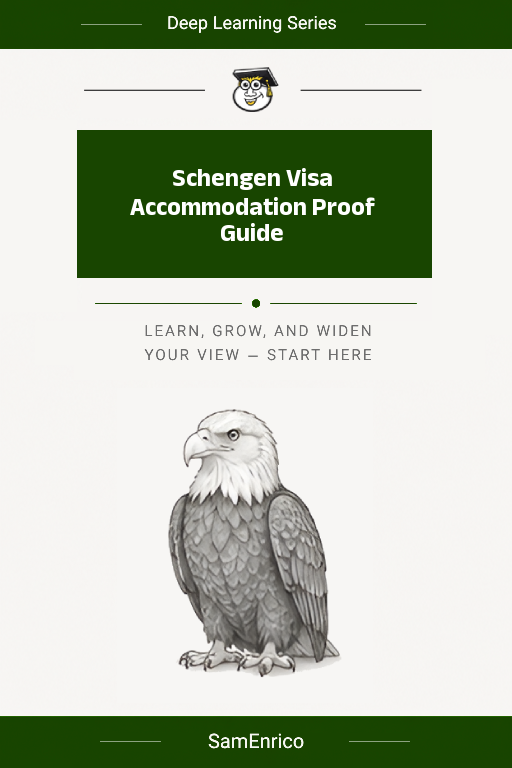
Schengen Visa Accommodation Proof Guide eBook
Present dorm reservation or rental contract verifi
Present dorm reservation or rental contract verified by university for student visa interview success.
Formats
Free sample
Chapter 1: The Anchor Principle--–- The rejection letter arrived on a Tuesday. Maria from Colombia had done everything right – her university admission was confirmed, her blocked account held more than the required €11,208 for Germany, and her passport had plenty of blank pages. But pinned to the bottom of the refusal notice, under the box marked "Reason for Denial," were four words that would change how she understood visa applications forever: Accommodation proof not credible.She had submitted an invitation letter from a friend in Berlin – a friend she had known for years, who had written a warm, detailed letter promising housing. What more could they want? The consular officer didn't explain.
There was no appeal hotline, no feedback session. Just a stamp and a shattered semester.Maria's story is not unusual. It is repeated thousands of times every year across the Schengen Area. Students with perfect grades, full funding, and genuine intentions are rejected not because they lack money or academic ability, but because they failed to understand one deceptively simple document: proof of accommodation.This book exists because that document is almost never what it seems.The Hidden Weight of a Piece of Paper Most applicants approach accommodation proof as a bureaucratic nuisance – a box to check, a formality to satisfy. They believe that as long as they can show somewhere to stay, the visa officer will move on to more important matters like bank statements or enrollment letters.This misunderstanding is dangerous.Consular officers do not view accommodation proof as a minor detail.
They view it as a window into your entire application. Here is what a single housing document tells them, if they know how to read it:First, it tells them whether you have a realistic plan. A student who books a hotel for five nights while applying for a two-year Master's degree has not thought seriously about their future. That suggests impulsiveness – a trait consulates associate with visa overstays.Second, it tells them whether someone has vouched for you legally. A dormitory contract from a university means an institution has accepted responsibility for your presence.
A private lease means a landlord has verified your identity and financial capability. An invitation from a friend means... nothing legally binding. The friend can change their mind. The friend might not even own the apartment.Third, and most subtly, accommodation proof tells the officer whether you will disappear.
Every Schengen country has a problem with visa overstayers – people who enter legally and simply never leave. The single strongest predictor of overstaying is the absence of a verifiable, long-term address. A hotel booking expires. A friend's couch has no paper trail. But a registered lease or a dorm contract creates an anchor – something that ties you to a specific place, making it harder to vanish into the shadows.This is the core insight that separates successful applicants from rejected ones: Accommodation proof is not about where you sleep.
It is about whether you can be found.Call this The Anchor Principle.The Anchor Principle Explained Imagine you are a consular officer. You have two hundred applications on your desk this week. Each one looks similar – good grades, sufficient funds, plausible study plans. You need to find the five percent who are likely to misuse their visa. How do you choose?You look for anchors.An anchor is any documented, verified, legally recognized connection to the host country that would make it difficult or costly for the applicant to disappear.
Accommodation is the most common anchor, but not all accommodation is equal.Consider three applicants:Applicant A submits a confirmation from the university dormitory. The document includes her name, room number, building address, lease dates, monthly rent, and a stamp from the housing office. The university has already run a background check. The address is registered with the city. If she overstays, the police know exactly where to find her.Applicant B submits a twelve-month lease for a studio apartment.
The contract is signed by both parties, notarized, and accompanied by the landlord's ID and property deed. The landlord is a German citizen with taxable income. If the applicant disappears, the landlord has legal exposure and incentive to report her.Applicant C submits an invitation letter from a friend who says she can stay "as long as needed." The friend rents a shared apartment and is not providing any official documentation. The consulate cannot verify the apartment's size, the friend's legal status, or whether there is even space for a guest.Which applicant gets the visa? All else being equal, Applicant A and B sail through.
Applicant C faces an uphill battle – not because the friend is untrustworthy, but because the consulate cannot prove the friend is trustworthy.The Anchor Principle is simple: The more legally binding and verifiable your housing document, the stronger your application.Why Consulates Care More About Housing Than You Think Most visa guides focus on financial proof – bank statements, scholarships, blocked accounts. These are undoubtedly important. But accommodation proof often receives less attention, which is precisely why it becomes a trap.In 2024, internal documents leaked from a major Schengen consulate revealed that accommodation issues were the primary reason for denial in approximately eighteen percent of student visa rejections, and a contributing factor in nearly forty percent. That means almost half of all denials could have been prevented with better housing documentation.Why is housing so frequently the weak link?Three reasons:First, students underestimate it. They assume that because their university admission is difficult to obtain, that will carry the application.
But consulates operate on a "weakest link" model. Your admission letter could be from Oxford; if your housing proof is a screenshot of an Airbnb booking, that is what the officer remembers.Second, accommodation documents are easy to fake – and consulates know it. During the pandemic, online booking fraud exploded. Students discovered that they could generate fake hotel reservations using free templates. In response, consulates developed sophisticated verification systems.
They now cross-reference booking codes, check property ownership records, and sometimes call landlords directly. A document that looks real but fails verification is worse than no document at all – it suggests deliberate fraud.Third, housing reveals character. Visa officers are trained to look for what psychologists call "low-effort signals." When an applicant submits a lazy or incomplete housing document, the officer infers that the applicant is lazy about other things too – like returning home when the visa expires.A German consular officer interviewed anonymously for this book put it bluntly: "If a student can't figure out how to get a proper lease, why should I believe they can figure out how to pass their exams and leave on time?"The Ranking That Matters Not all accommodation documents are created equal. Based on interviews with former consular officers and analysis of thousands of successful applications, here is the definitive ranking of housing proof from strongest to weakest.Tier One: The Gold Standard University dormitory reservation or contract University-affiliated housing (private residences partnered with the university)Official student housing foundation letters (CROUS in France, Studentenwerk in Germany, DSU in Italy)These documents are nearly impossible to challenge. The university has already verified your identity.
The housing office has already processed your payment. The consulate trusts institutions more than individuals.Tier Two: The Verified Lease Private…
This is the end of the free sample. Get the eBook to keep going. Buy now
About this book
Details
- Author
- Chin Antionette
- Publisher
- SamEnrico
- Language
- English
- Genre
- Non-Fiction, Student's Shortcut
- Released
- 2026-06-01
- Pages (approx.)
- 157
- Available as
- eBook, Audiobook

Read better in the ZLOADR app
Your eBooks on your phone or tablet. Sign in with your SamEnrico account and start reading.
More by Chin Antionette
 The Interruption Prevention Checklist CourseChin Antionette$11.99
 Teen Self Esteem and RaceChin Antionette$11.99
 IBS Acceptance Commitment TherapyChin Antionette$11.99
 Living Abroad for HR ProfessionalsChin Antionette$11.99
 The Legal Billing Time BlockChin Antionette$11.99
 The Employer Social Media RiskChin Antionette$11.99
 Waze Live Traffic AcceptanceChin Antionette$11.99
 Persuasion In AdvertisingChin Antionette$11.99
 Bursitis Hip Pain Exercise ProtocolChin Antionette$11.99
 The Frozen Summit: The Tragic Rescue of the Lost Alpine ExpeditionChin Antionette$11.99
 The Great Emu War: When Birds Outsmarted the British ArmyChin Antionette$11.99
 Understanding Annular Constricting BandsChin Antionette$17.99
You may also like
 Hong Kong Handover 1997Dunn Johnnie$11.99
 Zumba For Postnatal Recovery CourseNeal Christian$11.99
 Zumba for BeginnersLadner Nikia$11.99
 YouTube Comment Mining GuideHumes Pandora$12.99
 Worry Box MeditationCarlin Rudy$11.99
 Workplace Stress MeditationNguyen Lynn$11.99
 Workplace Stress and Sleep RepairHawley Ivory$11.99
 Workplace Perfectionism CureDelaney Jeffry$11.99
 Workplace Injustice Anger GuideWallen Isabelle$11.99
 Work Addiction and Burnout LinkGreenwood Ester$11.99
 Women in Yoga and WellnessBeattie Galina$11.99
 Women in Stand Up ComedyChun Evangeline$11.99