
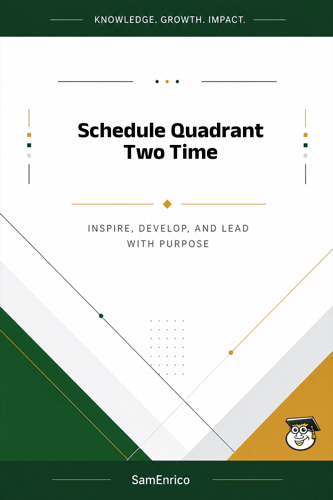
Non-FictionSelf-HelpCalendar Management
Schedule Quadrant Two Time eBook
Blocks calendar time for important-not-urgent stra
Blocks calendar time for important-not-urgent strategic work.
Formats
Free sample
Chapter 1: The Busy Trap--–- It is 5:00 PM on a Tuesday. You have been moving nonstop since 8:00 AM. Your calendar shows eleven separate meetings. You have answered forty-seven emails. You have put out three small fires, responded to two urgent requests from your boss, and spent thirty minutes on a Slack thread that could have been an email.
Your back hurts from sitting. Your eyes are tired from staring at screens. And when someone asks, "How was your day?" you say the same thing you said yesterday and the day before: "Busy. So busy."And yet.Sitting at the bottom of your to-do list, untouched for the third week in a row, is a single item. It is important.
You know it is important. It might be a strategic plan for the next quarter. It might be the one-on-one conversation you need to have with a struggling team member. It might be the workout you swore you would start. It might be the fifteen minutes of quiet reading with your child before bedtime.
It is not urgent. No one is yelling about it. No email is pinging. No deadline is looming. And so, despite your best intentions, it never happens.This chapter is about why that happens.
It is about the neurological and structural reasons that urgency hijacks your attention, why importance loses every single time, and how a simple two-by-two matrix can save you from a lifetime of being busy without being productive. More importantly, this chapter will force you to confront a number you probably do not want to know: the actual percentage of your week that you spend on work that truly matters.The Feeling That Fooled You Let us start with an honest question. When was the last time you finished a workday and thought, "I accomplished something today that will matter six months from now"? Not "I cleared my inbox." Not "I survived that back-to-back meeting block." But something strategic. Something preventive.
Something that made your future self’s life easier or your team’s work more effective.If you are like most knowledge workers, that moment is distant. And there is a reason for that. Your brain is wired to prioritize urgency over importance. This is not a character flaw. It is not laziness or a lack of discipline.
It is a feature of human neurology that was very useful when the urgent thing was a predator in the bushes and the important thing was building a better shelter for next winter. The predator had to be handled now. The shelter could wait until tomorrow. And so your brain learned to release dopamine—the feel-good chemical associated with reward—whenever you responded to something immediate.That same neurological circuit is alive and well in your office, your home, and your smartphone. Every time you hear a ping and check a message, your brain gives you a tiny hit of dopamine.
Every time you clear a notification, another hit. Every time you answer an email within thirty seconds, another hit. You are not lazy. You are not distracted. You are chemically rewarded for responding to urgency.
And the work that truly matters—the strategic planning, the relationship building, the skill development, the prevention of future crises—gives you no such reward. It has no ping. It has no notification. It has no deadline. It just sits there, quietly important, waiting for you to choose it.Most people never do.The Matrix That Changes Everything In the late 1980s, Stephen R.
Covey introduced a simple but profound framework in his book The 7 Habits of Highly Effective People. It is called the Time Management Matrix, and it has been taught in corporations, universities, and executive seminars for decades. Yet almost no one actually uses it. They nod along, understand the concept, and then go back to their urgent, chaotic, reactive lives.The matrix divides every possible activity into four quadrants based on two questions: Is this urgent? And is this important?Quadrant I: Urgent and Important These are crises, deadlines, and emergencies.
A server goes down. A client threatens to leave. A child gets sick at school. A report is due tomorrow. These tasks demand immediate attention and have significant consequences.
They are the fires you put out. The problem with Quadrant I is not that it exists—crises are real. The problem is that many people live their entire lives here, moving from fire to fire, never stopping to ask why so many fires are starting in the first place.Quadrant II: Not Urgent and Important This is the neglected quadrant. Strategic planning. Prevention.
Relationship building. Skill development. Exercise. Deep work. Long-term projects.
These activities have no deadline, no alarm, and no external pressure. They are the things you know you should do but never get around to because they do not scream for your attention. Quadrant II is where leverage lives. An hour spent here can save ten hours in Quadrant I later. But because it is not urgent, it is almost always sacrificed for the immediate demands of the day.Quadrant III: Urgent and Not Important This is the dangerous quadrant because it feels important.
Most emails fall here. Most phone calls. Most interruptions. Many meetings. These tasks are urgent—someone is waiting, a notification is flashing, a question is being asked—but they are not actually important to your long-term goals.
They are other people’s priorities disguised as emergencies. Quadrant III is where busyness lives. You spend hours here and feel productive because you are moving fast and checking boxes. But you are not moving forward.Quadrant IV: Not Urgent and Not Important This is the waste quadrant. Mindless social media scrolling.
Excessive television. Busywork that does not matter. Gossip. Tasks you do to feel productive without actually producing anything. Most people do not spend too much time here (though some do).
The real problem is not Quadrant IV; it is Quadrant III masquerading as Quadrant I.Here is the brutal truth that most books on productivity are afraid to tell you: The average knowledge worker spends approximately 80 percent of their time in Quadrants I and III. That is right. Eighty percent. And of that 80 percent, the majority is not even real crisis work. It is Quadrant III—urgent, not important, and entirely self-inflicted.The Self-Diagnostic No One Wants to Do You can read about the matrix and nod along.
Or you can do the work. This book is for people who choose the latter.For the next five workdays, you are going to log your calendar in fifteen-minute increments. This is not fun. It is tedious. You will hate it by day two.
But you need the data. Without the data, you are guessing. And guessing is what got you into this mess.Here is how it works:Get a notebook, a spreadsheet, or a note-taking app. Create a table with three columns: Time, Activity, Quadrant. Every fifteen minutes of your workday, write down what you are doing.
Not what you think you are doing. What you are actually doing. If you are in a meeting, write the meeting topic. If you are answering email, write "email." If you are on…
This is the end of the free sample. Get the eBook to keep going. Buy now
About this book
Details
- Author
- Cowan Chrystal
- Publisher
- SamEnrico
- Language
- English
- Genre
- Non-Fiction, Self-Help, Calendar Management
- Released
- 2026-06-06
- Pages (approx.)
- 134
- Available as
- eBook, Audiobook

Read better in the ZLOADR app
Your eBooks on your phone or tablet. Sign in with your SamEnrico account and start reading.
More by Cowan Chrystal
 Eliminate Quadrant TasksCowan Chrystal$11.99
 Assertiveness In Online Communication GuideCowan Chrystal$11.99
 Morning Walking RitualsCowan Chrystal$11.99
 The Black Dahlia Crime Scene PhotographyCowan Chrystal$11.99
 The Silent Strategist: How Japan's 'Father of Baseball' Built a National ObsessionCowan Chrystal$11.99
 Understanding RhypophobiaCowan Chrystal$17.99
 How to Become a Lens-mold SetterCowan Chrystal$11.99
 MaskmakerCowan Chrystal$11.99
 Rwanda Tuition and Living CostsCowan Chrystal$12.99
 EU VAT Rates ComparisonCowan Chrystal$12.99
You may also like
 Hong Kong Handover 1997Dunn Johnnie$11.99
 Zumba For Postnatal Recovery CourseNeal Christian$11.99
 Zumba for BeginnersLadner Nikia$11.99
 YouTube Comment Mining GuideHumes Pandora$12.99
 Worry Box MeditationCarlin Rudy$11.99
 Workplace Stress MeditationNguyen Lynn$11.99
 Workplace Stress and Sleep RepairHawley Ivory$11.99
 Workplace Perfectionism CureDelaney Jeffry$11.99
 Workplace Injustice Anger GuideWallen Isabelle$11.99
 Work Addiction and Burnout LinkGreenwood Ester$11.99
 Women in Yoga and WellnessBeattie Galina$11.99
 Women in Stand Up ComedyChun Evangeline$11.99