
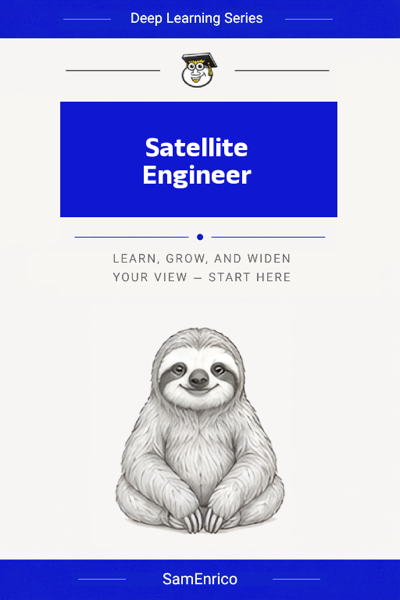
Non-FictionInformativeEducational
Satellite Engineer eBook
A Coursebook on Satellite Engineer
by Paz Lucila
A Coursebook on Satellite Engineer
Formats
Free sample
Chapter 1: The Orchestrator's Orbit--–- On a crisp October morning in 1999, a team of engineers at Lockheed Martin watched in horror as the Mars Climate Orbiter fired its thrusters to enter orbit around the red planet. The spacecraft dipped too low into the Martian atmosphere—25 kilometers lower than intended—and disintegrated. Three hundred twenty-seven million dollars, nine years of work, and a generation of planetary science evaporated in seconds. The cause? A sub-contractor had provided thruster performance data in pound-seconds for a test that the navigation team assumed was in newton-seconds.
One team used imperial units. Another used metric. No single engineer had seen the entire system. No one had asked the question: "How does this piece fit with that piece?" The Mars Climate Orbiter was not lost because of bad engineering. It was lost because of bad integration.
No one was the orchestrator.This book is about becoming that orchestrator.The satellite engineer is not merely a specialist who knows everything about one subsystem. Nor are they a generalist who knows a little about everything. The satellite engineer is the person who stands at the center of the spacecraft's complexity and ensures that every piece works with every other piece. They understand thermal systems well enough to tell the thermal engineer why the power system's dissipation affects radiator sizing. They understand attitude control well enough to tell the ADCS engineer why the communications antenna's field of view restricts the pointing budget.
They understand software well enough to tell the C&DH engineer why the fault detection algorithm must watch for power bus undervoltage before battery depletion.This chapter is not about equations. It is not about orbital mechanics or link budgets or thermal analysis. Those will come in abundance throughout the rest of this book. This chapter is about something far more fundamental: the mindset of a top-tier satellite engineer. Because you can master every formula in Wertz & Larson, memorize every NASA-STD, and simulate every orbit in STK—but if you do not have the right mental framework, you will design subsystems that work perfectly in isolation and fail catastrophically when integrated.The False Definition: Why Most Satellite Projects Fail Within the Specifications Walk into any aerospace company's cleanroom, and ask a young engineer what they do.
You will hear some version of the same answer: "I design the power system," or "I write the flight software," or "I run the thermal analysis." These are all true statements. They are also dangerously incomplete as a mindset for a satellite engineer.The problem with the "subsystem specialist" mindset is that it focuses on local optimization at the expense of global performance. A power engineer who optimizes the solar array for maximum output at beginning of life might select cells that degrade faster than alternatives, causing a power shortage at end of life. A thermal engineer who adds margin to every component might double the mass of the radiator, pushing the structure over its mass budget. A software engineer who implements every possible fault detection algorithm might exceed the processor's memory and cause periodic watchdog resets.Each of these engineers made the correct decision for their subsystem.
Each decision, in isolation, was rational. Together, they broke the mission.The satellite engineer's job is not to be the best power engineer or the best thermal engineer or the best software engineer. The satellite engineer's job is to be the person who sees the whole system and makes the trade-offs that no single discipline can make alone. They ask the questions that no specialist asks: "If we reduce the power system's mass by 10 percent, can the ADCS meet pointing requirements with smaller reaction wheels?" "If we relax the thermal control system's precision by two degrees, can we simplify the MLI blanket design and save two weeks of integration time?" "If we accept a lower data rate, can we reduce the transmitter power and extend battery life in eclipse?"The average satellite project overruns its budget by 45 percent and its schedule by 36 percent, according to studies of NASA and ESA missions. More than half of first-time anomalies on orbit trace back to integration errors—problems at the interfaces between subsystems, not problems within subsystems.
The "subsystem specialist" mindset guarantees these outcomes. The orchestrator mindset—which this chapter will teach you—is the only path to mission success.The Orchestrator: Redefining the Satellite Engineer's True Role The engineers who could have saved the Mars Climate Orbiter—the ones who would have asked, "What units are we using for thruster performance?"—were orchestrators. An orchestrator does not wait for integration to reveal problems. They anticipate interface mismatches before parts are built. They see the entire spacecraft as a system of interacting constraints, not as a collection of independent subsystems.An orchestrator opens a new mission concept and immediately begins building a constraint network.
They ask questions that a specialist never thinks to ask: What is the mass allocation for each subsystem? What is the power budget, broken down by operating mode? What are the thermal limits of every component, and how do they change with age? What are the data rate requirements for telemetry, and do they fit within the downlink capacity? What is the pointing accuracy needed for the payload, and can the ADCS provide it?By the time a specialist is still optimizing their own subsystem in isolation, an orchestrator has already identified every critical interface, every potential trade, and every show-stopping constraint.
This is not magic. It is not a personality trait. It is a disciplined, systematic approach to engineering that any satellite engineer can learn.The Hierarchy of Satellite Engineer Responsibilities: Performance, Reliability, and Integration Every action a satellite engineer takes can be sorted into one of three categories of responsibility. Understanding this hierarchy is essential because it tells you where to focus your attention when the schedule is tight and the budget is shrinking—a condition that describes every satellite program ever executed.First Responsibility: Mission Performance At the most basic level, the satellite engineer ensures that the spacecraft will do what it was designed to do. The Earth observation satellite must collect images at the specified resolution.
The communications satellite must provide the specified bandwidth. The science satellite must return data within the specified accuracy. Performance is the reason the mission exists.Performance requirements come from the mission stakeholders. They are documented in the Mission Requirements Document, which flows down to the System Requirements Document, which flows down to subsystem specifications. The satellite engineer traces every requirement to a verification method: analysis, inspection, demonstration, or test.
If a requirement cannot be verified, it is not a requirement—it is a wish.An orchestrator does not simply accept performance requirements as given. They ask: "Is this requirement really necessary? What science outcome depends on 5-meter resolution instead of 10-meter resolution? What business case requires 99.99 percent uptime instead of 99.9 percent?" Reducing requirements is the most powerful cost and schedule lever available. A requirement that costs 50milliontoachievebutdelivers50 million to achieve but delivers 50milliontoachievebutdelivers5 million in value is a bad requirement.Second Responsibility: Designing for Reliability Performance means nothing if the satellite fails.
Reliability is the ability of the spacecraft to perform its required functions under stated conditions for a specified period. For…
This is the end of the free sample. Get the eBook to keep going. Buy now
About this book
Details
- Author
- Paz Lucila
- Publisher
- SamEnrico
- Language
- English
- Genre
- Non-Fiction, Informative, Educational
- Released
- 2026-05-06
- Pages (approx.)
- 152
- Available as
- eBook, Audiobook

Read better in the ZLOADR app
Your eBooks on your phone or tablet. Sign in with your SamEnrico account and start reading.
More by Paz Lucila
 Choosing Your Transcendental MantraPaz Lucila$11.99
 Harvard Extension School Course CatalogPaz Lucila$11.99
 NVC Giraffe Ears MethodPaz Lucila$11.99
 Hostage Negotiator DiplomatPaz Lucila$11.99
 Longwang's Lost Pearl: The Dragon King's DescentPaz Lucila$11.99
 How to Produce Bicycle MirrorsPaz Lucila$11.99
 Academic Publishing From ProposalsPaz Lucila$12.99
 How to Become a Stereotyper ApprenticePaz Lucila$11.99
You may also like
 Hong Kong Handover 1997Dunn Johnnie$11.99
 Zumba For Postnatal Recovery CourseNeal Christian$11.99
 Zumba for BeginnersLadner Nikia$11.99
 YouTube Comment Mining GuideHumes Pandora$12.99
 Worry Box MeditationCarlin Rudy$11.99
 Workplace Stress MeditationNguyen Lynn$11.99
 Workplace Stress and Sleep RepairHawley Ivory$11.99
 Workplace Perfectionism CureDelaney Jeffry$11.99
 Workplace Injustice Anger GuideWallen Isabelle$11.99
 Work Addiction and Burnout LinkGreenwood Ester$11.99
 Women in Yoga and WellnessBeattie Galina$11.99
 Women in Stand Up ComedyChun Evangeline$11.99