
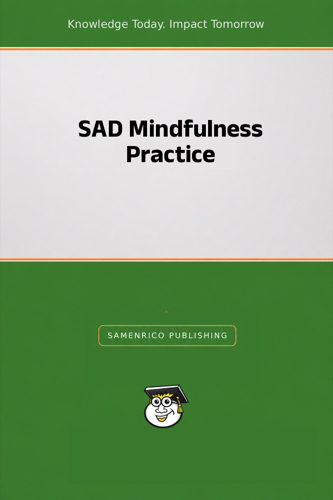
Non-FictionHealth & WellnessMindfulness
SAD Mindfulness Practice eBook
Use present moment awareness to navigate seasonal
by Sommer Mica
Use present moment awareness to navigate seasonal lows.
Formats
Free sample
Chapter 1: The Winter Lie--If you are reading this on a dark morning in November, with the rain tapping against the window and a heavy blanket pulled up to your chin, I want you to know something before we go any further: you have not failed. The voice in your head that says “I should be able to handle this better” is not telling you the truth. The comparison you are making—between your current self, slumped and sluggish, and your summer self, energetic and capable—is a trap that has been set by a culture that does not understand seasonal depression.Let me say it again, because it matters more than any technique or meditation in this book: you have not failed.The lie that winter tells us—the one that has been repeated so often by productivity gurus, well-meaning friends, and even our own internal monologue—is that the low energy, the carb cravings, the desire to sleep more and socialize less are signs of weakness, laziness, or a character flaw. This is The Winter Lie. And until we dismantle it completely, no mindfulness practice will work.
Because you cannot heal something you are actively fighting.This chapter is not about fixing you. It is about freeing you from the belief that you are broken.The Two Winters: Subsyndromal SAD and Clinical SADBefore we go any further, we need to talk about what you are actually experiencing. Seasonal Affective Disorder exists on a spectrum, and one of the most common reasons people suffer unnecessarily is that they assume their experience is “not bad enough” to warrant help—or, conversely, that it is so bad that no book could possibly help.Let me be precise.Subsyndromal SAD—often called the “winter blues”—affects somewhere between 10 and 20 percent of people living in northern latitudes. If you have this, you notice a distinct shift when the days shorten. You feel less motivated.
You crave carbohydrates more than usual. You would rather stay in than go out. But you can still function. You still go to work, feed yourself, answer text messages (eventually). The winter blues is real, it is valid, and it deserves attention—but it is not the same as clinical depression.Major Depressive Disorder with Seasonal Pattern—the clinical diagnosis of SAD—affects approximately 1 to 10 percent of the population, depending on how far north you live.
If you have this, winter does not merely make you tired. It makes you someone else entirely. You may sleep twelve or fourteen hours and still wake up exhausted. Your concentration collapses to the point where reading a paragraph feels like running a marathon. You may have thoughts of hopelessness or, in severe cases, thoughts of ending your life.
The shift from summer to winter is not gradual; it feels like falling off a cliff.A critical note, and I need you to hear this: If you are having thoughts of suicide, if you have not been able to get out of bed for multiple days in a row, or if you are sleeping more than fourteen hours regularly, please close this book and contact a mental health professional immediately. This book is designed for mild to moderate SAD—for the winter blues and for those with clinical SAD who are already under professional care. These practices can support you, but they are not a replacement for medication, therapy, or a suicide hotline. If you are in crisis, call or text 988 (in the US) or your local emergency number. You matter.
Come back to this book when you are safe.For everyone else—for those who have been silently enduring the seasonal shift, wondering why winter hits them so much harder than everyone else—let us continue.The Biology of Betrayal: Why Your Brain Changes in Winter Here is the first thing you need to understand: your brain is not malfunctioning. It is responding exactly as it evolved to respond. The problem is not your brain. The problem is that your brain is living in a world it did not evolve for.Let me explain.Deep inside your brain, in a tiny region called the suprachiasmatic nucleus, sits your master clock. Every cell in your body—every organ, every hormone, every tissue—takes its cues from this cluster of approximately twenty thousand neurons.
This is your circadian rhythm, and it is designed to sync with one primary external signal: sunlight.When sunlight hits your retinas in the morning, it sends a signal through a special pathway (the retinohypothalamic tract, if you want the technical term) directly to your suprachiasmatic nucleus. That signal says: “Day has begun. Wake up the body. Raise the temperature. Stop producing melatonin.”Melatonin is the hormone of darkness.
Your pineal gland begins producing it when the sun goes down, and it makes you feel sleepy, calm, and ready for rest. In summer, with long days and short nights, melatonin production is brief and mild. In winter, with short days and long nights, melatonin production is extended and intense.Here is what most people do not understand: melatonin does not just make you sleepy. It also suppresses dopamine and serotonin. Those are the neurotransmitters associated with motivation, pleasure, and emotional stability.
So when winter arrives and your melatonin production stretches from seven or eight hours to fourteen or sixteen hours, you are not just sleeping more. You are actively suppressing the very chemicals that make you feel like yourself.This is not a character flaw. This is biology.Dr. Norman Rosenthal, the psychiatrist who first identified and named Seasonal Affective Disorder in the 1980s, described it this way: “People with SAD are not suffering from a psychological weakness. They are suffering from a biological clock that is overly sensitive to the changing seasons.”Think of it this way.
If you lived in a cave with no light for three months, no one would blame you for feeling depressed. Your body would be doing exactly what it evolved to do: conserve energy, reduce activity, and wait for spring. The only difference between that cave and your apartment in December is the presence of electric lights—which, as we will learn in Chapter 8, are not the same as sunlight.So when you feel that heavy, leaden fatigue in November, your brain is not betraying you. It is doing exactly what it was designed to do. The betrayal is the expectation that you should feel the same way in December as you do in June.
That expectation is The Winter Lie.The Vicious Cycle: How Thoughts Make Symptoms Worse Here is where it gets complicated—and where mindfulness becomes essential.The biological symptoms of SAD are real. Low serotonin, elevated melatonin, circadian disruption—these are measurable physiological events. But they are not the whole story. Because once those symptoms appear, your brain does something that makes everything worse: it starts telling stories about them.Let me give you an example.You wake up on a dark December morning. The alarm goes off at 7 AM, but outside your window, it is still pitch black.
Your body feels like it is filled with wet sand. Your eyelids weigh ten pounds each. This is the biological symptom…
This is the end of the free sample. Get the eBook to keep going. Buy now
About this book
Details
- Author
- Sommer Mica
- Publisher
- SamEnrico
- Language
- English
- Genre
- Non-Fiction, Health & Wellness, Mindfulness
- Released
- 2026-06-10
- Pages (approx.)
- 137
- Available as
- eBook, Audiobook

Read better in the ZLOADR app
Your eBooks on your phone or tablet. Sign in with your SamEnrico account and start reading.
More by Sommer Mica
 Networking for StudentsSommer Mica$11.99
 Vegan Bodybuilding GuideSommer Mica$11.99
 Sky VisualizationSommer Mica$11.99
 Fear of Failure in EntrepreneursSommer Mica$11.99
 Workplace Achievement BalanceSommer Mica$11.99
 Collaborative StorytellingSommer Mica$11.99
 Anger De escalation at HomeSommer Mica$11.99
 The First Light of Aotearoa: How Māori Photography Transformed a NationSommer Mica$11.99
 The Roar of the Bamboo: How 18th-Century Fans Transformed Chinese Martial ArtsSommer Mica$11.99
 How to Produce Voip ProductsSommer Mica$11.99
 A Collector's Handbook to the Mazda Cosmo 110sSommer Mica$11.99
 How to Produce a Leaf BlowerSommer Mica$11.99
You may also like
 Hong Kong Handover 1997Dunn Johnnie$11.99
 Zumba For Postnatal Recovery CourseNeal Christian$11.99
 Zumba for BeginnersLadner Nikia$11.99
 YouTube Comment Mining GuideHumes Pandora$12.99
 Worry Box MeditationCarlin Rudy$11.99
 Workplace Stress MeditationNguyen Lynn$11.99
 Workplace Stress and Sleep RepairHawley Ivory$11.99
 Workplace Perfectionism CureDelaney Jeffry$11.99
 Workplace Injustice Anger GuideWallen Isabelle$11.99
 Work Addiction and Burnout LinkGreenwood Ester$11.99
 Women in Yoga and WellnessBeattie Galina$11.99
 Women in Stand Up ComedyChun Evangeline$11.99