
Non-FictionStudent's ShortcutStudent Work
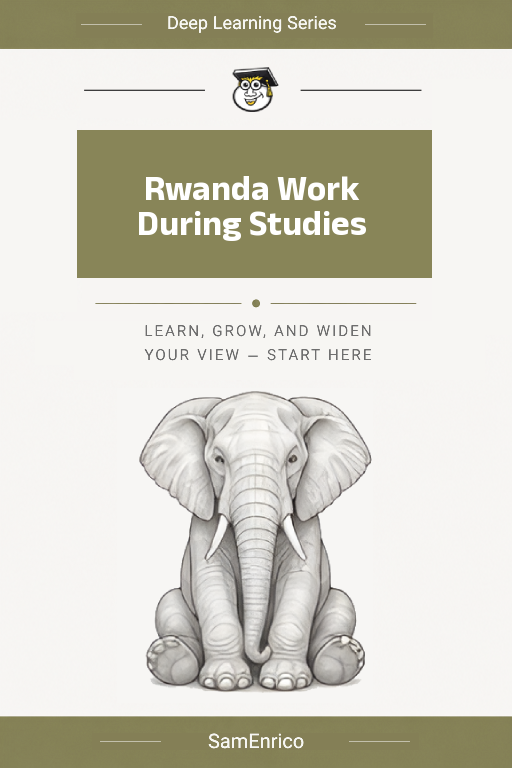
Rwanda Work During Studies eBook
Understands work rights for international students
Understands work rights for international students in Rwanda including part-time work, internships, and post-graduation employment options.
Formats
Free sample
Chapter 1: The Kigali Gambit--–- The young man from Nairobi had done everything right. He had his acceptance letter from the University of Rwanda, his student permit was stamped and current, and he had saved three months of living expenses. On his second week in Kigali, a hotel near the convention center offered him a weekend job as a front desk assistant. Cash in hand, no questions asked. "Just help us on Saturdays," the manager said.
"No need for papers. It's informal."He worked four Saturdays. He earned 80,000 Rwandan Francs. He bought groceries, paid for a nicer room, and felt proud of his resourcefulness. Then, on the fifth Saturday, immigration officers conducted a spot check.
They asked for his work permit. He showed his student permit. They asked for his employment contract. He had nothing. They asked for his employer's name.
He gave it. The hotel manager denied everything.Within 72 hours, his student permit was revoked. Within two weeks, he was on a flight back to Nairobi with a three-year entry ban to Rwanda. His degree—half-finished, now worthless—remained in Kigali.This is not a hypothetical story. It happened in 2022 to a real student whose name has been changed to protect his privacy.
And it happens every semester to international students who arrive in Rwanda with ambition, work ethic, and absolutely no understanding of how the Rwandan labor market actually operates.This book exists to ensure that student is not you.The Great Misconception Most international students come to Rwanda with a dangerous assumption: work is work. If you show up, do the job, and get paid, what difference does it make whether there is a contract or a permit? The answer—and this is the single most important sentence in this entire book—is that Rwanda treats work as a legal status, not just an economic activity.Unlike some countries where informal work exists in a gray area that authorities tolerate, Rwanda's labor market is built around a rigid distinction between the formal sector and the informal sector. For Rwandan citizens, that distinction affects taxes and benefits. For international students, that distinction can mean the difference between graduating with a degree and being deported with a ban.Let us be absolutely clear: as an international student holding a student permit, you have no legal right to perform any work—paid or unpaid, productive or educational, one hour or one hundred hours—without specific additional authorization from the Directorate General of Immigration and Emigration (DGIE).
Your student permit is a permission to study. It is not a permission to work. It is not a permission to intern. It is not a permission to volunteer at an organization that would otherwise pay a Rwandan worker.This chapter will teach you to see the Rwandan labor market the way immigration officers see it: as a binary system. There is formal work, which is regulated, documented, and safe.
There is informal work, which is unregulated, undocumented, and a direct path to deportation. Nothing in between.The Binary That Determines Your Future Rwanda's labor market is divided into two sectors that operate under completely different legal regimes. Understanding this binary is not academic—it is the foundation of every work decision you will make during your studies.The Formal Sector The formal sector comprises all employment relationships that are governed by a written employment contract compliant with the Rwandan Labour Code, registered with the Rwanda Social Security Board (RSSB) when applicable, and subject to tax withholding. In the formal sector, you have:A written contract specifying all 16 mandatory provisions (detailed in Chapter 4 of this book)A defined work schedule (typically 40 hours per week, though part-time arrangements can be negotiated)A stated wage that meets or exceeds the judicial benchmark of 3,000 RWF per day (see Chapter 6)Clear leave entitlements (annual leave, sick leave, circumstantial leave)Termination protections (notice periods, indemnity for unused leave)Access to dispute resolution through the Labour Inspectorate and courts For international students, formal sector employment also means one more critical feature: your employer is willing to document your employment for immigration purposes. That documentation is required for the Holiday Work Permit (Chapter 3) and the Post-Graduation Work Permit (Chapter 9).The Informal Sector The informal sector comprises all work arrangements that are not documented in a written contract compliant with the Labour Code.
This includes cash payments for tutoring, unregistered "gigs" at hotels or restaurants, freelance work without a contract, and any arrangement where the employer says, "Just help us out informally."In the informal sector, you have:No written contract No stated work schedule No guaranteed wage No leave entitlements No termination protections No access to dispute resolution No immigration compliance For international students, informal sector employment has one additional feature that formal sector employment does not: it is illegal. Working in the informal sector without the proper permit violates both labor law (because there is no contract) and immigration law (because you are working without authorization). The consequences range from fines (50,000 to 200,000 RWF) to permit revocation to deportation with entry bans of three to ten years.The Self-Assessment Test Before you accept any work opportunity during your studies in Rwanda, run it through this seven-question self-assessment. If you answer "no" to any of the first five questions, the opportunity belongs in the informal sector—and you must either formalize it or reject it.Will there be a written contract signed by both you and the employer before you begin working?Does the contract specify your exact working hours per week or per day?Does the contract state your wage or salary in Rwandan Francs?Is the wage at least 3,000 RWF per full day of work?Does the contract include leave provisions (even if proportional to part-time hours)?Is your employer willing to provide a recommendation letter for a Holiday Work Permit?Has your employer registered with the Rwanda Social Security Board (or can they explain why they are exempt)?If you answered "no" to questions 1 through 4, stop. Do not accept the work.
If you answered "no" to question 5, negotiate. If you answered "no" to questions 6 or 7, proceed with extreme caution and only after obtaining your own permit.Five Sectors Where International Students Actually Find Work The formal sector in Rwanda is not equally accessible to international students. Some industries are accustomed to hiring foreign workers and have established processes for permits and contracts. Others operate almost entirely in the informal economy. Based on analysis of DGIE permit data and interviews with international students who successfully worked during their studies, here are the five sectors where formal opportunities are most common.Sector One: Hospitality (International Hotels)Kigali's international hotel brands—Marriott, Radisson Blu, Serena, and others—are accustomed to hiring foreign workers.
They have HR departments that understand permit requirements. They issue written contracts as a matter of course. And they have a steady need for multilingual front desk staff, event coordinators, and guest relations personnel, particularly during peak tourism seasons (June to September and December to January).What to expect: Wages typically range from 3,500 to 6,000 RWF per hour for part-time roles. Contracts are usually fixed-term (covering a specific season). Employers will provide recommendation letters for Holiday Work Permits.
The work is demanding (weekends and holidays are busy), but the legal compliance is excellent.How to find opportunities: Apply directly…
This is the end of the free sample. Get the eBook to keep going. Buy now
About this book
Details
- Author
- Layton Khadijah
- Publisher
- SamEnrico
- Language
- English
- Genre
- Non-Fiction, Student's Shortcut, Student Work
- Released
- 2026-05-28
- Pages (approx.)
- 156
- Available as
- eBook, Audiobook

Read better in the ZLOADR app
Your eBooks on your phone or tablet. Sign in with your SamEnrico account and start reading.
More by Layton Khadijah
 Fear Of Failure In TechnologyLayton Khadijah$11.99
 Eisenhower Matrix for HealthLayton Khadijah$11.99
 The Walking Gratitude PracticeLayton Khadijah$11.99
 The Arthritis Flare Management PlanLayton Khadijah$11.99
 Eisenhower Matrix For New MomsLayton Khadijah$11.99
 Understanding Richieri–Costa–orquizas SyndromeLayton Khadijah$17.99
 VAT Audit Preparation GuideLayton Khadijah$12.99
 Medical Insurance VerificationLayton Khadijah$11.99
 How to Become a Pleat TaperLayton Khadijah$11.99
You may also like
 Hong Kong Handover 1997Dunn Johnnie$11.99
 Zumba For Postnatal Recovery CourseNeal Christian$11.99
 Zumba for BeginnersLadner Nikia$11.99
 YouTube Comment Mining GuideHumes Pandora$12.99
 Worry Box MeditationCarlin Rudy$11.99
 Workplace Stress MeditationNguyen Lynn$11.99
 Workplace Stress and Sleep RepairHawley Ivory$11.99
 Workplace Perfectionism CureDelaney Jeffry$11.99
 Workplace Injustice Anger GuideWallen Isabelle$11.99
 Work Addiction and Burnout LinkGreenwood Ester$11.99
 Women in Yoga and WellnessBeattie Galina$11.99
 Women in Stand Up ComedyChun Evangeline$11.99