
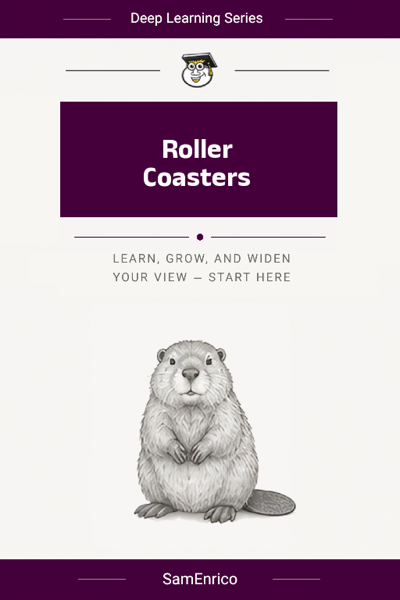
Non-FictionInformativeEducational
Roller Coasters eBook
A Coursebook on Roller Coasters
A Coursebook on Roller Coasters
Formats
Free sample
Chapter 1: The Gravity of Fear...--–- The click echoes through the station like a gunshot. Fourteen tons of steel and polyurethane, twenty-four riders arranged in four rows of six, all of us now locked into place by a single lap bar that feels simultaneously too thin and impossibly strong. Somewhere behind me, a child asks if this is the one that goes upside down. His father lies and says no. Ahead of me, the train lurches forward—six inches, then stop.
The restraint check. An unseen ride operator walks the length of the train, pushing down on every lap bar, pulling up on every harness, performing the same ritual they have performed two hundred times today and will perform two hundred more before the park closes. I watch their face. They look bored. That boredom is the most reassuring thing I have seen all day.The train advances again.
The station's cheerful recorded voice—"Please keep your hands inside the vehicle at all times"—fades behind us as we roll onto the lift hill. Then the anti-rollback dogs engage. The sound is unmistakable: a mechanical ratchet, a series of heavy steel teeth clicking over a toothed rail with each upward pull of the chain. Click. Pause.
Click. Pause. Click. One hundred and forty-two times from the base of the lift to the crest, if this is a standard hypercoaster. One hundred and forty-two chances to change your mind.
One hundred and forty-two seconds of pure, unfiltered anticipation.The world expands beneath us. Parking lots shrink to gray rectangles. Trees become green punctuation marks. The distant lake, which from ground level seemed vast, now looks like a puddle someone forgot to clean up. The riders ahead of me have raised their hands already, arms stretched toward a sky that feels closer than it should.
I keep my hands on the lap bar. Not because I am afraid of the drop—I have ridden this specific coaster forty-seven times, according to the photo keychain in my desk drawer—but because I want to feel the moment of transition. The exact nanosecond when the chain stops pulling and gravity begins.It comes without warning. There is no countdown. No buzzer.
No "three, two, one." The chain simply ends, the train rolls over the crest, and for one crystalline second, we hang suspended at the top of a two-hundred-foot steel arch. The front row tips forward. The rest of us follow. And then we fall.The first second of freefall is silent. Not quiet—silent.
The wind has not yet caught up to us. The screams have not yet started. There is only the strange, stomach-left-behind sensation that physicists call negative vertical acceleration and the rest of us call the drop. My hands leave the lap bar without my permission. They rise.
At negative one G, the force of gravity that normally presses me into my seat has been exactly canceled. I weigh nothing. For two seconds, I am a satellite in orbit around a planet made of steel and wood and the collective anxiety of two dozen strangers.Then the train hits the bottom of the drop, and the silence shatters.Positive four Gs crush me into the seat. My vision narrows at the edges—the gray tunnel of peripheral shutdown that pilots call grey-out. My cheeks pull back against my skull.
The man next to me, a complete stranger whose name I will never know, screams something that might be a word or might just be a sound. The train banks left, hard, and lateral Gs try to peel me off the seat and deposit me in his lap. The track straightens. The train climbs. We crest a camelback hill, and suddenly I am floating again—negative half G, gentle floater airtime this time, not the violent ejector of the first drop.
My hands find the sky again. The man next to me laughs. Not a nervous laugh. A genuine, surprised, delighted laugh.We hit the brake run forty-five seconds after we left the station. The magnetic brakes—silent, fail-safe, powered by nothing more than eddy currents and physics—slow us from seventy miles per hour to walking speed in less than three seconds.
The train does not jerk. It simply stops being in a hurry. The recorded voice thanks us for riding. The restraints release with a pneumatic hiss. The man next to me turns and says, "That was my first time."I tell him mine was forty-seven rides ago.
He looks confused. He has not yet learned that a roller coaster is not something you survive. It is something you study.This book is for him. And for you. And for everyone who has ever stepped off a coaster and immediately turned around to look at the lift hill, trying to understand how something so terrifying could also be so joyful.
Because that is the central mystery of the roller coaster: we pay money, sometimes a lot of money, to experience forces that in any other context would indicate imminent death. A negative G, after all, is what you feel in an elevator whose cable has snapped. A positive four Gs is what fighter pilots experience during a hard turn—and they wear special suits to keep from blacking out. Lateral Gs are what throw passengers from cars during high-speed crashes.And yet we line up. We wait forty-five minutes in the sun.
We hand over twenty dollars for a photograph of ourselves looking like startled animals. We do it again. And again. And again.Why?That question is the reason this book exists. But before we can answer it, we need to understand what a roller coaster actually is.
Not just the obvious answer—a train on a track, a lift hill, a drop, some brakes—but the deeper answer. A roller coaster is a machine for converting height into speed, and speed into fear, and fear into joy. It is a controlled fall. It is a physics demonstration disguised as entertainment. It is, as the historian Robert Cartmell once wrote, "the only form of public transportation designed specifically to terrify its passengers."And it is, without exaggeration, one of the most significant engineering achievements of the modern era.The Machine That Forgets It Is a Machine Let us start with a simple fact that most riders never consider: a roller coaster has no engine.
The chain lift pulls the train to the top of the first hill, yes, and some modern coasters add launch systems—hydraulic, pneumatic, magnetic—that provide additional propulsion. But the vast majority of the ride, the part that actually matters, the drops and loops and turns that define the experience, are powered entirely by gravity. Once the train crests that first hill, it is on its own. No throttle. No brakes (except at the very end).
No steering. The train is a purely passive vehicle, following a track that was carved into the landscape years before you were born.This is terrifying if you think about it. It is also beautiful.The roller coaster is a machine that forgets it is a machine. Unlike a car, which requires constant input from a driver, or an…
This is the end of the free sample. Get the eBook to keep going. Buy now
About this book
Details
- Author
- Frey Conception
- Publisher
- SamEnrico
- Language
- English
- Genre
- Non-Fiction, Informative, Educational
- Released
- 2026-06-02
- Pages (approx.)
- 136
- Available as
- eBook, Audiobook

Read better in the ZLOADR app
Your eBooks on your phone or tablet. Sign in with your SamEnrico account and start reading.
More by Frey Conception
 TM For Artists GuideFrey Conception$11.99
 Docker Hub Registry OutageFrey Conception$11.99
 Cooperative Housing for RetireesFrey Conception$11.99
 Empty Nest Relationship RenewalFrey Conception$11.99
 The Infant Death Grief GuideFrey Conception$11.99
 The Silk Road Heist: A Prisoner’s GambitFrey Conception$11.99
 Understanding Walbaum–titran–durieux–crepin SyndromeFrey Conception$17.99
 ARIPO Banjul Protocol HandbookFrey Conception$12.99
 Angel Investor vs BootstrappingFrey Conception$12.99
 How to Start a Bathing Pool Proprietor Business (Beginners Guide)Frey Conception$11.99
You may also like
 Hong Kong Handover 1997Dunn Johnnie$11.99
 Zumba For Postnatal Recovery CourseNeal Christian$11.99
 Zumba for BeginnersLadner Nikia$11.99
 YouTube Comment Mining GuideHumes Pandora$12.99
 Worry Box MeditationCarlin Rudy$11.99
 Workplace Stress MeditationNguyen Lynn$11.99
 Workplace Stress and Sleep RepairHawley Ivory$11.99
 Workplace Perfectionism CureDelaney Jeffry$11.99
 Workplace Injustice Anger GuideWallen Isabelle$11.99
 Work Addiction and Burnout LinkGreenwood Ester$11.99
 Women in Yoga and WellnessBeattie Galina$11.99
 Women in Stand Up ComedyChun Evangeline$11.99