
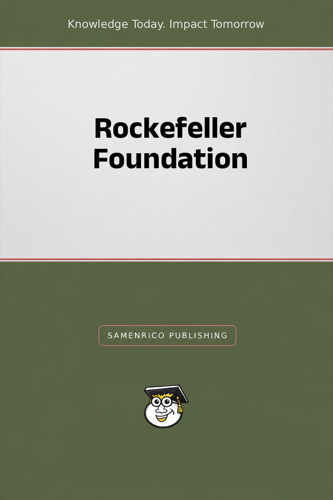
Rockefeller Foundation eBook
Traces the global health philanthropy of the famil
by Gage Annett
Traces the global health philanthropy of the family.
Formats
Free sample
Chapter 1: The Avalanche’s Shadow...--–- In the winter of 1896, John Davison Rockefeller Sr. sat alone in the mahogany-paneled study of his Forest Hill estate in Cleveland, Ohio, staring at a single piece of paper. On it, his private secretary had calculated the precise sum of his wealth: approximately $200 million—a figure that exceeded the annual budget of the United States government. By the standards of the Gilded Age, Rockefeller was not merely rich. He was a geological event, a force of nature that had reshaped the American continent the way glaciers had carved its valleys.
Yet the man behind the desk wore the hollow expression of a condemned prisoner. His hands, those instruments of industrial warfare that had signed the death warrants of hundreds of competitors, trembled slightly as he turned the paper over. Outside, the newspapers called him "the most hated man in America." Inside, he heard a different accusation, one that came not from populist politicians or muckraking journalists, but from the Baptist God he had worshipped since childhood. The question that haunted him was simple and absolute: What does it profit a man to gain the whole world, and forfeit his soul?This chapter is not about oil wells, railroad rebates, or the birth of Standard Oil. Those stories have been told masterfully elsewhere, most notably in Ron Chernow's Titan.
Instead, this chapter is about the peculiar alchemy by which immense wealth, accumulated through ruthless efficiency, transforms into something called "philanthropy." It is about the invention of a new moral technology: scientific giving. And it is about the strange partnership between a tormented monopolist and a former Baptist preacher named Frederick Taylor Gates, who together would conceive an institution that would outlive both of them—the Rockefeller Foundation. To understand why a family that built its fortune on kerosene would spend the next century eradicating hookworm, yellow fever, and malaria, one must first understand the psychological crisis that unfolded in that Cleveland study. For the Rockefeller Foundation was not born of generosity. It was born of terror.The Most Hated Man in America By 1896, John D.
Rockefeller had achieved everything he had ever wanted and nothing he had ever needed. At fifty-seven, he was the richest person in modern history, a distinction he wore like a hair shirt. His Standard Oil Trust controlled nearly 90 percent of the nation's oil refining capacity, a monopoly so complete that it had become a verb: to "Rockefeller" a competitor meant to destroy them systematically, legally, and irrevocably. He had done this not through overt violence—Rockefeller abhorred the Pinkerton thugs that other industrialists employed—but through something far more insidious: efficiency. He had mastered the art of the secret rebate from railroads, the below-cost pricing that bled rivals dry, and the quiet acquisition of bankrupt competitors at pennies on the dollar.
When he was done, the landscape of American industry resembled a desert punctuated by a single, towering obelisk.The public hated him with a fervor reserved for traitors and tyrants. The New York World called him "the greatest criminal of the age." The Chicago Tribune ran a cartoon showing Rockefeller as a vampire sucking the blood from the corpse of small business. Populist orators like Mary Elizabeth Lease urged farmers to "raise less corn and more hell," and much of that hell was directed at the man in Cleveland. In 1896, the same year he sat in his study, William Jennings Bryan was crisscrossing the country denouncing "the money power" that had "crucified mankind upon a cross of gold." In every audience, the unspoken face of that power was Rockefeller.But the hatred that troubled Rockefeller most was not the hatred of strangers. It was the hatred he suspected in the eyes of his own children, and the hatred he feared in the judgment of his God.
He was, by every measure, a devout Baptist. He had taught Sunday school since he was a young man. He had never drunk alcohol, never smoked, never gambled, never visited a brothel. He gave ten percent of his income to the church before he gave a penny to himself. He read his Bible daily and could recite entire chapters from memory.
And yet, the more money he made, the more he sensed a growing chasm between the Sermon on the Mount and the ledgers of Standard Oil.The Audit of the Soul Into this moral vacuum stepped Frederick Taylor Gates, a man who would prove to be Rockefeller's most important advisor—more important than any lawyer, banker, or oil executive. Gates was, improbably, a former Baptist minister who had stumbled into philanthropy by accident. In the 1880s, he had been a young pastor in Minneapolis when the American Baptist Education Society asked him to help raise money for a new university in Chicago. Gates proved to have a genius for fundraising, and he caught the attention of Rockefeller, who was already funding Baptist causes. By 1891, Gates had become Rockefeller's principal philanthropic advisor, and by 1896, he was something closer to a confessor.The meeting in which Gates delivered his most famous advice has become the stuff of philanthropic legend, but its core is worth repeating because it captures the precise psychological mechanism that would birth the Foundation.
According to Gates's own memoir, he sat with Rockefeller in the Cleveland study and said, with the directness of a man who feared God more than he feared his employer:"Your fortune is rolling up like an avalanche. You must distribute it faster than it grows. If you do not, it will crush you and your children."This was not a metaphor. Gates meant it literally. The wealth was increasing at a rate that outstripped any possible charitable expenditure.
Each year, Rockefeller's investments generated millions of dollars in new income, and each year, he gave away perhaps a few hundred thousand to Baptist colleges, churches, and missions. The gap was widening, not closing. If he continued at this pace, Gates argued, he would die with an estate so vast that it would corrupt his heirs, inflame the public, and damn his soul. The avalanche was coming. The only question was whether Rockefeller would learn to control it or be buried by it.Rockefeller listened in silence.
Then he asked a single question: "What should I do?"Gates had an answer ready. It was an answer that would change the course of modern philanthropy. He told Rockefeller to stop giving away money haphazardly—to stop handing dimes to panhandlers, to stop writing checks to every church that asked, to stop funding pet projects based on sentiment rather than strategy. Instead, Gates argued, Rockefeller should apply the same principles that had made Standard Oil successful to the problem of giving. He should systematize.
He should investigate. He should measure. He should treat charity as a science, not as an emotion.The Invention of Scientific Philanthropy This was a radical idea. In the late nineteenth century, charity was largely a matter of religious obligation and sentimental impulse. Wealthy men funded orphanages, libraries, and hospitals based on personal connections or emotional appeals.
There was little rigor, little accountability, and often little lasting impact. Gates proposed to change all of that. He argued…
This is the end of the free sample. Get the eBook to keep going. Buy now
About this book
Details
- Author
- Gage Annett
- Publisher
- SamEnrico
- Language
- English
- Genre
- Non-Fiction, Biography, Industrialist
- Released
- 2026-06-07
- Pages (approx.)
- 122
- Available as
- eBook, Audiobook

Read better in the ZLOADR app
Your eBooks on your phone or tablet. Sign in with your SamEnrico account and start reading.
More by Gage Annett
 Comparison Cessation GuideGage Annett$11.99
 Job Loss Sleep Recovery GuideGage Annett$11.99
 Citation Rules for Maps and CartographyGage Annett$11.99
 Rafale Pilot MemoirGage Annett$11.99
 Mindfulness Study ConcentrationGage Annett$11.99
 MDD Symptom Recognition GuideGage Annett$11.99
 Uber Driver Car Cleaning GuideGage Annett$11.99
 Indian GST Registration for Franchise Operators CourseGage Annett$11.99
 The Mysterious Deaths of the Andes: Unraveling the High-Altitude EnigmaGage Annett$11.99
 The Alpine Watchmakers: Timekeeping Through Fire and IceGage Annett$11.99
 Echoes of the Forgotten: The Lost Apollo 20 MissionGage Annett$11.99
 Paystack Acquisition By Stripe Exit GuideGage Annett$12.99
You may also like
 Carnegie Hero FundSaucedo Rosanna$11.99
 Rockefeller StandardKemper Lahoma$11.99
 Ford Highland ParkBruce Holley$11.99
 Carnegie Gospel WealthCoffman Randee$11.99
 Rockefeller UniversityLacey Tristan$11.99
 Ford Pinto FiresSeymore Sherryl$11.99
 Ford Edsel FailureMeredith Martine$11.99
 Carnegie HallFong Rona$11.99
 Rockefeller GrandchildrenOreilly Nilsa$11.99
 Rockefeller EstateDesantis Peg$11.99
 Rockefeller CenterPeace Cleveland$11.99
 Ford MustangEckert Astrid$11.99