
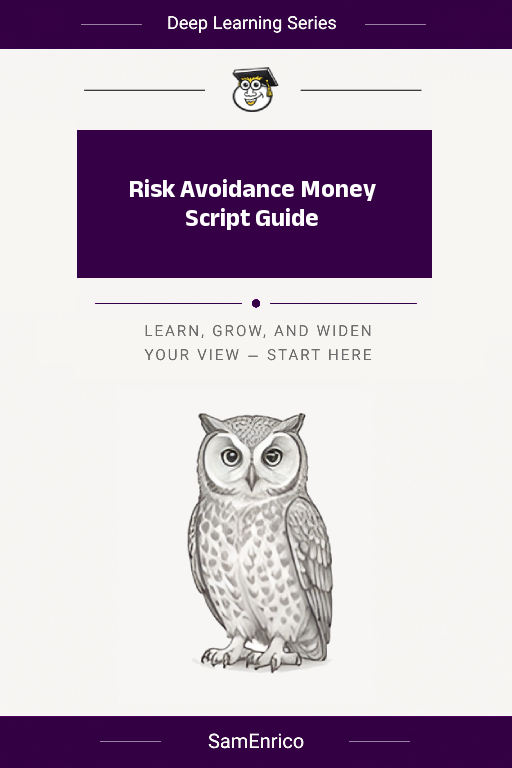
Risk Avoidance Money Script Guide eBook
Challenge the belief that all financial risk is da
by Mchugh Alena
Challenge the belief that all financial risk is dangerous, learned from parents who lost everything, opening to calculated investment opportunities.
Formats
Free sample
Chapter 1: The Ghost in Your Wallet--The first time I watched someone die from money, I was eleven years old.He didn’t collapse at the dinner table. There was no ambulance, no hospital gown, no final beep of a heart monitor. What died was slower and quieter. It was my grandfather’s sense of safety. He had just opened his quarterly brokerage statement—a single page of paper, back then—and the numbers at the bottom were smaller than they had been three months earlier.
Not by much. Less than four percent. But he stared at that page for a full minute, then folded it carefully, placed it in his breast pocket, and did not speak for the rest of the evening.My grandmother whispered to my mother later: “He lost thirty thousand dollars today.”She did not say “the market dipped.” She did not say “unrealized losses.” She said “lost.” As if the money had fallen out of his pocket on a city bus, never to be seen again. And in that moment, I absorbed something without knowing it. I absorbed the equation that would govern my relationship with money for the next twenty years:Risk = Loss.
Loss = Danger. Danger = Shame.That equation is the Ghost. And if you are reading this book, it lives inside you too.The Inheritance You Didn’t Ask For Let me tell you what I believe about you. I believe you are not stupid about money. I believe you are not lazy, or irresponsible, or hopeless.
In fact, I suspect you are the opposite. I suspect you are hyper-vigilant. You check your bank account too often. You feel a small pulse of relief every time you see that your cash balance hasn’t gone down. You have turned down promotions because they involved “too much financial risk.” You have left money sitting in a checking account earning zero percent interest for years, not because you didn’t know about inflation, but because the thought of moving it into an investment felt like stepping off a cliff.This is not a character flaw.
This is a trauma response.The concept of a “money script” was developed by financial psychologists Brad Klontz and Ted Klontz, and it describes the unconscious, often unspoken beliefs about money that we absorb before the age of ten. These scripts come from our parents, our grandparents, and the emotional atmosphere of our childhood homes. They are not rational. They are not chosen. They are inherited—like eye color, like temperament, like the shape of your grandmother’s hands.The specific script that haunts you is what I call the Risk Avoidance Script.
Its commandments are simple and absolute:All debt is evil.The stock market is a casino.If it feels risky, run.Cash is the only safe thing.Losing money is the worst thing that can happen.These commandments are not stupid. They made perfect sense for someone, somewhere, in a specific time and place. Maybe your grandparents lived through the Great Depression, when banks actually failed and people actually lost everything. Maybe your parents lived through 2008, when home values cratered and retirement accounts were cut in half. Maybe you personally watched someone you love rebuild from ashes, and you swore you would never let that happen to you.The tragedy is that the very strategy that saved them—avoidance, hyper-vigilance, hoarding cash—is the strategy that will slowly impoverish you.The Neuroscience of a Hijack Here is what happens inside your skull when you see your investment portfolio drop by five percent.Your eyes send the number—lower than yesterday—to your thalamus, the brain’s relay station.
From there, the information travels along two pathways. The fast pathway goes directly to your amygdala, the almond-shaped cluster of neurons that is your brain’s smoke alarm. The amygdala does not analyze. It does not contextualize. It does not ask questions like “Is this a five percent drop in a diversified index fund that has always recovered?” or “Do I need this money in the next three years?” The amygdala asks exactly one question: “Is this a threat?”If the answer is even possibly yes, the amygdala triggers a cascade of stress hormones—cortisol, adrenaline—that prepare your body for fight or flight.
Your heart rate increases. Your breathing shallows. Your digestion slows. Blood rushes to your large muscle groups. You are, in every physiological sense, preparing to be eaten by a predator.The problem is that the predator is a number on a screen.The slow pathway, by contrast, goes from the thalamus to the prefrontal cortex—the part of your brain responsible for reasoning, planning, and impulse control.
The prefrontal cortex can ask contextual questions. It can remember that the S&P 500 has historically recovered from every crash in history. It can calculate that you don’t need this money for ten years. But the slow pathway is slower. By the time your prefrontal cortex has an opinion, your amygdala has already flooded your body with stress hormones.
You are already in panic mode. You are already thinking about selling.This is not weakness. This is evolution.Your ancestors who did NOT panic at the sound of a rustling bush were eaten by predators. Your ancestors who did NOT hoard food during times of scarcity starved to death. The Ghost in your wallet is not your enemy.
It is your protector. It kept your grandparents alive during real catastrophes.But it is now misfiring. The rustling bush is a diversified ETF. The scarcity is manufactured by twenty-four-hour news channels that profit from your fear. The Ghost cannot tell the difference between a bear market and a bear attack.
That is your job.The Diagnostic Checklist: Does the Ghost Live in You?Before we go any further, I want you to take an honest inventory. Do not answer these questions the way you wish you would answer them. Answer them the way you actually behave when no one is watching.Do you check your investment accounts more than once a week—and feel physical relief when the numbers are up and physical dread when they are down?Do you have more than twelve months of living expenses sitting in a checking or savings account earning less than one percent interest?Have you ever sold an investment because it dropped, then watched it recover without you, and felt too ashamed to recalculate what that mistake cost you?Do you avoid looking at your retirement account statements for months at a time because you are afraid of what you might see?When someone mentions the stock market, do you feel a small knot in your stomach?Do you believe, deep down, that anyone who invests in the market is either lucky, reckless, or both?Have you ever turned down a career opportunity, a business investment, or a real estate purchase because the potential loss felt unbearable—even when the potential gain was significantly larger?Do you feel secretly superior to people who take financial risks, even as you watch them build wealth?Did your parents or grandparents lose significant money in a market crash, a foreclosure, or a bankruptcy—and did that event become a family story told with fear and reverence?If you answered…
This is the end of the free sample. Get the eBook to keep going. Buy now
About this book
Details
- Author
- Mchugh Alena
- Publisher
- SamEnrico
- Language
- English
- Genre
- Non-Fiction, Mental Wealth
- Released
- 2026-05-30
- Pages (approx.)
- 130
- Available as
- eBook, Audiobook

Read better in the ZLOADR app
Your eBooks on your phone or tablet. Sign in with your SamEnrico account and start reading.
More by Mchugh Alena
 Christmas Morning SilenceMchugh Alena$11.99
 Santa Bill McReynoldsMchugh Alena$11.99
 Self Hypnosis for Fear of DyingMchugh Alena$11.99
 Self Esteem After BullyingMchugh Alena$11.99
 The Ghana Startup GuideMchugh Alena$11.99
 Haemophilus Influenzae Type B VaccineMchugh Alena$11.99
 Home Lighting ModificationsMchugh Alena$11.99
 High Conflict Divorce RecoveryMchugh Alena$11.99
 The Kidnapping of Charles Lindbergh Jr.: The Birth of Modern Ransom NegotiationsMchugh Alena$11.99
 Sun Chasers: The Forgotten Solar Revolution of Ancient EgyptMchugh Alena$11.99
 How to Produce Serveware AccessoriesMchugh Alena$11.99
 How to Produce Foam BlocksMchugh Alena$11.99
You may also like
 Hong Kong Handover 1997Dunn Johnnie$11.99
 Zumba For Postnatal Recovery CourseNeal Christian$11.99
 Zumba for BeginnersLadner Nikia$11.99
 YouTube Comment Mining GuideHumes Pandora$12.99
 Worry Box MeditationCarlin Rudy$11.99
 Workplace Stress MeditationNguyen Lynn$11.99
 Workplace Stress and Sleep RepairHawley Ivory$11.99
 Workplace Perfectionism CureDelaney Jeffry$11.99
 Workplace Injustice Anger GuideWallen Isabelle$11.99
 Work Addiction and Burnout LinkGreenwood Ester$11.99
 Women in Yoga and WellnessBeattie Galina$11.99
 Women in Stand Up ComedyChun Evangeline$11.99