
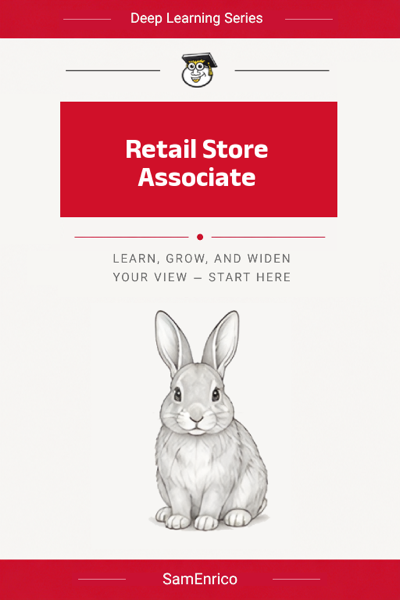
Non-FictionInformativeEducational
Retail Store Associate eBook
A Coursebook on Retail Store Associate
A Coursebook on Retail Store Associate
Formats
Free sample
Chapter 1: The Experience Mandate...–- Three years ago, a retail analyst named James walked into a flagship electronics store on Fifth Avenue. He was not there to buy anything. He was there to test a hypothesis: In an age of one-click ordering and drone deliveries, does the human sales associate still matter? James brought a simple question to every employee he encountered. He asked each of them, "What makes this store different from my phone?" The first associate pointed to the price match guarantee.
The second mentioned the extended warranty. The third, a young woman named Elena who had worked there for eleven months, paused for a moment and then said something that would shape the rest of this book. She said, "Your phone can tell you the specs of this laptop in 0.3 seconds. Your phone cannot tell you that the thirteen-inch model fits perfectly in the backpack you bought last year, because I saw you come in wearing it. Your phone cannot see that you are left-handed and show you the mouse designed for your grip.
Your phone cannot remember you. That is what makes me different." Elena sold the laptop in under four minutes. She also sold a mouse, a protective sleeve, and a three-year service plan. James bought everything she suggested. He later wrote that the transaction felt less like a sale and more like being seen.This book is about becoming Elena.It is not a collection of scripts or a list of policies to memorize.
It is a field manual for a profession that most people misunderstand and too many associates underestimate. You are not a stock keeper. You are not a cashier with a title upgrade. You are not a human placeholder until a kiosk or an app replaces you. You are an Experience Maker, and the distinction between that role and every other job in retail is the difference between surviving automation and thriving alongside it.The Great Misconception Retail employment occupies a strange place in the modern economy.
More than fifteen million people work in retail in the United States alone, making it one of the largest employment sectors in the country. Yet the common perception of retail work hovers somewhere between "temporary job for college students" and "safety net for people who could not find anything better." This perception is not merely inaccurate. It is destructive. It leads associates to treat their roles as disposable, which leads customers to treat associates as invisible, which leads managers to invest less in training, which leads to higher turnover, which leads customers to have worse experiences, which leads to more online shopping, which leads stores to close. The cycle is brutal and self-fulfilling.The truth, which the industry does a remarkably poor job of communicating, is that retail associates occupy one of the few job categories that artificial intelligence cannot easily replicate.
A chatbot can answer a sizing question. A recommendation algorithm can suggest a complementary product. A warehouse robot can retrieve a box from a shelf. None of these things can do what Elena did. They cannot observe.
They cannot interpret body language. They cannot remember a customer from a previous visit. They cannot adjust their tone when they notice a customer is having a bad day. They cannot build trust through the slow, deliberate work of human conversation.This is not sentimentality. It is economics.The Algorithm's Limit Consider what happens when you shop online.
The website records your clicks, your time on each page, your abandoned cart, your past purchases, and a hundred other data points. An algorithm processes this information and offers recommendations. Some of these recommendations will be useful. Many will be absurd. The algorithm does not know that you are buying a gift for your mother rather than for yourself.
It does not know that you are shopping after a thirteen-hour shift and have zero patience for browsing. It does not know that you are left-handed, or that you have a dog that sheds, or that you live in a fourth-floor walk-up with narrow staircases. It knows what you did. It does not know why.You do.You have something that no algorithm will possess in our lifetimes: context. Context is the secret weapon of the retail associate.
It allows you to see a customer hesitating in front of a jacket and understand that they are not confused about the price but about whether the color works with their complexion. It allows you to hear a customer say "I need a gift for my dad" and know that the next question is not "What does he like?" but "What did you get him last year?" Context transforms a transaction into a relationship. Relationships drive loyalty. Loyalty drives revenue. This is not a soft skill.
It is the hardest skill in retail, and it is the most valuable.The Economics of One Smile Let us talk about money, because money is the language that corporate offices understand, and if you want to be valued as an associate, you need to speak that language fluently. Every store operates according to a set of financial metrics that determine everything from payroll hours to holiday bonuses. The most important of these metrics for frontline associates is something called Conversion Rate. Conversion Rate is the percentage of customers who enter your store and make a purchase. A store with a 30 percent conversion rate is doing well.
A store with a 20 percent conversion rate is struggling. The difference between these two numbers is often determined by the quality of customer interactions.Here is the math that matters. If an average customer spends fifty dollars per visit, and your store sees five hundred customers per day, then every single percentage point of conversion rate is worth two hundred and fifty dollars per day. Over a month, that is seven thousand five hundred dollars. Over a year, that is ninety thousand dollars.
This is the direct, measurable impact of your work. When you approach a customer who looks lost and offer help, you are not being nice. You are adding potential value to the store's bottom line. When you remember a returning customer's name, you are not being friendly. You are increasing the likelihood that they will convert by a statistically significant margin.
When you handle a return with grace instead of irritation, you are not being professional. You are preventing that customer from becoming a statistic in the store's attrition report.The business world has a name for this concept. It is called the Service-Profit Chain, and it works like this: internal service quality (how well the company treats you) leads to employee satisfaction, which leads to employee retention, which leads to external service value (how well you treat customers), which leads to customer satisfaction, which leads to customer loyalty, which leads to profitability and growth. You are the hinge point of this entire chain. Without you, the chain breaks.Experience Makers vs.
Task Completers Every retail store has two kinds of employees. The first kind is the Task Completer. The Task Completer arrives on time, clocks in, processes transactions, stocks shelves, recovers the fitting rooms, and clocks out. They do everything that is asked…
This is the end of the free sample. Get the eBook to keep going. Buy now
About this book
Details
- Author
- Michel Sheryll
- Publisher
- SamEnrico
- Language
- English
- Genre
- Non-Fiction, Informative, Educational
- Released
- 2026-05-08
- Pages (approx.)
- 154
- Available as
- eBook, Audiobook

Read better in the ZLOADR app
Your eBooks on your phone or tablet. Sign in with your SamEnrico account and start reading.
More by Michel Sheryll
 Project Deadline ManagementMichel Sheryll$11.99
 Geothermal Pool GuideMichel Sheryll$11.99
 Mindfulness Based Alcohol RecoveryMichel Sheryll$11.99
 Cognitive Reserve Building WorkbookMichel Sheryll$11.99
 The Seated Body Scan WorkbookMichel Sheryll$11.99
 The Seven-Year Siege: Korea's Forgotten War Against the QingMichel Sheryll$11.99
 Emerson Electric SWOTMichel Sheryll$12.99
 College Essay Quote IntegrationMichel Sheryll$12.99
 Understanding Nonne–milroy DiseaseMichel Sheryll$17.99
 How to Become a Central-office RepairerMichel Sheryll$11.99
You may also like
 Hong Kong Handover 1997Dunn Johnnie$11.99
 Zumba For Postnatal Recovery CourseNeal Christian$11.99
 Zumba for BeginnersLadner Nikia$11.99
 YouTube Comment Mining GuideHumes Pandora$12.99
 Worry Box MeditationCarlin Rudy$11.99
 Workplace Stress MeditationNguyen Lynn$11.99
 Workplace Stress and Sleep RepairHawley Ivory$11.99
 Workplace Perfectionism CureDelaney Jeffry$11.99
 Workplace Injustice Anger GuideWallen Isabelle$11.99
 Work Addiction and Burnout LinkGreenwood Ester$11.99
 Women in Yoga and WellnessBeattie Galina$11.99
 Women in Stand Up ComedyChun Evangeline$11.99