
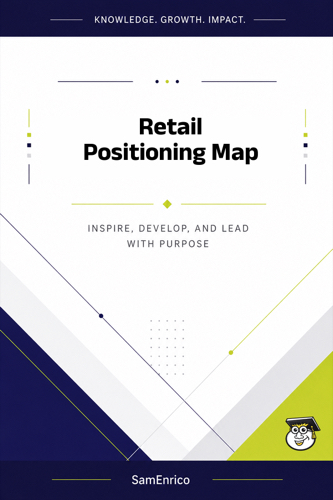
Non-FictionStrategic AtlasRetail Strategy
Retail Positioning Map eBook
Plot retailers on store experience versus price co
Plot retailers on store experience versus price competitiveness dimensions.
Formats
Free sample
Chapter 1: The Graveyard of “Fine”--–- In the sprawling suburbs of Cleveland, Ohio, there once stood a mall that contained every mistake retail has to offer. The building itself was not remarkable—fluorescent lighting, beige tile, the faint smell of stale pretzel dough and regret. But inside that mall, three stores sat side by side, and their stories explain everything you need to know about why most retailers fail.The first store was a department store chain that had been profitable for forty consecutive years. By the time you read this sentence, that chain no longer exists. The second store was a discount grocer that opened during the 2008 recession.
It now has over two thousand locations and annual revenue larger than the GDP of Iceland. The third store was a specialty electronics retailer that everyone said was “fine.” It was clean. It was adequately staffed. The prices were reasonable. The selection was acceptable.
“Fine” killed it within six years.This book is about the difference between the second store and the first. It is about why “fine” is a death sentence in modern retail, and about the simple but brutal framework that separates the thriving from the barely breathing.The Two Questions That Determine Everything Let us begin with a radical simplification. Walk into any retail store anywhere in the world—a luxury boutique in Paris, a hardware store in rural Nebraska, a grocery co-op in Portland, a convenience store in Tokyo. Strip away the merchandise, the lighting, the music, the staff uniforms, the loyalty program, the website, the app, the delivery options, the return policy, and everything else that retail consultants bill hundreds of hours to analyze.You are left with two questions. Only two.First: How much does the customer pay?
This is not just the sticker price. It is the full equation of price competitiveness—including perceived value, discounts, promotions, membership fees, and the psychological calculation of whether the wallet feels heavier or lighter after the transaction. Some retailers win because they are the cheapest. Others win because they are expensive but worth it. But every successful retailer has a clear answer to this question.Second: How does the customer feel while shopping?
This is not about efficiency or speed. It is about the emotional texture of the experience. Does the store wrap the customer in warmth and sensory delight? Does it feel like a chore or a reward? Does the customer leave energized, neutral, or depleted?
Some retailers win by making the experience so pleasurable that price becomes irrelevant. Others win by making the experience so frictionless that customers tolerate the emotional emptiness. But again, every successful retailer has a clear answer.Every retail failure, without exception, is a failure to answer these two questions coherently. The department store in that Cleveland mall tried to answer both at once: “We are moderately priced and moderately pleasant.” That is not an answer. That is an epitaph.The Most Expensive Word in Retail Let me introduce a word that has destroyed more shareholder value than bankruptcy, recessions, and e-commerce combined.
The word is “fine.”When customers describe a store as “fine,” they are not complimenting you. They are dismissing you. “Fine” means: I have no strong feelings about this place. I will not drive out of my way to visit. I will not recommend it to a friend.
I will not remember it tomorrow. And crucially, if a competitor offers me anything even slightly better—lower price, nicer atmosphere, faster checkout, better selection—I will abandon you without a second thought.Fine is the retail equivalent of being the fourth most interesting person at a dinner party. You are present. You are not offensive. But no one is going home thinking about you.The data on this is merciless.
A five-year study of over two thousand retail bankruptcies conducted by the Corporate Executive Board found that seventy-eight percent of failed retailers were described by their own customers as “average,” “acceptable,” or “fine” in the three years preceding collapse. Not hated. Not criticized for being overpriced or dirty. Just . .
. fine.Fine is not a stable equilibrium. It is a slow leak. Every day you are “fine,” a competitor somewhere is becoming cheaper or more delightful. And when the leak finally drains the tank, the bankruptcy filing is sudden but the decline was not.The Birth of the Map Now let me show you the tool that will replace “fine” with something sharper.
It is called the Retail Positioning Map, and despite the formal name, it fits on a napkin.Draw a vertical line. Label the top “High Price” and the bottom “Low Price.” This is your price competitiveness axis. Some retailers compete by being expensive and delivering value that justifies it. Others compete by being cheap and delivering acceptable quality. Most “fine” retailers sit somewhere in the middle, charging average prices for average products to average customers.
This is the first problem.Now draw a horizontal line. Label the right side “High Hedonic Experience” and the left side “Low Hedonic Experience.” This axis measures emotional and sensory experience—not functional efficiency. A store can be easy to navigate and fast to check out (high functional experience) while offering no emotional warmth (low hedonic experience). Aldi is a perfect example: ruthlessly efficient, clean, logical, and completely devoid of ambiance, music, or human warmth. By contrast, a Sephora store is deliberately inefficient in the best way—you wander, you sample, you discover, you linger.
That is hedonic experience.The combination of these two axes creates four quadrants. Each quadrant is a distinct retail species with its own strategy, economics, risks, and customer psychology. And here is the critical insight that separates this framework from academic abstractions: You must pick one quadrant. The moment you try to occupy two, you become fine.Quadrant One: The Bargain Bin Let us start in the bottom-left quadrant: Low Price, Low Hedonic Experience. I call this the Bargain Bin.These retailers are not trying to make you happy.
They are trying to make you less poor. The transaction is purely economic: give me your money, take the product, and leave me alone so I can serve the next customer. Aldi, Dollar General, Lidl, and the discount sections of larger retailers live here.The Bargain Bin strategy is productivity-led differentiation. You win by being ruthlessly, obsessively, almost religiously cheaper than anyone else. Every cost that does not contribute to lower prices is eliminated.
No bagging assistance. No elaborate displays. No music licensing fees. No free samples. No greeters.
No return policies that require human judgment—just a simple “within thirty days with receipt” or nothing at all.Aldi’s famous shopping cart quarter system is a masterpiece of Bargain Bin psychology. You deposit a quarter to unlock a cart, and you get it back when you return the cart. This eliminates the cost of employing someone to retrieve carts from the parking lot. It also subtly communicates: we do not pay for services you can do yourself. The quarter is trivial.
The message is not.The customer of a Bargain Bin retailer is not loyal in the emotional sense. They will not tattoo your logo on their…
This is the end of the free sample. Get the eBook to keep going. Buy now
About this book
Details
- Author
- Valdez Lawrence
- Publisher
- SamEnrico
- Language
- English
- Genre
- Non-Fiction, Strategic Atlas, Retail Strategy
- Released
- 2026-06-09
- Pages (approx.)
- 143
- Available as
- eBook, Audiobook

Read better in the ZLOADR app
Your eBooks on your phone or tablet. Sign in with your SamEnrico account and start reading.
More by Valdez Lawrence
 Password Pattern RecognitionValdez Lawrence$11.99
 The Metabolic Testing GuideValdez Lawrence$11.99
 CBT For Bipolar Disorder GuideValdez Lawrence$11.99
 Multi Echelon Inventory AIValdez Lawrence$11.99
 Self Esteem and BurnoutValdez Lawrence$11.99
 Family Boundary Setting GuideValdez Lawrence$11.99
 Improv for FilmmakersValdez Lawrence$11.99
 The Illusionist Who Defied Apartheid: The Untold Story of Dada MoriykeValdez Lawrence$11.99
 The Battle of the Beauties: Twiggy vs. Jean Shrimpton in the Swinging SixtiesValdez Lawrence$11.99
 How to Produce Outdoor Umbrella and Sunshade AccessoriesValdez Lawrence$11.99
 How to Produce Condiments and SaucesValdez Lawrence$11.99
 A Collector's Handbook to the Tornado ThunderboltValdez Lawrence$11.99
You may also like
 Hong Kong Handover 1997Dunn Johnnie$11.99
 Zumba For Postnatal Recovery CourseNeal Christian$11.99
 Zumba for BeginnersLadner Nikia$11.99
 YouTube Comment Mining GuideHumes Pandora$12.99
 Worry Box MeditationCarlin Rudy$11.99
 Workplace Stress MeditationNguyen Lynn$11.99
 Workplace Stress and Sleep RepairHawley Ivory$11.99
 Workplace Perfectionism CureDelaney Jeffry$11.99
 Workplace Injustice Anger GuideWallen Isabelle$11.99
 Work Addiction and Burnout LinkGreenwood Ester$11.99
 Women in Yoga and WellnessBeattie Galina$11.99
 Women in Stand Up ComedyChun Evangeline$11.99