
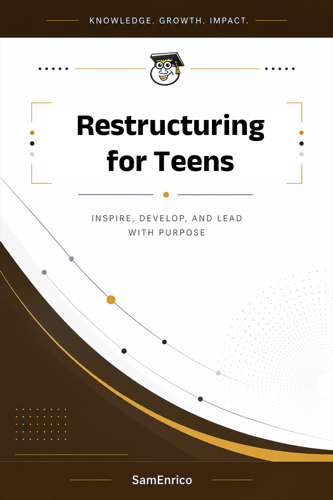
Restructuring for Teens eBook
Adapt cognitive techniques for adolescent anger an
by Kearns Amal
Adapt cognitive techniques for adolescent anger and family conflict.
Formats
Free sample
Chapter 1: The Iceberg Lies--All your life, when you have gotten angry, someone has probably told you one of three things. Either they said, "You have a bad attitude," or they said, "You need to calm down," or they said, "What is wrong with you?" None of those questions ever helped, did they? In fact, each one probably made you angrier. That is not your fault. It is because every single one of those responses is looking at the wrong thing.
They are all staring at the tiny tip of an enormous iceberg floating in freezing water, and they are yelling at the tip to be smaller while the massive mountain of ice underneath keeps growing.Here is the truth that no one has told you yet. Your anger is not the problem. It is a symptom. It is a loud, aggressive, sometimes terrifying signal that something else is happening underneath. Think of the angriest you have ever been.
Maybe it was when your parent took your phone. Maybe it was when they said no to a plan with your friends. Maybe it was when they asked about your grades for the fifth time in one hour. In that moment, you probably felt a surge of heat, a tightening in your chest, and words exploding out of your mouth that you did not even plan to say. Afterward, you might have felt exhausted, ashamed, or even confused about why you reacted so strongly.
That confusion is the first sign that your anger is not what it appears to be.This entire book is built on a single idea that will change everything about how you see yourself and your family. That idea is this: Between every single thing that happens to you and your reaction to it, there is a split second where your brain produces a thought. That thought determines your feeling. That feeling determines your behavior. Most teens believe they go straight from event to explosion.
Your mom says something annoying, and you scream. But that is not what actually happens. What actually happens is: your mom says something, your brain instantly interprets what she said, that interpretation creates an emotion, and that emotion drives your reaction. The explosion is not the first step. It is the last step.If you can learn to catch that split-second thought, you can change everything downstream.
That is what cognitive restructuring means. It sounds like clinical psychology jargon, but it is actually very simple. Restructuring means taking a thought that is distorted, unfair, or exaggerated and rebuilding it into something that matches reality. You are not trying to pretend you are not angry. You are not trying to become a robot who feels nothing.
You are trying to see clearly so that your anger serves you instead of destroying you.The Anger Iceberg Let us return to that iceberg. Imagine a massive sheet of ice floating in the ocean. The part you see above the water is small, sharp, and dangerous. That is your anger. It is the yelling, the door slamming, the sarcastic comment, the silent treatment, the explosion that makes everyone in the house walk on eggshells.
But underneath the water, hidden from view, is the real mass of the iceberg. That hidden part is made of everything your anger is actually protecting you from. Those are the primary emotions. Social anxiety. Fear of failure.
Rejection sensitivity. Humiliation. Helplessness. Feeling disrespected. Physical exhaustion.
Overwhelm. Grief. Loneliness.Here is the uncomfortable question this chapter will force you to answer. What is under your anger? Not what your parents think is under it.
Not what your teachers assume. What is actually there, in your body, when you feel the heat rising? Most teens have never been asked this question. Most teens have only been told to stop being angry, as if anger were a light switch you could just flip off. But anger is not a switch.
It is a smoke alarm. And smoke alarms do not go off for no reason. Something is burning somewhere. Your job is not to smash the smoke alarm. Your job is to find the fire.Let us walk through an example.
Imagine your parent says, "Have you done your homework yet?" On the surface, this is a neutral question. But for many teens, this question triggers an immediate spike of irritation or rage. Why? Because underneath the surface, your brain might be thinking something like, "They think I am lazy," or "They do not trust me," or "They are always on my case," or "I am already stressed about school and now they are making it worse." Those thoughts produce feelings of shame, inadequacy, frustration, or being controlled. Those feelings then explode outward as anger.
The homework question was not the cause. The thought about the homework question was the cause.This is why simply being told to "calm down" never works. Calming down addresses the explosion after it has already started. It is like trying to put out a forest fire by spitting on a single tree. The real work happens before the explosion, in that split second where the thought is born.
That is where this book lives. That is where you will learn to live.The Cognitive Triangle The single most important tool you will learn in this entire book is called the Cognitive Triangle. You will see it in every chapter. You will use it in every conflict. You will eventually be able to draw it in your sleep.
Here it is.Thoughts lead to Feelings lead to Behaviors.That is it. That is the entire operating system of your emotional life. Event happens. Your brain produces a thought about that event. That thought creates a feeling in your body.
That feeling drives you to act in a certain way. Most people believe their feelings come directly from events. They say things like, "You made me angry," or "That situation stressed me out." But that is not how the brain works. The same event can produce completely different feelings in two different people because they have different thoughts about it.Imagine you text a friend and they do not respond for three hours. One teen might think, "They are ignoring me because they are mad about something I said." That thought creates anxiety and hurt, which leads to a passive-aggressive text or a cold shoulder at school.
Another teen might think, "They are probably busy with practice or homework." That thought creates patience, which leads to waiting calmly and following up later. Same event. Completely different thoughts. Completely different feelings. Completely different behaviors.Your anger works the exact same way.
Your parent says, "You cannot go to the party on Saturday." One teen might think, "They are trying to control my entire social life and ruin everything." That thought creates fury and resentment, which leads to screaming, slamming a door, and getting grounded longer. Another teen might think, "They have a reason, even if I do not know what it is yet. Let me ask calmly." That thought creates curiosity, which leads to a conversation that might actually change their parent's mind. Same event. Different thought.
Different outcome.The Cognitive Triangle is not about pretending to feel something different. It is about checking whether your thought is…
This is the end of the free sample. Get the eBook to keep going. Buy now
About this book
Details
- Author
- Kearns Amal
- Publisher
- SamEnrico
- Language
- English
- Genre
- Non-Fiction, Self-Help
- Released
- 2026-06-09
- Pages (approx.)
- 146
- Available as
- eBook, Audiobook

Read better in the ZLOADR app
Your eBooks on your phone or tablet. Sign in with your SamEnrico account and start reading.
More by Kearns Amal
 Uber Driver Rating Recovery PlanKearns Amal$11.99
 Rescripting Nightmares In EMDRKearns Amal$11.99
 Doe Network Facial Aging TechniquesKearns Amal$11.99
 The Magnetic Hands InductionKearns Amal$11.99
 Georgian Winemaker In OregonKearns Amal$11.99
 Academic Presentation SkillsKearns Amal$11.99
 Laparoscopy DiagnosisKearns Amal$11.99
 The Star Chart of the Dogon: Ancient Astronomy and the Precision of MaliKearns Amal$11.99
 The Unseen Eye: How Ridley Scott Reinvented Sci-Fi and Changed Hollywood ForeverKearns Amal$11.99
 How to Produce a Northrop LoomKearns Amal$11.99
 How to Become a Paint Sprayer - SandblasterKearns Amal$11.99
 How to Produce Antimony IngotsKearns Amal$11.99
You may also like
 Hong Kong Handover 1997Dunn Johnnie$11.99
 Zumba For Postnatal Recovery CourseNeal Christian$11.99
 Zumba for BeginnersLadner Nikia$11.99
 YouTube Comment Mining GuideHumes Pandora$12.99
 Worry Box MeditationCarlin Rudy$11.99
 Workplace Stress MeditationNguyen Lynn$11.99
 Workplace Stress and Sleep RepairHawley Ivory$11.99
 Workplace Perfectionism CureDelaney Jeffry$11.99
 Workplace Injustice Anger GuideWallen Isabelle$11.99
 Work Addiction and Burnout LinkGreenwood Ester$11.99
 Women in Yoga and WellnessBeattie Galina$11.99
 Women in Stand Up ComedyChun Evangeline$11.99