
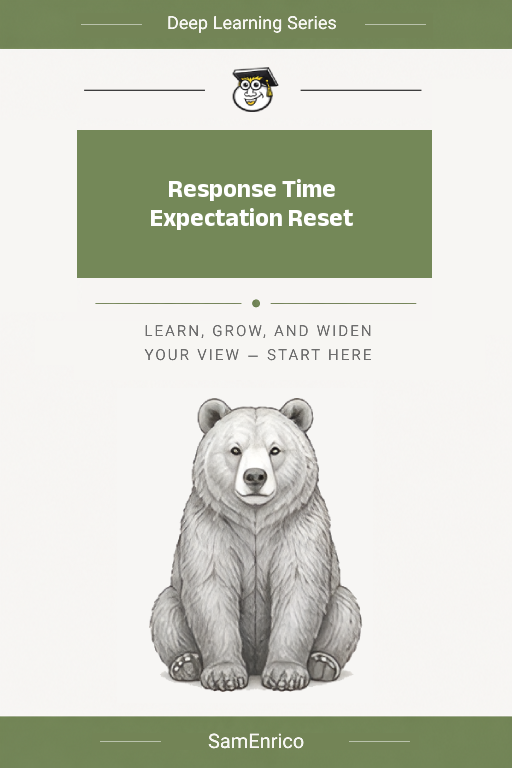
Non-FictionMental WealthProfessional Norms
Response Time Expectation Reset eBook
Train colleagues to expect 24 hour email replies i
by Burgos Verda
Train colleagues to expect 24 hour email replies instead of instant responses to reduce always on pressure.
Formats
Free sample
Chapter 1: The 23-Minute Thief--–- The email arrived at 9:14 AM. Nothing urgent – just a colleague asking for a quick data point. You reply in 45 seconds and return to your spreadsheet. It is now 9:15 AM. By 9:38 AM, you realize you have been staring at the same cell, unable to remember what you were about to do.
That is not a personal failing. That is the 23-Minute Thief at work.Every professional knows the feeling. You are deep in a complex task – a strategy document, a budget model, a piece of code, a design. The work is hard, but you are in flow. Your mind is fully engaged.
Then comes the chime. The banner. The little red badge. You check. You reply.
You return. And then you sit there, lost, for what feels like forever, trying to remember where you were.Most people blame themselves. "I have poor concentration." "I am easily distracted." "I lack discipline." But the data tells a different story. The problem is not your attention span. The problem is the hidden cost of switching – a cost that modern knowledge work has been designed to maximize.This chapter is the intervention.
Before we can reset response time expectations, before we can implement the 24-hour pledge, before we can train colleagues or measure ROI, we must first understand what we are actually fighting against. The enemy is not your inbox. The enemy is not your needy colleague. The enemy is a neurological reality called context switching, and it is stealing between one and four hours of your cognitive focus every single day without your permission.Let me show you exactly how.The Discovery That Changed How We Understand Focus In the early 2000s, a researcher named Gloria Mark began studying how knowledge workers actually spend their time. She equipped dozens of professionals at technology companies with tracking software and then watched.
What she found upended decades of assumptions about workplace productivity.The average knowledge worker, Mark discovered, spends only about 11 minutes on any given task before being interrupted or switching to something else. But here is the devastating part: after an interruption, it takes an average of 23 minutes to return to the original task with the same level of focus.Twenty-three minutes. Not seconds. Not a quick mental reset. Twenty-three minutes of cognitive drift, partial attention, and low-grade frustration.Let me put that number in context.
If you check email just ten times during a workday – which is conservative for most professionals – you lose nearly four hours of focused cognitive capacity. Four hours. Half a workday. Not to the act of replying to those emails, but to the act of recovering from having replied.Mark's research has been replicated across industries, job functions, and countries. The 23-minute figure is remarkably stable.
It applies to software engineers, marketing managers, financial analysts, and executives. It applies whether the interruption is an email, a Slack message, a phone call, or a colleague tapping you on the shoulder. The medium does not matter. The switch itself is the thief.Here is what makes this so insidious: most of the interruptions we experience are self-inflicted. We are not waiting for someone to tap our shoulder.
We are checking email voluntarily, compulsively, dozens of times per day, each time resetting the 23-minute clock. We are stealing from ourselves, and we do not even know we are doing it.The Math of Your Lost Life Let me make this personal. I want you to do a quick calculation.Estimate how many times per day you check your email. Not how many times you reply – how many times you open your inbox. For most professionals, the number is between 20 and 40.
Let us be generous and say 20.Multiply that by 23 minutes. You get 460 minutes. That is 7.6 hours per day of lost focus recovery time. That cannot be right, you are thinking. And you are correct – because you do not spend the full 23 minutes recovering from every single check.
Some checks are shallow. Some interruptions are brief. The research accounts for this.So let us use the more conservative figure from the original study: the average knowledge worker loses about 2.1 hours per day to context switching. That is still staggering. That is still one quarter of your working day.
That is still more time than most people spend on lunch, breaks, and meetings combined.Now multiply that by 5 days per week. Ten and a half hours. Multiply by 48 working weeks per year. Five hundred and four hours. That is twenty-one full days.
Three weeks of your life, every single year, lost to the time it takes your brain to recover from switching tasks.Three weeks. That is a vacation. That is a month of evenings with your family. That is time you could have spent on strategic thinking, creative work, or simply leaving the office at 5 PM without guilt.And here is the cruelest part: you are not even getting anything valuable in return for those three weeks. Most of the emails you are interrupting yourself to read and reply to are low-stakes, non-urgent, and could have waited.
You are trading deep focus for shallow reactivity, and the exchange rate is terrible.The Urgency Bias: Why Your Brain Betrays You If the cost of context switching is so high, why do we keep doing it? Why do we not simply close our email client and check it twice per day? The answer lies in a cognitive quirk called urgency bias.Urgency bias is the tendency of the human brain to prioritize immediate, low-impact tasks over delayed, high-impact tasks. It is the reason you reply to a non-urgent email before finishing the presentation that is due tomorrow. It is the reason you clean your desk before starting the difficult report.
It is the reason you answer every ping as if it were a five-alarm fire.From an evolutionary perspective, urgency bias made sense. Our ancestors lived in environments where immediate threats – a predator, a storm, a rival tribe – required immediate responses. The brain that prioritized "now" survived. The brain that thought about "later" got eaten.But email is not a predator. A Slack DM is not a storm.
A request for a data point is not a rival tribe. Yet your brain cannot tell the difference. The notification chime triggers the same ancient threat-detection circuitry. Your heart rate increases slightly. Your pupils dilate.
Your attention snaps to the new stimulus, and your prefrontal cortex – the part of your brain responsible for long-term planning and complex reasoning – is momentarily hijacked.This is not a failure of willpower. This is biology. Your brain is doing exactly what evolution designed it to do. The problem is that evolution did not design it for email.Here is what urgency bias feels like in practice. You are working on a strategic initiative that could increase your department's revenue by 20 percent.
It is important. It is complex. It requires sustained attention. An email arrives. It is a routine question from a colleague about a meeting time.
Your brain tags that email as "immediate" because it is right there, and the strategic initiative as "later" because it is abstract and distant. You reply to the email. The 23-minute…
This is the end of the free sample. Get the eBook to keep going. Buy now
About this book
Details
- Author
- Burgos Verda
- Publisher
- SamEnrico
- Language
- English
- Genre
- Non-Fiction, Mental Wealth, Professional Norms
- Released
- 2026-06-01
- Pages (approx.)
- 151
- Available as
- eBook, Audiobook

Read better in the ZLOADR app
Your eBooks on your phone or tablet. Sign in with your SamEnrico account and start reading.
More by Burgos Verda
 The SMART Goals WorkbookBurgos Verda$11.99
 Fixed Vs Growth Mindset WorkbookBurgos Verda$11.99
 Bankruptcy Emotional RecoveryBurgos Verda$11.99
 Team Brainwriting ManualBurgos Verda$11.99
 Self Esteem for New HiresBurgos Verda$11.99
 Outsourcing for EcommerceBurgos Verda$11.99
 Flow for Musicians GuideBurgos Verda$11.99
 Cannabis Master GuideBurgos Verda$11.99
 Frostborn and the Troll King's RiddleBurgos Verda$11.99
 The Silk Road of the Sea: Byzantine Navigators and the Age of DiscoveryBurgos Verda$11.99
 The Essential Guide to DowntempoBurgos Verda$11.99
 How to Produce Electronic Measuring InstrumentsBurgos Verda$11.99
You may also like
 Hong Kong Handover 1997Dunn Johnnie$11.99
 Zumba For Postnatal Recovery CourseNeal Christian$11.99
 Zumba for BeginnersLadner Nikia$11.99
 YouTube Comment Mining GuideHumes Pandora$12.99
 Worry Box MeditationCarlin Rudy$11.99
 Workplace Stress MeditationNguyen Lynn$11.99
 Workplace Stress and Sleep RepairHawley Ivory$11.99
 Workplace Perfectionism CureDelaney Jeffry$11.99
 Workplace Injustice Anger GuideWallen Isabelle$11.99
 Work Addiction and Burnout LinkGreenwood Ester$11.99
 Women in Yoga and WellnessBeattie Galina$11.99
 Women in Stand Up ComedyChun Evangeline$11.99