
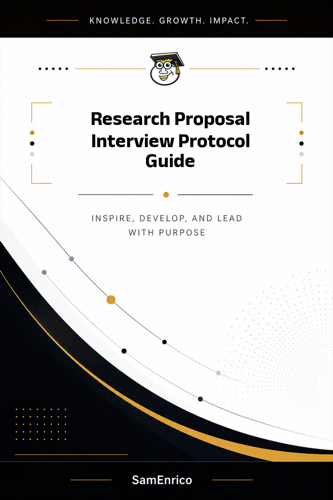
Research Proposal Interview Protocol Guide
Develop semi structured interview guides with effe
Develop semi structured interview guides with effective probes.
Formats
About this book
Free sample
Chapter 1: The Interview Trap--Most novice researchers believe they already know how to ask questions. After all, they have been asking questions their entire lives—to teachers, to colleagues, to friends, to strangers. What could be so difficult about asking a few more questions, this time with a recorder running?Everything, as it turns out.The gap between casual conversation and rigorous qualitative interviewing is not a crack; it is a canyon. And every year, thousands of researchers—graduate students, UX professionals, market researchers, journalists, and program evaluators—throw themselves into that canyon, armed with nothing but a list of questions and a misplaced confidence in their own conversational abilities. They emerge on the other side with hundreds of pages of transcripts, rich with data that is often beautifully irrelevant, systematically biased, or both.This chapter is about why that happens and what to do about it.
It is not a gentle introduction. It is a wake-up call.The Most Expensive Mistake in Interviewing Let us begin with a story. A technology company had spent eighteen months developing a new feature for their flagship product. The feature was technically brilliant, elegantly engineered, and internally beloved. The product team was certain it would revolutionize how users interacted with their platform.Before launch, they conducted thirty interviews with power users.
The interview guide asked questions like: "How would this feature improve your workflow?" "What problems does this feature solve for you?" "How excited are you to use this feature?"Every single participant answered positively. They described improvements, identified problems, expressed excitement. The team launched with confidence. The feature failed catastrophically. Adoption was near zero.
Users complained that it solved problems they did not have and created new problems they had not anticipated.What happened? The interview guide was not designed to learn. It was designed to confirm. Every question contained an assumption: that the feature would improve workflows, that it did solve problems, that excitement was the appropriate emotional response. Participants, being polite humans who generally want to be helpful and not cause conflict, answered accordingly.
They gave the company exactly what it asked for: validation of its own assumptions, delivered in the form of data…
This is the end of the free sample. Get the eBook to keep going. Buy now
Contents
- Chapter 1
- Chapter 2
- Chapter 3
- Chapter 4
- Chapter 5
- Chapter 6
- Chapter 7
- Chapter 8
- Chapter 9
- Chapter 10
- Chapter 11
- Chapter 12
Details
- Author
- Bethea Glennis
- Publisher
- SamEnrico
- Language
- English
- Genre
- research, Student's Shortcut, Interviewing
- Released
- 2026-06-09
- Pages (approx.)
- 129
- Available as
- eBook, Audiobook

Read better in the ZLOADR app
Your eBooks on your phone or tablet. Sign in with your SamEnrico account and start reading.
More by Bethea Glennis
 Rock Climbing Fear ReleaseBethea Glennis$11.99
 Exposure Ladder BuilderBethea Glennis$11.99
 Sector for NeurodivergentsBethea Glennis$11.99
 Substitutes and ComplementsBethea Glennis$11.99
 Wedding Planner Stress ManagementBethea Glennis$11.99
 Therapeutic Suggestion WritingBethea Glennis$11.99
 Shane Dawson ConspiracyBethea Glennis$11.99
 The Vanishing Act of the Great Pyramid’s Missing CornerstoneBethea Glennis$11.99
 The Sole Invaders: How a Sneaker Heist Rocked the NBABethea Glennis$11.99
 Cooperative Social Impact MetricsBethea Glennis$12.99
 US Business Credit Repair GuideBethea Glennis$12.99
 The Mineral Guide to BukovskyiteBethea Glennis$11.99