
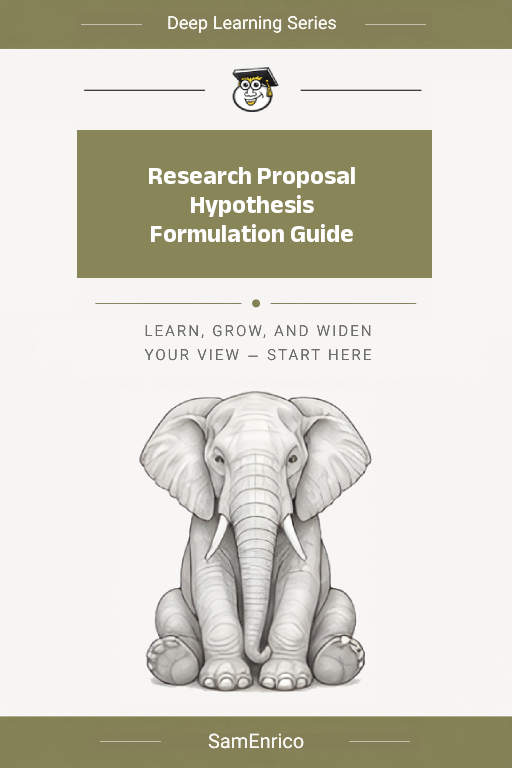
Research Proposal Hypothesis Formulation Guide
Write testable directional or null hypotheses that
by Durr Glynda
Write testable directional or null hypotheses that connect directly to your methodology and analysis plan.
Formats
About this book
Free sample
Chapter 1: The Rejection Letter...--–- You have just spent six months writing a research proposal. You have read three hundred papers. You have refined your research question until it shone like a polished stone. You have described your methodology with painstaking precision. You have even anticipated potential limitations and addressed them preemptively, because you are thorough, because you care, because this proposal—this project—matters to you.Then the email arrives.The subject line reads: "Decision on Your Proposal."Your heart does something unpleasant in your chest.
You open it. You skim past the polite salutations, past the "thank you for your submission," past the generic praise that everyone receives. You land on the section that matters: the reviewer comments.And there it is."The hypothesis is not clearly stated.""This reads more as a research question than a testable prediction.""I do not see how you would statistically evaluate the stated hypothesis given the proposed methods.""The direction of the hypothesized effect is not specified.""The null hypothesis is missing or incorrectly framed."Your proposal has been rejected. Or, if you are fortunate, it has been returned for "major revisions"—academic code for "we are giving you one more chance to fix this before we say no."You read the comments again. And again.
And you realize something that makes your stomach tighten: you are not entirely sure what you did wrong.The reviewer used words like "falsifiable" and "operationalized" and "directional" and "null." You have heard these words before, in methods classes, in conversations with advisors, in the margins of statistics textbooks. But somehow, when you tried to apply them to your own work, the result came out wrong. Your hypothesis—the sentence you wrote with such confidence—failed.This chapter is about why that happens. More importantly, this chapter is about how to make sure it never happens to you again.The Anatomy of a Proposal Rejection Before we can fix broken hypotheses, we must understand how they break. Over fifteen years of reviewing proposals for graduate committees, grant agencies, and journals, I have read thousands of hypotheses.…
This is the end of the free sample. Get the eBook to keep going. Buy now
Contents
- Chapter 1
- Chapter 2
- Chapter 3
- Chapter 4
- Chapter 5
- Chapter 6
- Chapter 7
- Chapter 8
- Chapter 9
- Chapter 10
- Chapter 11
- Chapter 12
Details
- Author
- Durr Glynda
- Publisher
- SamEnrico
- Language
- English
- Genre
- research, Student's Shortcut
- Released
- 2026-06-01
- Pages (approx.)
- 155
- Available as
- eBook, Audiobook

Read better in the ZLOADR app
Your eBooks on your phone or tablet. Sign in with your SamEnrico account and start reading.
More by Durr Glynda
 Senior Housing Tax DeductionsDurr Glynda$11.99
 Parenting Trigger ManagementDurr Glynda$11.99
 Sam Sheppard Death And MysteryDurr Glynda$11.99
 Hookah and Shisha Toxin GuideDurr Glynda$11.99
 Neurotech Investment MapDurr Glynda$11.99
 The Elevator Pitch BlueprintDurr Glynda$11.99
 Tinnitus Hypnosis ScriptsDurr Glynda$11.99
 Theme Days SchedulingDurr Glynda$11.99
 Customer Service AngerDurr Glynda$11.99
 Gold, Guns, and Ghosts: The Cursed 1968 Mexico City OlympicsDurr Glynda$11.99
 Steel and Secrets: The Golden Spike ConspiracyDurr Glynda$11.99
 Quetzalcoatl's Feathers: The Serpent's Divine FlightDurr Glynda$11.99
You may also like
 Scientific Research On TM GuideMartens Nathanial$11.99
 Research Proposal Methodology Section MasteryPauley Debroah$11.99
 Research Proposal Appendix CompilationRaines Tyisha$11.99
 Academic Researcher Distraction GuideFord Virgil$11.99
 TM Research and ScienceCovert Nicki$11.99
 Social Anxiety Research ReviewRoberge Cole$11.99
 Research Proposal Significance Section GuideBock Tory$12.99
 Research Proposal Reviewer PsychologyLugo Tawanda$11.99
 Research Proposal Research Questions DesignLara Robbi$11.99
 Research Proposal References and CitationsPatten Shanice$11.99
 Research Proposal Mixed Methods DesignCameron Omega$11.99
 Research Proposal Data Management PlanAnderson Roberto$12.99