
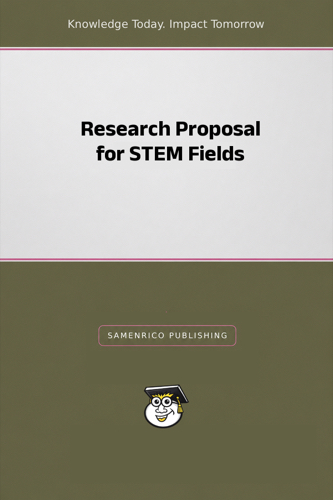
researchStudent's ShortcutSTEM Writing
Research Proposal for STEM Fields
Tailor proposals for engineering, biology, physics
by Culp Nida
Tailor proposals for engineering, biology, physics, or chemistry research.
Formats
About this book
Free sample
Chapter 1: The Permission Problem--–- Every year, thousands of brilliant research ideas die not because they are wrong, not because they are impossible, and not because the scientist lacked talent. They die because no one said yes. A postdoc in chemistry spends six months designing a novel catalyst that could turn atmospheric CO₂ into usable fuel. A physics graduate student discovers a theoretical path to room-temperature superconductivity. A biologist finds a CRISPR-based approach that might cure a rare genetic disorder.
An engineer prototypes a water filtration membrane that costs pennies to manufacture. And then they write a proposal. And then they wait. And then they receive a form letter that begins with polite regret.The problem is rarely the science. The problem, more often than not, is that the researcher did not understand what the reviewer needed to see.
They wrote for themselves, or for their advisor, or for the imaginary audience of a journal article. But a grant proposal is none of those things. A grant proposal is a permission machine. It exists for one reason: to convince a stranger—a busy, skeptical, overworked stranger who has read fifty proposals that week—that your idea deserves money that fifty other people also want.This book exists because the gap between a good idea and a funded proposal is not talent. It is translation.
Every STEM field has its own language of persuasion, its own hidden expectations, its own version of what counts as evidence. Most proposal guides ignore this. They treat a proposal for a new laser like a proposal for a new mouse model, as if the same rules apply. They do not. And pretending they do is the fastest route to rejection.This chapter introduces the central problem that the entire book solves: the mismatch between what researchers write and what reviewers need.
We will dismantle the myth of the universal proposal, expose the hidden structure of STEM persuasion, and give you a diagnostic tool to identify exactly what kind of proof your specific project requires. By the end of this chapter, you will never look at…
This is the end of the free sample. Get the eBook to keep going. Buy now
Contents
- Chapter 1
- Chapter 2
- Chapter 3
- Chapter 4
- Chapter 5
- Chapter 6
- Chapter 7
- Chapter 8
- Chapter 9
- Chapter 10
- Chapter 11
- Chapter 12
Details
- Author
- Culp Nida
- Publisher
- SamEnrico
- Language
- English
- Genre
- research, Student's Shortcut, STEM Writing
- Released
- 2026-06-09
- Pages (approx.)
- 150
- Available as
- eBook, Audiobook

Read better in the ZLOADR app
Your eBooks on your phone or tablet. Sign in with your SamEnrico account and start reading.
More by Culp Nida
 Mice Phobia Pest ControlCulp Nida$11.99
 Sector Research ReviewCulp Nida$11.99
 The Consumer Choice FrameworkCulp Nida$11.99
 Cannabis and Motivation GuideCulp Nida$11.99
 The Positive Aging Affirmation GuideCulp Nida$11.99
 Recovery Self Hypnosis ScriptsCulp Nida$11.99
 Addison Rae DanceCulp Nida$11.99
 The Hollow King’s Last Stand: A Warrior’s Oath in the OtherworldCulp Nida$11.99
 Kali’s Shadow: The Goddess Who Dances on CorpsesCulp Nida$11.99
 The Mineral Guide to BorniteCulp Nida$11.99
 Crowd Monitoring and Public Safety DronesCulp Nida$11.99
 UK Company Credit Score FactorsCulp Nida$12.99
You may also like
 Scientific Research On TM GuideMartens Nathanial$11.99
 Research Proposal Methodology Section MasteryPauley Debroah$11.99
 Research Proposal Appendix CompilationRaines Tyisha$11.99
 Academic Researcher Distraction GuideFord Virgil$11.99
 TM Research and ScienceCovert Nicki$11.99
 Social Anxiety Research ReviewRoberge Cole$11.99
 Research Proposal Significance Section GuideBock Tory$12.99
 Research Proposal Reviewer PsychologyLugo Tawanda$11.99
 Research Proposal Research Questions DesignLara Robbi$11.99
 Research Proposal References and CitationsPatten Shanice$11.99
 Research Proposal Mixed Methods DesignCameron Omega$11.99
 Research Proposal Data Management PlanAnderson Roberto$12.99